Q.1.
False fruit is a fruit which develops from:
-
17%
a) Ovary
-
83%
b) Any part of the flower except the ovary
-
0%
c) Aporcarpous carpellary
-
0%
d) Syncorpous carpellary
Q.2.
In the maize grain , the starchy food is stored in:
-
0%
a) Cotyledons
-
25%
b) Coleoptile
-
25%
c) Aleurone layer
-
50%
d) Endosperm
Q.3.
Phyllode is present in : (A.I.P.M.T. 2012)
-
25%
d) Asparagus
-
25%
a) Euphorbia
-
50%
b) Australian Acacia
-
0%
c) Opuntia
Q.4.
Succulents are likely to be found in:
-
0%
a) Tropical rain forest
-
25%
b) Deciduous forest
-
50%
c) Deserts
-
25%
d) Tundra
Q.5.
Viscum is: (AFMC 2004)
-
40%
a) total stem parasite
-
40%
b) total root parasite
-
0%
c) partial stem parasite
-
20%
d) partial root parasite
Q.6.
A pair of insectivorous plant is: ( C.B.S.E. 1999)
-
0%
a) Dionaea and viscum
-
60%
b) Nepenthes and bladderwort
-
40%
c) Drosera and rafflesia
-
0%
d) Venus fly and Rafflesia
Q.7.
Number of female flowers in a cyathium is:(keralaCET,05 UPCPMT,07 A.P.M.E.E. 1995)
-
25%
a) One
-
25%
b) Two
-
0%
c) Three
-
50%
d) Many
Q.8.
floral formula represents :
-
80%
a) number and arrangement of floral parts
-
20%
b) Number of flowers in an inflorescence
-
0%
c) Type of flowers in a family
-
0%
d) None of above
Q.9.
Vegetative reproduction of Agave occurs through:
-
20%
a) Rhizome
-
20%
b) Stolon
-
0%
c) Bulbils
-
60%
d) Sucker
Q.10.
Grasses are examples of the following type of stem:
-
25%
a) Suckers
-
25%
b) Runners
-
0%
c) Stolon
-
50%
d) Rhizomes.
Q.11.
In one of the following the stem performs the function of storage and propagation:
-
40%
a) Ginger
-
40%
b) Wheat
-
0%
c) Radish
-
20%
d) Groundnut
Q.12.
Fibrous root in maize develop from:
-
25%
a) Lower internodes
-
25%
b) Lower nodes
-
25%
c) Upper nodes
-
25%
d) None of the above
Q.13.
Name the character not associated with Bamboo:
-
60%
a) Iteropary.
-
20%
b) Sheathing of leaf base.
-
0%
c) Semelpary.
-
20%
d) Both (A) and (C).
Q.14.
Choose the odd one out among the following:
-
25%
a) Utricularia.
-
25%
b) Dionaea.
-
25%
c) Monotropa.
-
25%
d) Nepenthes.
Q.15.
Which one of the following statements is/are true? (i) Pneumatophores help to get oxygen for respiration. (ii) The region of the stem where leaves are borne are called nodes while internodes are the portions between two nodes. (iii) The leaf is attached to the stem by the leaf base and may bear two lateral small leaf like structures called sepals. (iv) The lamina is the green expanded part of the leaf with veins and veinlets.
-
0%
a) (i) and (ii) only.
-
25%
b) (iii) and (iv) only.
-
25%
c) (i), (ii) and (iii) only.
-
50%
d) (i), (ii) and (iv) only.
Q.16.
In racemose type of branching
-
67%
a) Branches continue to grow indefinitely and give off further branches laterally in a basipetal order
-
33%
b) Branches continue to grow indefinitely and give off further branches laterally in an acropetal order
-
0%
c) Branches stop growing after some time and give off further branches laterally in a basipetal order
-
0%
d) Branches stop growing after some time and give off further branches laterally in an acropetal order
Q.17.
The common feature of marginal and basal placentation is:
-
0%
a) Multilocular with many ovules.
-
25%
b) Unilocular ovary.
-
0%
c) Placenta arises from inner surface as well as septa.
-
75%
d) Syncarpous ovary.
Q.18.
Stem tendrils are found in
-
25%
a) cucumber
-
25%
b) pumpkins
-
0%
c) grapevines
-
50%
d) all of these
Q.19.
Select the correct pair of answers in which the former represents the set of characters present in Poinsettia and the latter in the pair represents the set of characters present in Casuarina
| (i) Modified aerial stem | Unisexual flowers develop acropetally | Chalazal entry of pollen tube |
| (ii) Flowers achlamydeous | Pedicels of the all flowers are of same length | Presence of false whorl |
| (iii) Cohesion of bracts forming a cup | Centrifugal opening of flower | Male flowers many |
| (iv) Flower formation on one side in a spiral manner | Presence of rachilla | Terminal part of the peduncle is flowerless |
-
20%
a) Both (ii) and (iii).
-
20%
b) Both (i) and (ii).
-
0%
c) Both (iv) and (iii).
-
60%
d) Both (iii) and (i).
Q.20.
The fruit of tomato can be described as:
-
33%
a) A berry, since the entire ovary wall ripens into fleshy fruit tissue.
-
0%
b) A capsule, since it is derived from a compound pistil.
-
33%
c) Aggregate, since it is derived from a pentacarpellary pistil.
-
33%
d) A pome, since the entire fruit wall is fleshy and the fruit has many seeds.
Q.21.
Seeds are regarded as products of sexual reproduction because they
-
0%
a) can be stored for long time.
-
50%
b) are result of fusion of pollen tube.
-
25%
c) are result of fusion of gametes.
-
25%
d) give rise to new plants.
Q.22.
Which of the following is an example of Pinnately compound leaf?
-
0%
a) Cucumber
-
0%
b) Papaya
-
0%
c) Cucurbita
-
100%
d) Neem
Q.23.
What is common in poppy, mustard and Argemone?
-
0%
a) Tetradynamous condition.
-
50%
b) Parietal placentation.
-
25%
c) Epigynous condition.
-
25%
d) Flower zygomorphic.
Q.24.
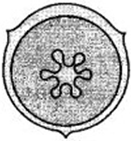
Identify the type of placentation given in the diagram:
-
33%
a) Marginal.
-
0%
b) Axile.
-
67%
c) Parietal.
-
0%
d) Free central.
Q.25.
A sub – aerial stem modification is:
-
25%
a) Rhizome.
-
75%
b) Corm.
-
0%
c) Sucker.
-
0%
d) Nodulose.
Q.26.
Assort the following set of plants in Column I with the aid of information given in Column II and choose the correct option:
| Column I | Column II |
| Mustard, Datura, Chilli. | a. Flowers epigynous |
| Pea, Gulmohar, Bean, Cassia. | b. Flowers achlamydeous |
| Canna, Marchantia. | c. Flowers asymmetric |
| Piper, Pepperomia | d. Flowers zygomorphic |
| Guava, cucumber, sunflower | e. Flowers actinomorphic |
-
67%
a) 1 = e ; 2 = d ; 3 = b ; 4 = a ; 5 = c
-
0%
b) 1 = e ; 2 = d ; 3 = a ; 4 = b ; 5 = c
-
0%
c) 1 = e ; 2 = d ; 3 = c ; 4 = b ; 5 = a
-
33%
d) 1 = c ; 2 = d ; 3 = b ; 4 = a ; 5 = e
Q.27.
Inflorescence found in members of Fabaceae is:
-
25%
a) Cyathium.
-
25%
b) Racemose.
-
50%
c) Cymose.
-
0%
d) Solitary.
Q.28.
Edible part of banana, almond and litchi are:
-
0%
a) Mesocarp, seeds, aril.
-
75%
b) Pericarp, seeds, thalamus.
-
0%
c) Testa, endosperm, aril.
-
25%
d) Epicarp and Mesocarp, seeds, aril.
Q.29.
S: In perigynous flower , the thalamus becomes flat, disc like R: The flower whorls are arranged on the rim of the thalamus
-
33%
a) S and R both are true, where R is definition of S
-
33%
b) S and R both are true, where R is not reason of S
-
33%
c) S is true, R is false
-
0%
d) S is false , R is true
Q.30.
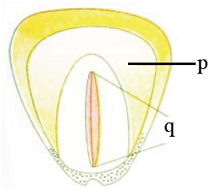
Name the labeling part of given diagram:
-
25%
a) P – Endosperm q- embryo
-
25%
b) P-seed coat q- coleoptile
-
25%
c) P- Endosperm q- cotyledon
-
25%
d) P- seed coat q –embryo
Q.31.
The correct match for edible part of fruit is: (AIPMT,CBSE 2001)
-
0%
a) Guava – pericarp with thalamus
-
0%
b) Tomato – thalamus
-
0%
c) Maize – cotyledon
-
100%
d) Date palm – epicarp
Q.32.
Drupe has : (UGET Manipal, 2004)
-
25%
a) hard Epicarp
-
50%
b) hard endocarp
-
0%
c) hard mesocarp
-
25%
d) no epicarp
Q.33.
____require more than two growing seasons to complete their life cycle.
-
33%
a) Annual
-
0%
b) Perennials
-
0%
c) Biennials
-
67%
d) Herbs
Q.34.
Fibers are found on the seeds of:
-
50%
a) Calotropis
-
25%
b) Gossypium
-
25%
c) Alstonia
-
0%
d) All of above
Q.35.
A fruit in which the fruit wall (pericarp) and seed coat have got fused is called
-
0%
a) Legume
-
25%
b) caryopsis
-
50%
c) nut
-
25%
d) drupe
Q.36.
In the monocotyledonous seeds the endosperm is separated from the embryo by a distinct layer known as: (Kerala 2008)
-
0%
a) testa
-
100%
b) epithelial layer
-
0%
c) tegmen
-
0%
d) scutellum
Q.37.
An underground specialized shoot with reduced disc like stem covered by fleshy leaves is: (J.K.R.E.T. 2000)
-
50%
a) bulb
-
25%
b) Rhizome
-
25%
c) rhizophore
-
0%
d) bulbil
Q.38.
Leaf apex is modified into tendril in:
-
0%
a) Smilax
-
0%
b) Gloriosa
-
0%
c) Australian acacia
-
100%
d) Pea
Q.39.
Diadelphous condition is present on:
-
0%
a) Citrus
-
50%
b) Bombyx
-
25%
c) Pisum
-
25%
d) Brassica
Q.40.
A brightly coloured bract like covering associated with the banana inflorescence is called:
-
50%
a) Spathe
-
25%
b) Scape
-
25%
c) Spiral
-
0%
d) Scapigeron
Q.41.
Which would do maximum harm to a tree ? The loss of:
-
50%
a) Half of its branches
-
25%
b) All of its leaves
-
25%
c) Half of its flower
-
0%
d) Half of its bark
Q.42.
Leaves are attached to the stem at :
-
25%
a) Apical meristem
-
50%
b) Internode
-
25%
c) Nodes
-
0%
d) Axillary meristem
Q.43.
The distinguishing character of imparipinnate leaf is that:
-
25%
a) Leaflets are large.
-
25%
b) Rachis is terminated by an unpaired odd leaflet.
-
25%
c) Rachis is so strong.
-
25%
d) All leaflets are borne in pairs.
Q.44.
Find the correct sequence of labelled diagram given below:
-
0%
a) (A) – Spike, (B) – Raceme, (C) – Dichasial cyme, (D) – Monochasial cyme.
-
75%
b) (A) – Raceme, (B) – Spike, (C) - Monochasial cyme, (D) – Dichasial cyme.
-
0%
c) (A) – Spike, (B) – Dichasial cyme, (C) – Raceme, (D) – Monochasial cyme.
-
25%
d) (A) – Raceme, (B) – Dichasial cyme, (C) – Monochasial cyme, (D) – Spike.
Q.45.
Mint is an example of:
-
75%
a) Sucker.
-
25%
b) Stolon.
-
0%
c) Offset.
-
0%
d) Scramblers.
Q.46.
Consider the following statements: (i) In Racemose inflorescence, the flowers are borne in a basipetal order. (ii) Epigynous flowers are seen in pea plant. (iii) In brinjal, ovary is superior. Choose the correct option:
-
50%
a) (i) and (ii) are true and (iii) is false.
-
50%
b) (i) and (iii) are true but (ii) is false.
-
0%
c) (i) and (ii) are false but (iii) is true.
-
0%
d) (i) and (iii) are false but (ii) is true.
Q.47.
Which of the following is found in Utricularia?
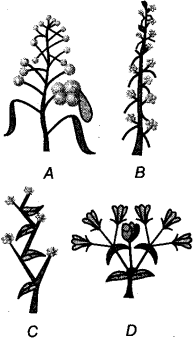
-
20%
a) A
-
40%
b) B
-
40%
c) C
-
0%
d) D
Q.48.
Turmeric is a stem and not a root because :
-
25%
a) It stores food material
-
25%
b) It grows parallel to soil surface
-
50%
c) It has nodes and internodes
-
0%
d) It has chlorophyll
Q.49.
Flower is a :
-
0%
a) Modified cone
-
0%
b) Modified spike
-
50%
c) Modified branch system
-
50%
d) Modified reproductive shoot
Q.50.
The “Eyes” of the potato tuber are : (A.P.M.T.2011)
-
0%
a) Root buds
-
25%
b) Flower buds
-
25%
c) Shoot bud
-
50%
d) Axillary buds