Q.1.
Amides are formed by:
-
25%
a) Hydroxyl part of amino acids replaced by NH2 group.
-
50%
b) Hydroxyl part of amino acid replaced by oxygen radicle.
-
25%
c) NH2 part of amino acid replaced by OH group.
-
0%
d) NH2 part of amino acid replaced by CH3 group.
Q.2.
The enzyme nitrogenase is highly sensitive to the molecular oxygen. It requires anaerobic conditions, to protect this enzyme nodule contains:
-
33%
a) Leg haemoglobin.
-
33%
b) Myoglobin.
-
0%
c) Haemoglobin.
-
33%
d) Rhizobium bacteria.
Q.3.
A plant shows appearance of brown spots surrounded by chlorotic veins. This indicates:
-
33%
a) Deficiency of Manganese.
-
33%
b) Toxicity of manganese.
-
33%
c) Toxicity of magnesium.
-
0%
d) Toxicity of molybdenum.
Q.4.
Match the following:
| a. nif, nod, fix genes | Leg haemoglobin |
| b. Infection thread | Polysaccharide membrane bound bacteria |
| c. Peribacteriodal membrane | Plasmid |
| d. Bacterioids | Root hairs |
| e. Root nodules | Knob like structures in roots of legumes |
-
0%
a) a → 3; b → 5; c → 2; d → 1; e → 4
-
50%
b) a → 3; b → 1; c → 4; d → 2; e → 5
-
0%
c) a → 3; b → 5; c → 1; d → 2; e → 4
-
50%
d) a → 3; b → 4; c → 1; d → 2; e → 5
Q.5.
Assertion: Nitrogen is the mineral element required by plant in greatest amount. Reason: Molybdenum is a micronutrient element required by plant in greatest amount.
-
0%
a) Both Assertion and Reason are true and Reason is the correct explanation of Assertion.
-
50%
b) Both Assertion and Reason are true but Reason is NOT the correct explanation of Assertion.
-
50%
c) Assertion is true but Reason is false.
-
0%
d) Both Assertion and Reason are false.
Q.6.
Which mineral elements are called critical elements for crops?
-
0%
a) N, P, K.
-
100%
b) C, H, O.
-
0%
c) N, S, Mg.
-
0%
d) K, Ca, Fe.
Q.7.
Function of zinc is:
-
0%
a) Biosynthesis of IAA.
-
0%
b) Synthesis of chlorophyll.
-
0%
c) Activate carboxylase enzyme.
-
100%
d) Both A and C.
Q.8.
Which method of hydroponics is used for providing nutrients to plants or seedlings in environ ment saturated with fine droplets of nutrients ?
-
0%
a) Aeroponics
-
100%
b) Continous flow of cultured solution
-
0%
c) Static cultured solution
-
0%
d) Suspension culture
Q.9.
Which elements play significant role in structure and synthesis of chlorophyll ?
-
0%
a) Fe, Ca
-
0%
b) Fe, Mg
-
100%
c) Cu, Fe
-
0%
d) Mg, Fe
Q.10.
State deficiency of Cl.
-
0%
a) Wilting of stubby roots
-
0%
b) brown spoted fruits
-
0%
c) accumalation of purple pigment
-
100%
d) premature leaf fall
Q.11.
State importance of Ca.
-
0%
a) Structural component of plasma membrance
-
100%
b) For the synthesis if IAA.
-
0%
c) Formation of bipolar centriole during cell-division
-
0%
d) Formation of nuclear membrance
Q.12.
Which substances of soil water are degraded gradually by, atmosphere and microorganisms ?
-
0%
a) Organic material
-
0%
b) inorganic material
-
100%
c) elements
-
0%
d) positive ions
Q.13.
In the following statements which option is correct for toxicity levels of elements. Statements : (A) Toxicity levels for any elements may inhibit the uptake of another element. (B) Low concentration of Mn may cause deficiencies of Mg and Ca. (C) A moderate increase toxicity are difficult to identify.
-
0%
a) A
-
100%
b) A and C
-
0%
c) B and C
-
0%
d) all
Q.14.
Which is improper pair of the following ?
-
100%
a) Ionic balance in plants - Na
-
0%
b) Cell wall component - B
-
0%
c) Activation of Nitrogenase - Cu
-
0%
d) Required for iron absorption - Ni
Q.15.
Rhizobium has symbiotic association with the roots of:
-
0%
a) Garden pea.
-
0%
b) Alfalfa.
-
0%
c) Sweet clover.
-
100%
d) All of these.
Q.16.
The main amino acid from which the transfer of NH2 group takes place and other amino acids are formed through Transamination is:
-
0%
a) Glutamic acid.
-
100%
b) Aspartic acid.
-
0%
c) Malic acid.
-
0%
d) Glycine
Q.17.
The given equation refers to: N2 + 8e- + 8H+ + 16ATP → 2NH3 + H2 + 16ADP + 16Pi
-
0%
a) Ammonification.
-
100%
b) Nitrification.
-
0%
c) Nitrogen fixation.
-
0%
d) Denitrification.
Q.18.
Which of the following amide is involved in the assimilation by plants?
-
0%
a) Glutamine.
-
0%
b) Alanine.
-
100%
c) Asparagine.
-
0%
d) Serine.
Q.19.
The movement of ions into the Apoplast usually occurs through:
-
50%
a) Trans membrane proteins.
-
50%
b) Expenditure of energy.
-
0%
c) Endosome formation.
-
0%
d) Lysis of membranes.
Q.20.
Which of the following is a group of micronutrients for plants?
-
0%
a) Fe, Mn, Cu, Mo, Zn.
-
0%
b) Fe, Mn, Cu, O, C.
-
0%
c) Cu, B, Cl, Fe, Ca.
-
100%
d) Ca, Mg, Fe.
Q.21.
Due to which type of bacteria atmospheric N2 is maintained ?
-
0%
a) Nitrosomonas
-
0%
b) Rhizobium
-
100%
c) Nitrobacter
-
0%
d) Pseudomonas
Q.22.
Out of the following, what is the function of Potasium ?
-
0%
a) ion balance
-
0%
b) stabilizes ribosomes
-
0%
c) Required for iron absorption
-
100%
d) In active site of many redox enzymes
Q.23.
State importance of iron ?
-
0%
a) Required for activation of Carboxyalase enzyme.
-
100%
b) Required for the structure of Ferodoxin.
-
0%
c) Required for the photolysis of H2O during photosynthesis.
-
0%
d) Required for the absorption and metabolism of Ca.
Q.24.
In the first phase of absorption of mineral ions from soil to root, element passes through which plant ?
-
0%
a) Cell wall
-
100%
b) Nuclear membrance
-
0%
c) tonoplast
-
0%
d) plasma membrance
Q.25.
Match proper pair
| Column I | Column II |
| 1 Silt particle | a. large |
| 2 Sand particle | b. Colloids |
| 3 Clay particle | c. medium |
| very small clay particle | d. small |
-
0%
a) 1 - a, 2 - d, 3 - c, 4 - b
-
100%
b) 1 - b, 2 - c, 3 - a, 4 - d
-
0%
c) 1 - c, 2 - b, 3 - d, 4 - a
-
0%
d) 1 - c, 2 - a, 3 - d, 4 - b
Q.26.
Which amino acid acts as a main donor of amino group in transamination ?
-
0%
a) Glutamic acid
-
0%
b) Glutamine
-
100%
c) Glutamate dehydrogenase
-
0%
d) Glycine
Q.27.
Which is correct for absorption of mineral ions, from the given statement ? select proper option. (i) Elements absorbed by root cells first enters region between cell wall and plasma membrance. (ii) It also enters in the inter cellular space of root cells. (iii) This process occurs rapidly through transportation and requires energy obtained from ATP. (iv) Later on mineral ions enters inside plasma membrance and vacuolar sap.
-
0%
a) i, ii and iii
-
100%
b) i and ii
-
0%
c) iii and iv
-
0%
d) i, ii and iv
Q.28.
Hydroponics is:
-
100%
a) Cultivation of plants in water.
-
0%
b) Growth of plants towards water.
-
0%
c) Growth of plants away from water.
-
0%
d) Soilless cultivation of plants.
Q.29.
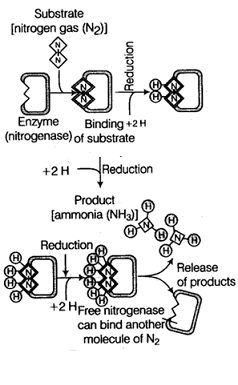
Pick out the correct statements for the given diagram of N2 fixation and choose the correct option: (i) Nitrogenase catalyses the reaction. (ii) The formation of ammonia is a reductive process. (iii) One molecule of nitrogen produces two molecules of ammonia. (iv) Nitrate reductase catalyses the reaction. (v) Formation of ammonia is an oxidative reductive process. (vi) One molecule of nitrogen produces one molecule of ammonia.
-
100%
a) (i), (ii) and (iii) are correct.
-
0%
b) (iv), (v) and (vi) are correct.
-
0%
c) (i), (v) and (vi) are correct.
-
0%
d) (iii), (iv) and (v) are correct.
Q.30.
Translocation of organic substances through the phloem is facilitated by the micronutrient:
-
0%
a) Calcium.
-
0%
b) Boron.
-
100%
c) Both A and B.
-
0%
d) Sulphur.