Q.1.
Which of the following gene clusters in bacteria is responsible for N2 fixation?
-
0%
a) nod, ori, f.
-
0%
b) nod, fix, nif.
-
0%
c) nod, ti, cry.
-
0%
d) nod, nif, rop.
Q.2.
Assertion: Hydroponics is one of the investigatory method to study the mineral requirements of plants. Reason: By hydroponics, essential elements were identified and their deficiency symptoms were discovered.
-
0%
a) Both Assertion and Reason are true and Reason is the correct explanation of Assertion.
-
0%
b) Both Assertion and Reason are true but Reason is NOT the correct explanation of Assertion.
-
0%
c) Assertion is true but Reason is false.
-
0%
d) Both Assertion and Reason are false.
Q.3.
Read the following statements: (i) Transfer of amino group from amino acid to keto group of a keto acid – Transamination. (ii) Hydroxyl part of amino acid is replaced by another amino acid – Amide formation. (iii) Transfer of amino group from keto acid to amino acid – Transamination. (iv) Hydroxyl part of keto acid is replaced by amino group – Amide formation. (v) Ammonia reacts with α ketoglutaric acid in the presence of NADPH and H+ and glutamate dehydrogenase to form glutamic acid. Which of the above statements are correct?
-
0%
a) (iii), (iv), (v).
-
0%
b) (i), (ii), (v).
-
0%
c) (i), (iv), (v).
-
0%
d) (ii), (iii), (v).
Q.4.
Amides are transported to the other parts of the plant through:
-
0%
a) Xylem vessels.
-
0%
b) Phloem.
-
0%
c) Sieve tubes.
-
0%
d) Both A and C.
Q.5.
Chlorosis is the loss of chlorophyll leading to yellowing in leaves. This symptom is caused by the deficiency of elements like:
-
0%
a) Ca, Mg, Cu, K.
-
0%
b) N, K, Ca, Mg, Fe, Mn.
-
0%
c) K, N, Mg, S, Fe, Mn, Zn, Mo.
-
0%
d) N, Mg, Fe, Zn, Mo.
Q.6.
N2 fixation in Alnus is brought about by:
-
0%
a) Frankia.
-
0%
b) Rhizobium.
-
0%
c) Nitrococcus.
-
0%
d) Azospirillum
Q.7.
Count the total number of true statements: (i) Potassium help to maintain anion cation balance in cells and is involved in protein synthesis. (ii) Mg2+ is an activator for both ribulose biphosphate carboxylase oxygenase and PEP carboxylase. (iii) Plants obtain sulphur in the form of SO (iv) Decomposition of organic nitrogen of dead plants and animals into ammonia is called ammonification. (v) Any mineral ion concentration in tissues that reduces the dry weight of tissues by 10% is considered as toxic.
-
0%
a) 1
-
0%
b) 2
-
0%
c) 3
-
0%
d) 4
Q.8.
Which of the following does not fix atmospheric nitrogen?
-
0%
a) Nostoc.
-
0%
b) Anabaena.
-
0%
c) Spirogyra.
-
0%
d) Azotobacter.
Q.9.
Farmers in a particular region were concerned that pre-mature yellowing of leaves of a pulse crop might cause decrease in the yield. Which treatment could be most beneficial to obtain maximum seed yield?
-
0%
a) Frequent irrigation of the crop
-
0%
b) Treatment of the plants with cytokinins along with a small dose of nitrogenous fertilizer
-
0%
c) Removal of all yellow leaves and spraying the remaining green leaves with 2, 4, 5 trichlorophenoxy acetic acid
-
0%
d) Application of iron and magnesium to promote synthesis of chlorophyll.
Q.10.
What is concentration of micronutrients in the dry mass of plants per gram ?
-
0%
a) 1 to 10 mg
-
0%
b) 0.1 mg
-
0%
c) 0.1 mg or less than that
-
0%
d) 10 mg or more than that
Q.11.
Deficiency of which element shows stunted growth ?
-
0%
a) Mo, Ca, S, N
-
0%
b) Cl, N, Cu, Zn
-
0%
c) P, S, Mn, Ca
-
0%
d) K, N, Fe, Ca
Q.12.
Donnan equillibrium is achieved at which surface ?
-
0%
a) Cell wall
-
0%
b) Nuclear membrance
-
0%
c) plasma membrance
-
0%
d) Vascular membrace
Q.13.
What is the function of leg haemoglobin ?
-
0%
a) To protect Nif gene from the side effect of O2
-
0%
b) To proctect nitrogenase from the side effect of O2
-
0%
c) To provide atmosheric N2 to Rhizobium bzcteria
-
0%
d) To synthesis reduction inducing unit FAD.
Q.14.
Due to natural lightening ...
-
0%
a) Nitrate is converted into Nitride
-
0%
b) N2 is converted into nitrate
-
0%
c) Modify from NO3 to N2
-
0%
d) to increase activity of Reductive Amination
Q.15.
Major portion of the dry weight of plants comprises of:
-
0%
a) Nitrogen, phosphorus, potassium.
-
0%
b) Calcium, magnesium, sulphur.
-
0%
c) Carbon, nitrogen, hydrogen.
-
0%
d) Carbon, hydrogen, oxygen.
Q.16.
Transamination reaction is catalysed by the enzyme:
-
0%
a) Glutamate dehydrogenase.
-
0%
b) Transaminase.
-
0%
c) Glutamate hydrogenase.
-
0%
d) Aspartate synthase.
Q.17.
Ammonia is first oxidised to nitrate by the bacteria in nitrogen fixation is:
-
0%
a) Nitrosomonas
-
0%
b) Nitrococcus.
-
0%
c) Nitrobacter.
-
0%
d) Both A and B.
Q.18.
Which enzyme complex is responsible for the reduction of molecular nitrogen to the level of NH3 in root module of legume?
-
0%
a) Aminase.
-
0%
b) Nitrogenase.
-
0%
c) Nitrate reductase.
-
0%
d) Nitrite reductase.
Q.19.
Which group is included in micronutrients ?
-
0%
a) Mn, Cu, Mo
-
0%
b) Cl, Ni, Co, Mg
-
0%
c) C, H, O, N
-
0%
d) Cl, S, Ni, Fe
Q.20.
What is the function of Zn ?
-
0%
a) Synthesis of Carboxyalase enzyme
-
0%
b) Formation of Indol Acetic acid (IAA)
-
0%
c) required for absprption and utilization of Ca.
-
0%
d) required for maintenance of ribosomal constituent.
Q.21.
Which inorganic substance is obtained by N2 - fraction ?
-
0%
a) Ammonium
-
0%
b) amino acid
-
0%
c) Ammonia
-
0%
d) Ammonium Hydroxide
Q.22.
Correlate the names of the bacteria with the related functions they carry out:
| a. Nitrosomonas | Symbiotic nitrogen fixation |
| b. Frankia | Free living nitrogen fixation |
| c. Bacillus ramosus | Nitrification |
| d. Beijernickia | Ammonification |
| e. Rhizobium | Symbiotic nitrogen fixation in the roots of Alnus |
-
0%
a) a → 3 ; b →5 ; → 4 ; d → 2 ; e → 1 ;
-
0%
b) a → 3 ; b →2 ; → 4 ; d → 5 ; e → 1 ;
-
0%
c) a → 4 ; b →5 ; → 2 ; d → 1 ; e → 3 ;
-
0%
d) a → 5 ; b →3 ; → 4 ; d → 1 ; e → 2 ;
Q.23.
Nitrifying bacteria:
-
0%
a) Convert free nitrogen to nitrogen compounds.
-
0%
b) Convert proteins into ammonia.
-
0%
c) Reduce nitrates to free nitrogen.
-
0%
d) Oxidize ammonia to nitrates.
Q.24.
The absorption, distribution and metabolism of various mineral elements is called .....
-
0%
b) absorption of mineral salts
-
0%
a) dispersal of mineral
-
0%
c) mineral metabolism
-
0%
d) mineral nutrition
Q.25.
Which is the correct path of transport of mineral nutrients from roots ?
-
0%
a) Root epidernal layer → endodermis → cortex → Pericycle → xylem tissue
-
0%
b) Root epidernal layer → cortex → endodermis → xylem tissue → Pericycle
-
0%
c) Root epidernal layer → cortex → endodermis → Pericycle → xylem tissue
-
0%
d) Root epidernal layer → Pericycle → cortex → endodermis → xylem tissue
Q.26.
Which are criteria for Essentiality of Elements. Choose the correct sentences from given sentences. (i) A plant must be able to complete its life cylce in the absence of the mineral element. (ii) The function of the element must not be replaceable by another mineral element. (iii) All minerals which are absorbed by plants are not essential minerals.
-
0%
a) i and ii
-
0%
b) iii and i
-
0%
c) ii and iii
-
0%
d) only ii
Q.27.
Which is proper pair of ions and its deficiency symtoms ?
-
0%
a) Nitrogen - Induction of dormancy
-
0%
b) Potassium - Scorched look to leaves
-
0%
c) Phosphorous - Chlorosis
-
0%
d) Zinc - Brown spoted of fruit
Q.28.
Select improper pair for the N2 fixation to the formation of Amino acid process.
-
0%
a) FAD - Reduction inducing unit
-
0%
b) Essential enzymes - Hydrogenase, Nitrogenase
-
0%
c) ATP - the introduction of H2 units in a diatomic N2 unit.
-
0%
d) Reductive Amination - Nitrogenase.
Q.29.
Which type of transport of mineral elements is shown in the given diagram ?
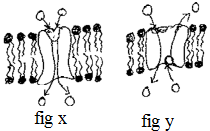
-
0%
a) Fig x Sympart Fig y Unipart
-
0%
b) Fig x Unipart Fig y Antipart
-
0%
c) Fig x Sympart Fig y Antipart
-
0%
d) Fig x Antipart Fig y sympart
Q.30.
By which principle, indirect storage of stable and non-diffusible ions is explained ?
-
0%
a) ion exchange
-
0%
b) principle of mass flow
-
0%
c) Donnan equillibrium
-
0%
d) principle of Diffusion