Q.1.
Assertion: Deficiency symptoms of N, K and Mg are first visible in the senescent leaves. Reason: Biomolecules containing these elements are broken down in the older leaves, making these elements available for mobilising to younger leaves.
-
50%
a) Both Assertion and Reason are true and Reason is the correct explanation of Assertion.
-
50%
b) Both Assertion and Reason are true but Reason is NOT the correct explanation of Assertion.
-
0%
c) Assertion is true but Reason is false.
-
0%
d) Both Assertion and Reason are false.
Q.2.
Which one of the following is essential for photolysis of water?
-
0%
a) Manganese.
-
0%
b) Zinc.
-
0%
c) Copper.
-
100%
d) Boron.
Q.3.
In which form Phosphorous is absorbed from soil ?
-
0%
a) H3PO4-
-
0%
b) HPO4-
-
100%
c) H2PO4-
-
0%
d) H4P2O7-
Q.4.
Toxicity of Mn inhibits function of which other elements ?
-
0%
a) Fe, Mg, S
-
100%
b) Ca, Fe, Mg
-
0%
c) Mg, K, Fe
-
0%
d) Ca, P, S
Q.5.
Pick out the matching sequence:
| (A) | Calcium and sulphur | Absorbed by plants in the form of bivalent ions | Deficiency symptoms appeared in younger tissues | Both are enzyme stimulators |
| (B) | Magnesium and Phosphorus | Major elements | Required by 1 – 10mg/gm of dry matter | Energy related elements |
| (C) | Silicon and selenium | Beneficial elements | Required by all plants in small quantities | Require less than 0.1mg/gm of dry matter |
| (D) | Molybdenum | Tracer element | Involved in nitrogen metabolism | Stimulates nitrate reductase enzymes |
-
0%
a) A
-
0%
b) B
-
100%
c) C
-
0%
d) D
Q.6.
Boron is absorbed by plants as BO33- and B4O72-. How many of the following are functions of Boron? (i) Uptake and utilisation of calcium. (ii) Membrane functioning. (iii) Pollen germination. (iv) Cell elongation, cell differentiation and carbohydrate translocation.
-
0%
a) (i) and (iii)only.
-
0%
b) (i), (ii) and (iv) only.
-
0%
c) (iv) only.
-
0%
d) (i), (ii), (iii) and (iv).
Q.7.
Find out the false statement regarding leg haemoglobin:
-
0%
a) Nodule contains an oxygen binding haem protein called leg haemoglobin which is present in the cytoplasm of infected nodule cells at high concentration.
-
0%
b) The host plant produce both globin portion and haem portion of leg haemoglobin to infection by the bacteria.
-
0%
c) It provides sufficient oxygen to Bacterioids.
-
0%
d) It is a pink coloured substance.
Q.8.
In plants, mineral nutrition, elements are called macro and micro elements depending upon their:
-
0%
a) Relative presence in plant ash.
-
0%
b) Relative importance in plant growth.
-
0%
c) Relative amount required in plants.
-
0%
d) Relative availability in soil.
Q.9.
Which element deficiency shows bronzing leaves ?
-
0%
a) K
-
0%
b) N
-
0%
c) Ca
-
0%
d) S
Q.10.
Write an example of bacteria and the process which is responsible for reducing nitrates to gaseous nitrogen ?
-
0%
a) Agrobacterium and Nitrification
-
0%
b) Pseudomonas and Agrobacterium
-
0%
c) Nitrosomonas and Denitrification
-
0%
d) Agrobacterium and Denitrification
Q.11.
Assertion: Excess manganese in soil, can adversely decrease magnesium, iron and calcium in the soil. Reason: Manganese increases the rate of photosynthesis thereby increasing the absorption of Mg, Fe and Ca from the soil.
-
0%
a) Both Assertion and Reason are true and Reason is the correct explanation of Assertion.
-
0%
b) Both Assertion and Reason are true but Reason is NOT the correct explanation of Assertion.
-
0%
c) Assertion is true but Reason is false.
-
0%
d) Both Assertion and Reason are false.
Q.12.
Match the following columns:
| Column I | Column II |
| a. Rhizobium leguminosarum | Cereal roots |
| b. Ureides | Azolla |
| c. Azospirillum brasiliense | Pisum sativum |
| d. Frankia | Soybeans |
| e. Anabaena | Alnus |
-
0%
a) a →3 ; b →4 ; c →1 ; d →5 ; e →2 ;
-
100%
b) a →4 ; b →3 ; c →1 ; d →2 ; e →5 ;
-
0%
c) a →5 ; b →4 ; c →2 ; d →1 ; e →3 ;
-
0%
d) a →3 ; b →5 ; c →4 ; d →1 ; e →2 ;
Q.13.
Deficiency of which mineral causes shortening of internodes and reduction in cambium activity ?
-
0%
a) K
-
0%
b) Fe
-
0%
c) Cu
-
0%
d) B
Q.14.
What is responsible for N2 fixation in Rhizobium ?
-
0%
a) nif - gene
-
100%
b) leghemoglobin
-
0%
c) Nitrogenase
-
0%
d) ATP
Q.15.
Match the following:
| Column I | Column II |
| a. Necrosis | Ca, Mg, Cu, K. |
| b. Chlorosis | N, K, S, Mo. |
| c. Inhibition of cell division. | N, S, Mo. |
| d. Delayed flowering | Fe, Mg. |
-
0%
a) a → 1; b → 2; c →3; d → 4
-
100%
b) a → 4; b → 2; c →1; d → 3
-
0%
c) a →2; b → 3; c →1; d → 4
-
0%
d) a → 1; b → 4; c →2; d → 3
Q.16.
Amonification is the release of NH3 after the death of plants and animals and their degradation. Find the mistake in the given statement.
-
0%
a) Conversion of NH3 into NO2- and 3NO3- is not mentioned.
-
0%
b) Excretory substances of dead bodies is not mentioned.
-
100%
c) Microbes responsible for degradation in the process are not mentioned.
-
0%
d) Release of NH3 from N2 containing substances (denitrification) is not mentioned.
Q.17.
Which element is required for absorption and utilization of calcium ?
-
50%
a) Fe
-
50%
b) Cu
-
0%
c) B
-
0%
d) K
Q.18.
Refer the given reaction, what does it depict?
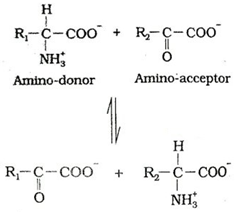
-
0%
a) Oxidative amination.
-
0%
b) Transamination.
-
0%
c) Reductive amination.
-
0%
d) Deamination.
Q.19.
Nitrogen is an important constituent of ... ... [ AMU 1998]
-
0%
a) Polyphosphates
-
0%
b) Carbohydrates
-
0%
c) Proteins
-
0%
d) Lipids
Q.20.
Match the column .... ..... [ kerala 2006 ]
| a) Aerobic | Frankia |
| b) Cyanobacteria | 2.Azospirillum |
| c) Casuarina | 3.Clostridium |
| d) Tropical grasses | Aulosira |
| - - - - | Azotobacter |
-
100%
a) a - 4, b - 3, c - 2, d - 1
-
0%
b) a - 5, b - 3, c - 4, d - 1
-
0%
c) a - 5, b - 4, c - 1, d - 2
-
0%
d) a - 3, b - 5, c - 4, d - 2
Q.21.
Element required in least quantity is ... ... [ AMU 1997]
-
0%
a) Zn
-
50%
b) Mn
-
50%
c) Mo
-
0%
d) Cl
Q.22.
Function of red pigment leghaemoglobin present in root nodules of leguminous plants is to regulate ... .... [ AMU 2011]
-
0%
a) CO2 supply in cells
-
0%
b) Mo supply to cells
-
0%
c) O2 supply to cells
-
0%
d) Production of phenolic compounds