Q.1.
Assertion: Nitrogen fixing bacteria in legume root nodules survive in oxygen depleted cells of nodules. Reason: Leg haemoglobin completely removes oxygen from the host cells.
-
0%
a) Both Assertion and Reason are true and Reason is the correct explanation of Assertion.
-
67%
b) Both Assertion and Reason are true but Reason is NOT the correct explanation of Assertion.
-
0%
c) Assertion is true but Reason is false.
-
33%
d) Both Assertion and Reason are false.
Q.2.
Which element delay flowering if its concentration in plants is low?
-
33%
a) Nitrogen.
-
0%
b) Sulphur.
-
0%
c) Molybdenum.
-
67%
d) All of these.
Q.3.
N2 fixation requires a strong reducing agent and energy in the form of ATP, which is provided by:
-
50%
a) Respiration of host cells.
-
0%
b) Bacteria.
-
0%
c) Absorbed from lightening.
-
50%
d) Absorbed from microbes present in soil.
Q.4.
One mineral element activates carbonic anhydrase, other activates RuBisco and PEPcase and third one is the activator of aconitase. These minerals are respectively:
-
50%
a) Zn, Mg, Fe.
-
0%
b) Zn, Mg, Mo.
-
50%
c) Mg, Zn, Fe.
-
0%
d) Mg, Fe, Zn.
Q.5.
Hydroponics or water culture was first commercially produced by:
-
0%
a) William Goerick.
-
50%
b) Julius Von Sachs.
-
0%
c) Knop.
-
50%
d) Hoagland.
Q.6.
Which of the following statements are correct regarding Manganese toxicity? (i) Any mineral ion concentration in tissues that reduces the dry weight of tissues by about 10 percent is considered toxic. (ii) The prominent symptoms of manganese toxicity is the appearance of brown spots surrounded by chlorotic veins. (iii) Manganese competes with iron and magnesium for uptake and with magnesium for binding with enzymes. (iv) Manganese also inhibits the calcium translocation in shoot apex. (v) The symptoms of Manganese toxicity may actually be the deficiency symptoms of iron, magnesium and calcium.
-
50%
a) (i), (ii) and (iii) only.
-
50%
b) (i), (iii) and (iv) only.
-
0%
c) (iii), (ii) and (iv) only.
-
0%
d) All are correct.
Q.7.
Which of the following statement is false?
-
50%
a) Mineral salts are translocated through xylem along the ascending stream of water.
-
50%
b) Majority of the nutrients that are essential for growth become available to roots due to weathering of rocks.
-
0%
c) Plants compete with microbes for limited nitrogen, so it acts as a limiting nutrient for both natural and agricultural ecosystem.
-
0%
d) Nitrate present in soil is reduced to nitrogen is known as nitrification.
Q.8.
Identify the mismatched pair:
-
100%
a) Sinigrin of crucifers – Sulphur.
-
0%
b) Khaira disease in paddy – Zinc.
-
0%
c) Tea yellow disease – Boron.
-
0%
d) Delayed seed germination – Phosphorus.
Q.9.
Find out the false statement regarding hydroponics: (i) It is a technique of growing plants in a nutrient solution. (ii) It is first demonstrated by Julius Von Sachs. (iii) By this method essential elements were identified and their deficiency symptoms were discovered. (iv) It is successfully employed as a technique for commercial production of vegetables such as tomato, seedless cucumber and lettuce by Goerick. (v) In this technique, nutrient solution must be adequately aerated to obtain the optimum growth.
-
0%
a) One.
-
0%
b) Two.
-
0%
c) Three.
-
100%
d) Zero.
Q.10.
Consider the following statements: (i) Sulphur is present in two amino acids – cysteine and valine. (ii) Low level of N, K, S and Mo causes an inhibition of cell division. (iii) The microbe that produces nitrogen fixing nodules on the root of non leguminous plant Alnus is Frankia. (iv) Denitrification is carried out by Nitrosomonas and Nitrobacter. Of the above statements:
-
0%
a) (i) and (ii) alone are correct.
-
100%
b) (i) and (iii) alone are correct.
-
0%
c) (ii) and (iii) alone are correct.
-
0%
d) (ii) and (iv) alone are correct.
Q.11.
Ion channels are:
-
100%
a) Water.
-
0%
b) Proteins.
-
0%
c) Lipids.
-
0%
d) Nucleic acids.
Q.12.
A small aquatic plant was put in each of the petri dishes X, Y and Z, containing different culture solutions, After six weeks, the plants in the dish X has the same number of leaves as it has previously and they were small and yellowish. Plants n dish Y had more leaves of normal size and dark green colour. Plants in dish Z had more leaves of normal size, but very pale. Identify the missing elements in all the three petri dishes:
-
0%
a) X – Magnesium, Y – Phosphorus, Z – Nitrogen.
-
100%
b) X – Phosphorus, Y – Magnesium, Z – Nitrogen.
-
0%
c) X – Phosphorus, Y – Nitrogen, Z – Magnesium.
-
0%
d) X – Magnesium, Y – Nitrogen, Z – Phosphorus.
Q.13.
In plants, mineral nutrition, elements are called macro and micro elements depending upon their:
-
0%
a) Relative presence in plant ash.
-
0%
b) Relative importance in plant growth.
-
0%
c) Relative amount required in plants.
-
100%
d) Relative availability in soil.
Q.14.
Arrange in the correct order of the following in fixation process:
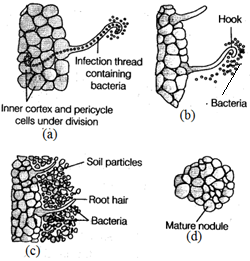
-
0%
a) b, c, d, a.
-
100%
b) c, b, a, d.
-
0%
c) d, a, b, c.
-
0%
d) a, b, c, d.
Q.15.
Plants do not get benefit from:
-
0%
a) N2 in air.
-
0%
b) O2 in air.
-
0%
c) CO2 in air.
-
100%
d) O3 in air.
Q.16.
Which group is included in Macronutrients?
-
0%
a) H, Mn, S
-
0%
b) S, P, Ca, Mg
-
100%
c) Mn, Cu, N
-
0%
d) Na, Cl,
Q.17.
In the figure identify A and B;
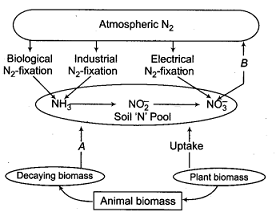
-
0%
a) A – Mineralisation, B – Demineralisation.
-
0%
b) A – Ammonification, B – Denitrification.
-
100%
c) A – Denitrification, B – Ammonification.
-
0%
d) A – Denitrification, B – Mineralisation.
Q.18.
One plant is given Urea fertilizer, but it has deficiency of phosphorous, this plant will show which symptom ?
-
0%
a) Cambium activity reduces
-
0%
b) fruit size deminishes
-
0%
c) Grey spots on leaves
-
100%
d) seed dormancy increases.
Q.19.
Which amino acid is formed when a keto - glutaric acid reacts with NH3 During transmmination ?
-
0%
a) Glutanic acid
-
0%
b) Aspartic acid
-
0%
c) Oxalo-acetic acid
-
100%
d) None of these
Q.20.
A : Leguminous plant are grown between crops to increase yield. R : Rizobium bacteria are present in the root - nodules of Leguminous plant.
-
100%
a) Both A and R are true, & R gives correct explanation of A.
-
0%
b) Both A and R are true, but R is not correct explanation of A.
-
0%
c) A is true, but R is wrong.
-
0%
d) A is wrong, but R is true.
Q.21.
lements and its deficiency symptoms are given in Column I and Column II
| Column I | Column II |
| 1 P | a. Accumulation of purple pigments. |
| 2 Cl | b. discolored tubers and roots. |
| 3 Mo | c. Wilting of stubby roots. |
| 4 B | d. Pale green leaves with rolled margins. |
| 5S | e. purple blots occur on leaf surface. |
-
0%
a) 1- a, 2 - d, 3 - b, 4 - c, 5 - e
-
0%
b) 1- d, 2 - c, 3 - a, 4 - b, 5 - e
-
100%
c) 1- e, 2 - c, 3 - d, 4 - b, 5 - a
-
0%
d) 1- e, 2 - c, 3 - b, 4 - d, 5 - a
Q.22.
The method of hydroponic in which with the use of NFT, automatically, nutrient rich solution is given, is called .....
-
100%
a) Continous flowing solution culture
-
0%
b) Tissue culture method
-
0%
c) Gas culture method
-
0%
d) Balanced - culture solution method
Q.23.
Which of the following is related with intra cellular fluid ?
-
0%
a) Mn
-
0%
b) Mg
-
100%
c) Mo
-
0%
d) Na
Q.24.
Which one is the correct statement from the given statements for Nitrogen cycle ? (i) Amonification is the transforming process of complex organic matters into the simple organic matters. (ii) Nostoc converting the gaseous N2 in to 2NO2- (iii) Agrobacterium converted directly from NO3 to N2 (iv) Psuedomonas converts NO3 into gaseous N2
-
0%
a) i and ii
-
0%
b) only iv
-
100%
c) i, ii and iii
-
0%
d) ii and iv
Q.25.
Of the following, S is essential for best production of which crop ?
-
0%
a) oily seeds
-
100%
b) leguminosae
-
0%
c) grains
-
0%
d) Fibres
Q.26.
Which is essential for Nitrogen metabolism?
-
100%
a) Boron.
-
0%
b) Molybdenum.
-
0%
c) Copper.
-
0%
d) Magnesium.
Q.27.
Mineral salts which are absorbed by roots from the soil are in the form of:
-
0%
a) Dilute solution.
-
100%
b) Very dilute solution.
-
0%
c) Concentrated solution.
-
0%
d) Very concentrated solution.
Q.28.
The group of mineral nutrients known as frame work elements:
-
0%
a) N, S, P.
-
0%
b) C, H, O.
-
0%
c) Mg, Fe, Zn.
-
100%
d) Zn, Mg, Cu.
Q.29.
Nitrogenase is an:
-
0%
a) Mo – Fe protein.
-
0%
b) Diazotroph.
-
0%
c) Oxygen removing enzyme.
-
100%
d) Both A and B.
Q.30.
Leg haemoglobin is produced in response to:
-
100%
a) N2 fixation in Pisum sativum.
-
0%
b) N2 fixation in Azolla.
-
0%
c) N2 fixation in blue green algae.
-
0%
d) N2 fixation in Zea mays.