Q.1.
Who discovered photophosphorylation?
-
26%
a) Arnon et. al.
-
22%
b) Von Mayer
-
38%
c) Calvin et.al.
-
14%
d) Hill
Q.2.
Bundle sheath chloroplast of C4 plants are:
-
37%
a) Large and agranal.
-
22%
b) Small and granal.
-
31%
c) Large and granal.
-
9%
d) Small and agranal.
Q.3.
Cyclic photophosphorylation is confined to
-
47%
a) Photosystem I
-
26%
b) Photosystem II
-
26%
c) both a & b
-
2%
d) none above
Q.4.
Photorespiration is favoured by
-
13%
a) low temperatures
-
11%
b) low light intensity
-
55%
c) high O2 and low CO2
-
22%
d) low O2 and high CO2
Q.5.
During photosynthessis, plants
-
23%
a) absorb O2, release CO2
-
73%
b) release O2, absorb CO2
-
3%
c) absorb N2, release O2
-
0%
d) absorb N2 and release NH3
Q.6.
Site of reduction of carbon is
-
11%
a) lamellae
-
35%
b) thylakoid
-
10%
c) grana
-
44%
d) stroma
Q.7.
Which of the following statements best describes the relationship between photosynthesis and respiration?
-
15%
a) Respiration is the reversal of the biochemical pathways of photosynthesis.
-
39%
b) Photosynthesis stores energy in complex organic molecules, while respiration releases it.
-
18%
c) Photosynthesis occurs only in plants and respiration occurs only in animals.
-
28%
d) ATP molecules are produced in photosynthesis and used up in respiration.
Q.8.
Read the following four statements, A, B, C and D and select the right option having both correct statements. STATEMENTS: (A) Z scheme of light reaction takes place in presence of PS I only. (B) Only PS I is functional in cyclic photophosphorylation. (C) Cyclic photophosphorylation results into synthesis of ATP and NADPH2 (D) stroma lamellae lack PS II as well as NADP.
-
38%
a) B and D are correct.
-
21%
b) A and B are correct.
-
29%
c) B and C are correct
-
12%
d) A and C are correct.
Q.9.
Stomatal movement is not affected by ... .. [NEET 2018]
-
34%
a) O2 concentration
-
30%
b) Light
-
18%
c) Temperature
-
17%
d) CO2 concentration
Q.10.
In C4 photosynthesis, both C4 and C3 cycles are involved. Identify the catalytic function of RUBISco in C4 cycle:
-
46%
a) Carboxylation of RuBp.
-
30%
b) Carboxylation of PEP.
-
16%
c) Oxygenation of RUBP.
-
7%
d) No function.
Q.11.
In a protein complex for the light reaction (a reaction center), energy is transferred from pigment molecule to pigment molecule, to a special chlorophyll a molecule, and eventually to the primary electron acceptor. Why does this occur?
-
26%
a) The action spectrum of that molecule is such that it is different from other molecules of chlorophyll.
-
24%
b) The potential energy of the electron has to go back to the ground state.
-
31%
c) The molecular environment lets it boost an electron to a higher energy level and also to transfer the electron to another molecule.
-
19%
d) These chlorophyll a molecules are associated with higher concentrations of ATP.
Q.12.
Which of the following statement is correct?
-
47%
a) H2S is the hydrogen donor for purple and green sulphur bacteria
-
17%
b) H2O is the hydrogen donor for purple and green sulphur bacteria
-
13%
c) Oxygen is evolved by the purple and green sulphur bacteria
-
23%
d) Oxygen evolved by the green plants comes from the CO2.
Q.13.
Identify the following: (i) They have a special type of leaf anatomy. (ii) They tolerate a high range of temperature. (iii) They show responses to high light intensities. (iv) They lack photorespiration. (v) They possess low CO2 compensation point.
-
12%
a) C3 plants.
-
16%
b) C2 plants.
-
57%
c) C4 plants.
-
16%
d) CAM plants.
Q.14.
How many of the following statements are true: (a) NAD mainly involved in catabolic pathway. (b) NADP mainly involved in anabolic pathway. (c) Non – cyclic electron transport is a multidirectional process. (d) D1 and D2 proteins are associated with both PS I and PS II.
-
24%
a) One.
-
35%
b) Two.
-
37%
c) Three.
-
4%
d) Four.
Q.15.
Why are C4 plants able to photosynthesize with no apparent photorespiration?
-
18%
a) They do not participate in the Calvin cycle.
-
55%
b) They use PEP carboxylase to initially fix CO2.
-
14%
c) They are adapted to cold, wet climates.
-
14%
d) They conserve water more efficiently.
Q.16.
Which of the following sequences correctly represents the flow of electrons during photosynthesis?
-
15%
a) NADPH → O2 → CO2
-
35%
b) H2O → NADPH → Calvin cycle
-
26%
c) NADPH → chlorophyll → Calvin cycle
-
24%
d) H2O → photosystem I → photosystem II
Q.17.
How many pigments are responsible for the colour of a plant leaf?
-
27%
a) 1
-
27%
b) 2
-
18%
c) 3
-
27%
d) 4
Q.18.
During photorespiration, the oxygen consuming reaction(s) occur in:
-
17%
a) Stroma of chloroplast and peroxisomes.
-
12%
b) Grana of chloroplasts and peroxisomes.
-
29%
c) Stroma of chloroplasts.
-
43%
d) Stroma of chloroplasts and mitochondria.
Q.19.
Consider the following statements: I. Rate of photosynthesis is independent of the duration of light. II. In all plants, photosynthesis is inhibited at 00 C. III. Rate of photosynthesis maximum occurs in polychromatic light. IV. Carotenoids absorb maximum light in the region of blue and red.
-
14%
a) All statements are false.
-
23%
b) All statements are true.
-
29%
c) I, II and IV are false but III is true.
-
34%
d) I and III are true while II and IV are false.
Q.20.
An action spectrum of photosynthesis was first described by:
-
12%
a) Jan Ingenhousz
-
26%
b) Julius von Sachs
-
45%
c) T.W. Engelmann
-
17%
d) Cornelius van Neil
Q.21.
Consider the situation where photosynthesis is going on at a steady pace in a typical experiment with a light on, and carbon dioxide is being combined with ribulose-bisphosphate (RuBP) to produce 3-phosphoglycerate (3PG). Then suddenly the source of carbon dioxide is eliminated. What changes in the concentrations of 3PG and RuBP would occur?
-
15%
a) 3PG levels rise, RuBP levels fall.
-
32%
b) 3PG levels fall, RuBP levels rise.
-
32%
c) 3PG levels rise, RuBP levels rise.
-
21%
d) 3PG levels fall, RuBP levels fall.
Q.22.
In a chloroplast the highest number of protons are found in
-
49%
a) lumen of thylakoid
-
20%
b) inter membrane space
-
12%
c) antennae complex
-
20%
d) Stroma
Q.23.
Stomata opens in C3 plants:
-
69%
a) in day time - for gaseous exchange
-
8%
b) in day time - no gaseous exchange
-
17%
c) in night time only - for gaseous exchange
-
6%
d) in night time only - no gaseous exchange
Q.24.
Photosynthesis in C4 plants is relatively less limited by atmospheric CO2 levels because
-
28%
a) there is effective pumping of CO2 into bundle sheath cells
-
33%
b) RuBisCO in C4 plants has higher affinity for CO2
-
17%
c) six carbon acids are the primary initial CO2 fixation products
-
22%
d) the primary fixation of CO2 is mediated via PEP carboxylase.
Q.25.
Compared with the lines for chlorophyll a in the figure, where would you expect to find the lines to differ for chlorophyll b?
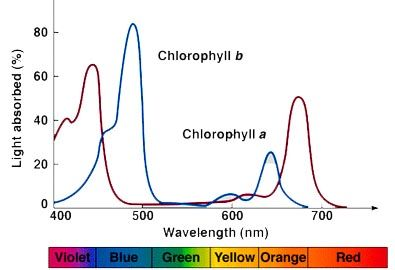
-
37%
a) The absorption spectrum line would be lowest for chlorophyll b somewhat to the right of that for chlorophyll a (500—600).
-
43%
b) The rate of photosynthesis line for chlorophyll b would be lowest from 600—700 nm.
-
17%
c) The lines for the two types of chlorophyll would be almost completely opposite.
-
3%
d) The lines for the two types of chlorophyll would be almost completely identical.
Q.26.
The sugar that results from three ʺturnsʺ of the Calvin cycle is glyceraldehyde-3-phosphate (G3P). Which of the following is a consequence of this?
-
23%
a) Formation of a molecule of glucose would require 9 ʺturns.ʺ
-
48%
b) G3P more readily forms sucrose and other disaccharides than it does monosaccharides.
-
6%
c) Some plants would not taste sweet to us.
-
23%
d) The formation of starch in plants involves assembling many G3P molecules, with or without further rearrangements.
Q.27.
How many of the following statements are true: (i) Photorespiration is also called photosynethic oxidation cycle, and involves an interaction of three organelles – Chloroplast, peroxisomes and mitochondria. (ii) Substrate of photorespiration is formed within the chloroplast by the dephosphorylation of two carbon phosphoglycolate. (iii) Site of oxidation of glycolate into glyoxylate and the formation of glycine – peroxisomes. (iv) The serine is taken up by the peroxisomes and through a series of reactions, is converted to glycerate; the glycerate enters the chloroplast, where it is phosphorylated to form PGA; the PGA molecule enters the Calvin cycle to make carbohydrates. 75 percent of the carbon lost by oxygenation is removed and 25 percent is lost as release of one molecule of CO2.
-
8%
a) One.
-
38%
b) Two.
-
23%
c) Three.
-
31%
d) All of these.
Q.28.
Which of the following statements do not justify the importance of photosynthesis?
-
16%
a) it is the primary source of all food on earth.
-
6%
b) it is responsible for the release of oxygen into the atmosphere.
-
52%
c) it is responsible for the water balance on earth.
-
26%
d) use of energy from sunlight by plants doing photosynthesis is the basis of life on earth.
Q.29.
The light reactions of photosynthesis supply the Calvin cycle with
-
19%
a) light energy.
-
22%
b) CO2 and ATP.
-
8%
c) H2O and NADPH.
-
50%
d) ATP and NADPH.
Q.30.
Which of the following are products of the light reactions of photosynthesis that are utilized in the Calvin cycle?
-
11%
a) CO2 and glucose
-
9%
b) ADP, Pi, and NADP+
-
75%
c) ATP and NADPH
-
5%
d) electrons and H+