Q.1.
or the following questions, compare the light reactions with the Calvin cycle of photosynthesis in plants. A) Produces NADPH
-
28%
a) light reactions alone
-
50%
b) the Calvin cycle alone
-
17%
c) neither the light reactions nor the Calvin cycle
-
6%
d) occurs in the chloroplast but is not part of photosynthesis
Q.2.
The pH of the inner thylakoid space has been measured, as have the pH of the stroma and of the cytosol of a particular plant cell. Which, if any, relationship would you expect to find?
-
54%
a) The pH within the thylakoid is less than that of the stroma.
-
15%
b) The pH of the stroma is higher than that of the other two measurements.
-
15%
c) The pH of the stroma is higher than that of the thylakoid space but lower than that of the cytosol.
-
15%
d) There is no consistent relationship.
Q.3.
Carbohydrates are commonly found as starch in plant storage organs. Which of the following five properties of starch (A-E) make it useful as a storage material? (A) Easily translocated (B) Chemically non-reactive (C) Easily digested by animals (D) Osmotically inactive (E) Synthesized during photosynthesis The useful properties are
-
15%
a) (B) and (C)
-
15%
b) (B) and (D)
-
62%
c) (A), (C) and (E)
-
8%
d) (A) and (E)
Q.4.
Which of the following is incorrect about the light reactions of photosynthesis?
-
50%
a) P680 and P700 are the reaction centres of PS-I, and PS-II respectively
-
43%
b) Light energy provides energy for the photolysis of water through excitation of the reaction centre of PS-II
-
7%
c) NADPH is not produced in cyclic electrons transport in light reactions
-
0%
d) Reactions of the two Photosystems are needed for the reduction of NADP
Q.5.
Match the Columns.
| Column I(Scientists) | Column II (Discoveries) |
| A. Stephen Hales | Importance of light and chlorophyll |
| B. Ingen Housz | Presence of chlorophyll in plants |
| C. Von Mohl | Product of photosynthesis is starch. |
| D. Sach | Air and light control plant growth. |
-
42%
a) A - 4 ; B -1 ; C - 2 ; D - 3
-
0%
b) A - 3 ; B - 2 ; C - 1 ; D - 4
-
25%
c) A - 2 ; B - 3 ; C - 4 ; D - 1
-
33%
d) A - 4 ; B - 3 ; C - 2 ; D - 1
Q.6.
Reduction of oxygen which forms water occurs during
-
50%
a) photosynthesis.
-
42%
b) respiration.
-
0%
c) both photosynthesis and respiration.
-
8%
d) neither photosynthesis nor respiration.
Q.7.
Which of the following connect the primary and secondary process of photosynthesis?
-
23%
a) ATP.
-
46%
b) ATP and NADPH2.
-
8%
c) NADPH2
-
23%
d) Ferrodoxin.
Q.8.
How many of the following statements are true: (i) In chloroplasts and mitochondria, proton motive force is sum of proton chemical potential and a Transmembrane electric potential. (ii) In both chloroplasts and mitochondria, ATP synthase complex have the same overall architecture and probably nearly identical catalytic sites. (iii) With regarding to the chloroplast, ATP synthase is found only in grana stacks. (iv) ATP synthase complex is a proton pump, mediated the transport of protons from perimitochondrial space to matrix.
-
0%
a) One.
-
86%
b) Two.
-
0%
c) Three.
-
14%
d) Four.
Q.9.
Some photosynthetic organisms contain chloroplasts that lack photosystem II, yet are able to survive. The best way to detect the lack of photosystem II in these organisms would be
-
30%
a) to determine if they have thylakoids in the chloroplasts.
-
40%
b) to test for liberation of O2 in the light.
-
20%
c) to test for CO2 fixation in the dark.
-
10%
d) to do experiments to generate an action spectrum.
Q.10.
The---------- acceptor of -------- which is located------- side of membrane transfers its electron not to an electron carrier but to a ----------. Fill in the blank according to causes of proton gradient in photosynthesis.
-
50%
a) Primary, proton, outer, proton carrier
-
40%
b) Primary, electron, outer, proton carrier
-
0%
c) Terminal, proton, outer, proton carrier
-
10%
d) Primary, electron, inner, Hydrogen carrier
Q.11.
Some anaerobic photosynthetic bacteria use other hydrogen donors like H2S instead of water because:
-
55%
a) They cannot tolerate oxygen.
-
27%
b) Other donors are freely available in the growth medium.
-
18%
c) Other donors need less energy input.
-
0%
d) Other donors yield more glucose molecules.
Q.12.
The conversion of phosphoglyceric acid to phosphoglyceraldehyde during photosynthesis can be described as:
-
25%
a) Oxidation.
-
8%
b) Hydrolysis.
-
0%
c) Electrolysis.
-
67%
d) Reduction.
Q.13.
Which process is most directly driven by light energy?
-
50%
a) creation of a pH gradient by pumping protons across the thylakoid membrane
-
0%
b) carbon fixation in the stroma
-
30%
c) reduction of NADP+ molecules
-
20%
d) removal of electrons from chlorophyll molecules
Q.14.
Water vapour comes out from the plant leaf through the stomatal opening. Through the same stomatal opening carbon dioxide diffuses into the plant during photosynthesis. Reason out the above statements using the following options.
-
33%
a) Both processes can happen together because the diffusion coefficient of water and CO2 is different.
-
22%
b) The above processes happen only during night time
-
11%
c) One process occurs during the day time and the other night
-
33%
d) Both processes cannot happen simultaneously
Q.15.
The Chemiosmotic coupling hypothesis of oxidative phosphorylation proposes that Adenosine Triphosphate (ATP) is formed because
-
38%
a) high energy bonds are formed in mitochondrial proteins
-
12%
b) ADP is pumped out of the matrix into the intermembrane space
-
25%
c) a proton gradient forms across the inner membrane
-
25%
d) there is a change in the permeability of the inner mitochondrial membrane toward Adenosine Diphosphate (ADP)
Q.16.
After performing the chromatographic separation of a plant leaf, experimentor found bright or blue green colour in the chromatogram. Then this pigment should be-
-
20%
a) xanthophyll
-
10%
b) Carotenoids
-
70%
c) chlorophyll a
-
0%
d) chlorophyll b.
Q.17.
Choose the correct statement:
-
29%
a) The C4 plants do not have RUBISco.
-
29%
b) Carboxylation of RuBP leads to the formation of PGA and phosphoglycolate.
-
14%
c) Carboxylation of phospho enol Pyruvate results in the formation of C4 acid.
-
29%
d) Decarboxylation of C4 acid occurs in the mesophyll cells.
Q.18.
Which of the following is correctly identified as (1) an (2) in the diagram of chloroplast and their functions?
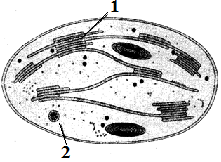
-
50%
a) (1) – Grana – CO2 fixation; (2) – Stroma – Photolysis of water.
-
12%
b) (1) – Stroma – Photolysis of water, (2) – Grana – CO2 fixation.
-
12%
c) (1) – Grana – CO2 fixation, (2) – Lamellae – Photolysis of water.
-
25%
d) (1) – Grana – Photolysis of water, (2) – Stroma – CO2 fixation.
Q.19.
Assertion: Due to pollution, atmospheric concentration of CO2 is increasing which will be harmful for C4 plants whereas productive for C3 plants. Reason: C4 plants have greater efficiency for CO2 as CO2 is fixed by PEP oxygenase.
-
29%
a) Both Assertion and Reason are true and Reason is the correct explanation of Assertion.
-
14%
b) Both Assertion and Reason are true but Reason is NOT the correct explanation of Assertion.
-
29%
c) Assertion is true but Reason is false.
-
29%
d) Both Assertion and Reason are false.
Q.20.
The reaction-center chlorophyll of photosystem I is known as P700 because
-
29%
a) there are 700 chlorophyll molecules in the center.
-
71%
b) this pigment is best at absorbing light with a wavelength of 700 nm.
-
0%
c) there are 700 photosystem I components to each chloroplast.
-
0%
d) the plastoquinone reflects light with a wavelength of 700 nm.
Q.21.
What does the chemiosmotic process in chloroplasts involve?
-
57%
a) establishment of a proton gradient
-
14%
b) diffusion of electrons through the thylakoid membrane
-
14%
c) reduction of water to produce ATP energy
-
14%
d) movement of water by osmosis into the thylakoid space from the stroma
Q.22.
Referring to Figure oxygen would inhibit the CO2 fixation reactions in

-
29%
a) cell I only.
-
43%
b) cell II only.
-
14%
c) neither cell I nor cell II.
-
14%
d) cell I during the night and cell II during the day.
Q.23.
CAM plants keep stomata closed in daytime, thus reducing loss of water. They can do this because they
-
43%
a) fix CO2 into organic acids during the night.
-
14%
b) fix CO2 into sugars in the bundle-sheath cells.
-
29%
c) fix CO2 into pyruvate in the mesophyll cells.
-
14%
d) use photosystems I and II at night.
Q.24.
In the C4 pathway, which of the following molecules combines with carbon dioxide?
-
22%
a) glyceraldehyde phosphate
-
33%
b) ribulose biphosphate
-
44%
c) Phosphoenol pyruvic acid
-
0%
d) citric acid
Q.25.
Cornelius van Neil, who, based on his studies demonstrated that photosynthesis is essentially a light-dependent reaction performed his experiments on-
-
44%
a) Cladophora
-
44%
b) purple and green bacteria
-
11%
c) green algae
-
0%
d) Non sulphur bacteria
Q.26.
Which of the following statements is a correct distinction between autotrophs and heterotrophs?
-
57%
a) Autotrophs, but not heterotrophs, can nourish themselves beginning with CO2 and other nutrients that are inorganic.
-
14%
b) Only heterotrophs require chemical compounds from the environment.
-
14%
c) Cellular respiration is unique to heterotrophs.
-
14%
d) Only heterotrophs require oxygen.
Q.27.
Quantum yield and quantum requirement are:
-
20%
a) 0.125, 4 photons.
-
20%
b) 0.125, 8 photons.
-
40%
c) 4 photons, 0.125.
-
20%
d) 8 photons, 0.125.
Q.28.
Which of the following electron carriers are present in the inner surface of thylakoid membrane? (i) Pheophytin. (ii) Ferrodoxin. (iii) Plastocyanin. (iv) Cytochrome b(v) PlastoQuinone – B. (vi) Cytochrome F.
-
17%
a) (i), (ii) and (iii).
-
50%
b) (iii), (iv) and (vi).
-
33%
c) All except (v).
-
0%
d) All except (i).
Q.29.
How many of the following statements are true regarding C4 pathway? (i) Restricted in certain plants like maize, sugarcane, etc. (ii) Process is carried out by the co – operation of both the granal chloroplast of bundle sheath and agranal chloroplast of mesophyll cells. (iii) Both primary carboxylation and carbohydrate synthesis takes place in bundle sheath cells. (iv) Presence of photoactive stomata. (v) Both PEP carboxylase and RuBisco are found at the same site.
-
20%
a) 5.
-
20%
b) 4.
-
60%
c) 3.
-
0%
d) 2.
Q.30.
Which of the events listed below occur in the light reactions of photosynthesis?
-
17%
a) NADP is produced.
-
17%
b) NADPH is reduced to NADP+.
-
0%
c) carbon dioxide is incorporated into PGA.
-
67%
d) light is absorbed and funneled to reaction-center chlorophyll a.