Q.1.
Assume a thylakoid is somehow punctured so that the interior of the thylakoid is no longer separated from the stroma. This damage will have the most direct effect on which of the following processes?
-
43%
a) the splitting of water
-
14%
b) the absorption of light energy by chlorophyll
-
14%
c) the flow of electrons from photosystem II to photosystem I
-
29%
d) the synthesis of ATP
Q.2.
The splitting of carbon dioxide to form oxygen gas and carbon compounds occurs during
-
62%
a) photosynthesis.
-
25%
b) respiration.
-
12%
c) both photosynthesis and respiration.
-
0%
d) neither photosynthesis nor respiration.
Q.3.
In metabolic processes of cell respiration and photosynthesis, prosthetic groups such as heme and iron -sulfur complexes are encountered. What do they do?
-
29%
a) donate electrons
-
43%
b) both oxidize and reduce during electron transport
-
29%
c) transport protons within the mitochondria and chloroplasts
-
0%
d) act as reducing agents
Q.4.
How is photosynthesis similar in C4 and CAM plants?
-
17%
a) In both cases, only photosystem I is used.
-
17%
b) Both types of plants make sugar without the Calvin cycle.
-
50%
c) In both cases, rubisco is not used to fix carbon initially.
-
17%
d) Both types of plants make most of their sugar in the dark.
Q.5.
Which of the following is false regarding C4 plants?
-
67%
a) The primary CO2 acceptor is a 5 carbon molecule.
-
17%
b) The initial Carboxylation reaction occurs in Mesophyll cells.
-
17%
c) The leaves fix that CO2 has two types of cells.
-
0%
d) The Mesophyll cells lack RUBISco enzyme.
Q.6.
Dark reactions of photosynthesis are actually not totally independent of light as:
-
0%
a) The initial reactions occur in the presence of light.
-
17%
b) The reaction will be inhibited by the presence of light.
-
33%
c) They can occur during the day as well.
-
50%
d) They utilize the products of the light reaction.
Q.7.
Which of the following are true regarding photosynthesis? (i) Anabolism. (ii) Catabolism. (iii) Amphibolic. (iv) Endergonic. (v) Exergonic. (vi) Oxido – reduction.
-
20%
a) (i), (iii), (iv) and (vi).
-
0%
b) (ii), (iii), (v) and (vi).
-
40%
c) (i), (iii) and (vi).
-
40%
d) (ii), (v) and (vi).
Q.8.
When CO2 is limited in the atmosphere: (i) C3 plants are more beneficial than C4 plants. (ii) C4 pathway is more efficient for synthesising glucose. (iii) C3 plants enter into C3 cycle only through C2 cycle. (iv) Decrease in the rate of photosynthesis in C3 plants.
-
17%
a) Only (i) is true.
-
17%
b) Only (iv) is true.
-
33%
c) Both (iii) and (iv) are true.
-
33%
d) (ii), (iii) and (iv) are true.
Q.9.
Which of the following sub units of oxysomes functions as proton channels?
-
25%
a) F1
-
25%
b) F0.
-
12%
c) Stalk.
-
38%
d) ATP synthase.
Q.10.
The first stable product of Calvin cycle is
-
44%
a) 3-phosphoglycerate
-
22%
b) 1, 3 Biphosphoglycerate
-
33%
c) glyceraldehyde - 3 phosphates
-
0%
d) ribulose - 5- phosphate
Q.11.
Which of the following with respect to early experiments of photosynthesis is wrongly matched:
-
50%
a) Joseph Priestly – Showed that plants can purify the air.
-
33%
b) Jan Ingenhousz – Showed that sunlight is essential for O2 release.
-
17%
c) Julius Von Sachs – Proved that plants produce glucose when they grow.
-
0%
d) T. W Engelmann – Showed that the green substance is located within special bodies in plants.
Q.12.
Which of the following statement is incorrect?
-
17%
a) Oxygen is released from water
-
33%
b) Photosynthesis is a single step reaction
-
33%
c) Action spectrum of photosynthesis resembles roughly the absorption spectra of chlorophyll a and b.
-
17%
d) In plants glucose is stored as starch.
Q.13.
Which statement describes the functioning of photosystem II?
-
50%
a) Light energy excites electrons in the electron transport chain in a photosynthetic unit.
-
17%
b) The excitation is passed along to a molecule of P700 chlorophyll in the photosynthetic unit.
-
17%
c) The P680 chlorophyll donates a pair of protons to NADPH, which is thus converted to NADP+.
-
17%
d) The electron vacancies in P680 are filled by electrons derived from water.
Q.14.
Requires ATP
-
14%
a) light reactions alone
-
14%
b) the Calvin cycle alone
-
71%
c) both the light reactions and the Calvin cycle
-
0%
d) neither the light reactions nor the Calvin cycle
Q.15.
In an experiment studying photosynthesis performed during the day, you provide a plant with radioactive carbon (14C) dioxide as a metabolic tracer. The 14C is incorporated first into oxaloacetate. The plant is best characterized as a
-
50%
a) C4 plant.
-
17%
b) C3 plant.
-
17%
c) CAM plant.
-
17%
d) heterotroph.
Q.16.
Find out the incorrect event in non cyclic photosynthesis: (i) Only one Photosystem participate. (ii) ATP and NADPH2 are not produced. (iii) Photolysis of water takes place. (iv) It is only concerned with the production of ATP. (v) This could be happening in stroma lamellae.
-
0%
a) (i) only.
-
40%
b) (i) and (ii) only.
-
0%
c) (i), (ii) and (v) only.
-
60%
d) (i), (ii), (iv) and (v).
Q.17.
The C4 -plants are photosynthetically more efficient than C3 -plants because
-
40%
a) the CO2 compensation point is more
-
60%
b) CO2 generated during photorespiration is trapped and recycled through PEP carboxylase
-
0%
c) the CO2 efflux is not prevented
-
0%
d) they have more chloroplasts.
Q.18.
Hill reaction occurs in:
-
43%
a) high altitude plants
-
14%
b) total darkness
-
36%
c) absence of water
-
7%
d) presence of ferricyanide
Q.19.
Which enzyme helps in transfer of phosphate group from ATP to carbohydrate?
-
40%
a) Phosphate
-
20%
b) ATPase
-
20%
c) Phosphorylase
-
20%
d) Catalase
Q.20.
Immediate source of energy for cellular activities is:
-
33%
a) NADH.
-
0%
b) FADH2.
-
67%
c) ATP.
-
0%
d) GTP.
Q.21.
Observe the graph given below and identify the specification B and D.
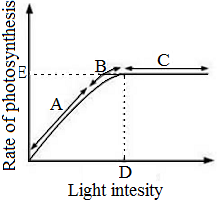
-
40%
a) B → Some factors other than light intensity is becoming limiting factor. D → light intensity.
-
20%
b) B → Light is no longer a limiting factor. D → light intensity.
-
0%
c) B → Light is no longer a limiting factor. D → Some factors other than light intensity is becoming limiting factor.
-
40%
d) B → Some factors other than light intensity is becoming limiting factor. D → Saturation point for light intensity.
Q.22.
The chloroplast stroma lamella membrane:
-
40%
a) Lack PS II as well as NADP reductase enzyme.
-
20%
b) Lack PS II but have NADP reductase enzyme.
-
20%
c) Lack NADP reductase enzyme but have PS II.
-
20%
d) Have PS II as well as NADP reductase enzyme
Q.23.
With reference to factors affecting the rate of photosynthesis, which of the following statements is not correct?
-
33%
a) Light saturation for CO2 -fixation occurs at 10% of full sunlight.
-
0%
b) Increasing atmospheric CO2 concentration upto 0.05% can enhance CO2 -fixation rate
-
67%
c) C3 -plants respond to higher temperature with enhanced photosynthesis, while C4 -plants have much lower temperature optimum.
-
0%
d) Tomato is greenhouse crop, which can be grown in CO2 -enriched atmosphere for higher yield.
Q.24.
Production of NADPH in a chloroplast takes place during
-
20%
a) cyclic photophosphorylation
-
60%
b) non-cyclic photophosphorylation
-
0%
c) series photophosphorylation
-
20%
d) substrate level photophosphorylation.
Q.25.
In Kranz anatomy, the bundle sheath cells have
-
0%
a) thin walls, much intercellular space and no chloroplast
-
100%
b) thick walls, no intercellular spaces and large number of chloroplasts
-
0%
c) thin walls, no intercellular spaces and several chloroplasts
-
0%
d) thick walls, many intercellular space and few chloroplasts
Q.26.
Identify a,b,c and d labelling in the following diagram.
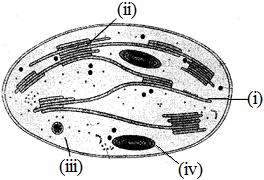
-
0%
a) i - stroma lamella; ii- thylakoid; iii- stroma; iv-genetic material
-
60%
b) i- stroma lamella; ii- grana; iii-stroma; iv-starch granule
-
20%
c) i- grana; ii- lamella; iii-stroma; iv-starch granule
-
20%
d) i- stroma lamella; ii- grana; iii-cytoplasm; iv-starch granule.
Q.27.
In chloroplast the movement of electrons from PS-II to electron transport system is-
-
80%
a) uphill in terms of redox potential scale.
-
0%
b) downhill in terms of redox potential scale.
-
20%
c) from one cytochrome to another
-
0%
d) None of the above.
Q.28.
How many carboxylations and decarboxylations are used for the synthesis of one molecule of glucose in C4 plants?
-
67%
a) One carboxylation in mesophyll, one carboxylation in bundle sheath, one decarboxylation in bundle sheath.
-
0%
b) One carboxylation in mesophyll, one carboxylation in bundle sheath and twelve decarboxylation in bundle sheath.
-
33%
c) Six carboxylation in mesophyll, six carboxylation in bundle sheath and six decarboxylation in bundle sheath.
-
0%
d) One carboxylation in mesophyll, six carboxylation in bundle sheath and one decarboxylation in bundle sheath.
Q.29.
Consider the following statements regarding light phase: (i) In PS I, antenna pigments absorb light in the region of 700nm. (ii) During cyclic electron transport, the excited electrons in the reaction centre does not pass on to NADP but is returned back to PS I. (iii) In PS I, the primary electron acceptor is an unknown compound. (iv) Cyclic photophosphorylation occurs when only light of wavelength below 680nm are available for excitation.
-
0%
a) (i), (ii) and (iii) are false.
-
0%
b) (i), (ii) and (iv) are false.
-
75%
c) (ii), (iii) and (iv) are true.
-
25%
d) (i), (ii) and (iii) are true.
Q.30.
Assertion: The higher concentration of O2 in the atmosphere is inhibitory of photosynthesis. Reason: CO2 is the main substrate for photosynthesis.
-
0%
a) Both Assertion and Reason are true and Reason is the correct explanation of Assertion.
-
100%
b) Both Assertion and Reason are true but Reason is NOT the correct explanation of Assertion.
-
0%
c) Assertion is true but Reason is false.
-
0%
d) Both Assertion and Reason are false.