Q.1.
If photosynthesizing green algae are provided with CO2 synthesized with heavy oxygen (18O), later analysis will show that all but one of the following compounds produced by the algae contain the 18O label. That one is
-
12%
a) PGA.
-
62%
b) RuBP.
-
12%
c) O2.
-
12%
d) PGAL.
Q.2.
In autotrophic bacteria, where are the enzymes located that can carry on organic synthesis?
-
50%
a) along the inner surface of the plasma membrane
-
33%
b) free in the cytosol
-
17%
c) chloroplast membranes
-
0%
d) along the outer edge of the nucleoid
Q.3.
In the thylakoid membranes, what is the main role of the antenna pigment molecules?
-
40%
a) split water and release oxygen to the reaction-center chlorophyll
-
60%
b) harvest photons and transfer light energy to the reaction-center chlorophyll
-
0%
c) synthesize ATP from ADP and Pi
-
0%
d) concentrate photons within the stroma
Q.4.
Suppose the interior of the thylakoids of isolated chloroplasts were made acidic and then transferred in the dark to a pH-8 solution. What would be likely to happen?
-
0%
a) The isolated chloroplasts will make ATP.
-
25%
b) The Calvin cycle will be activated.
-
25%
c) Cyclic photophosphorylation will occur.
-
50%
d) Only A and B will occur.
Q.5.
Synthesis of ATP by the chemiosmotic mechanism occurs during
-
50%
a) photosynthesis.
-
17%
b) photorespiration.
-
17%
c) both photosynthesis and respiration.
-
17%
d) neither photosynthesis nor respiration.
Q.6.
P680+ is said to be the strongest biological oxidizing agent. Why?
-
60%
a) NADP reductase will then catalyze the shift of the electron from Fd to NADP+ to reduce it to NADPH.
-
40%
b) This molecule results from the transfer of an electron to the primary electron acceptor of photosystem II and strongly attracts another electron.
-
0%
c) It is the receptor for the most excited electron in either photosystem.
-
0%
d) It is the molecule that transfers electrons to plastoquinone (Pq) of the electron transfer system.
Q.7.
Carotenoids are often found in foods that are considered to have antioxidant properties in human nutrition. What related function do they have in plants?
-
83%
a) They serve as accessory pigments.
-
0%
b) They dissipate excessive light energy.
-
17%
c) They cover the sensitive chromosomes of the plant.
-
0%
d) They take up toxins from the water.
Q.8.
Where do the enzymatic reactions of the Calvin cycle take place?
-
60%
a) stroma of the chloroplast
-
40%
b) thylakoid membranes
-
0%
c) outer membrane of the chloroplast
-
0%
d) electron transport chain
Q.9.
Produces three-carbon sugars
-
9%
a) light reactions alone
-
64%
b) the Calvin cycle alone
-
27%
c) occurs in the chloroplast but is not part of photosynthesis
-
0%
d) neither the light reactions nor the Calvin cycle
Q.10.
Which of the following set of elements are essential for the photosynthesis to occurs
-
0%
a) Cu, Co, Fe
-
0%
b) Cu, Mo, Zn
-
40%
c) Mg, Co, Mn
-
60%
d) Mg, Fe, Mn, Cu, Cl, P
Q.11.
When chloroplasts align perpendicular to the incident light:
-
100%
a) For maximum absorption.
-
0%
b) For minimum absorption.
-
0%
c) At the time of solarisation.
-
0%
d) At the time of photo oxidation.
Q.12.
What are the products of the light reactions that are subsequently used by the Calvin cycle?
-
80%
a) ATP and NADPH
-
20%
b) oxygen and carbon dioxide
-
0%
c) carbon dioxide and RuBP
-
0%
d) electrons and photons
Q.13.
In chloroplast, the site of NADP and NADP reductase respectively:
-
40%
a) Grana and stroma.
-
0%
b) Stroma lamellae and stroma.
-
60%
c) Stroma and grana lamellae.
-
0%
d) Fret and stroma.
Q.14.
Which of the following are special features of the C4 plants? I. They have a special type of leaf anatomy. II. They tolerate higher temperatures and show a response to high light intensities. III. They lack photorespiration and have greater productivity of biomass.
-
33%
a) Only I and II
-
0%
b) Only I and III
-
0%
c) Only II and III
-
67%
d) I, II and III
Q.15.
Suppose the interior of the thylakoid of isolated chloroplasts and then transferred in the dark to a pH 8 solution. What would be likely to happen?
-
100%
a) The isolated chloroplasts will make ATP
-
0%
b) The Calvin cycle will be activated.
-
0%
c) The cyclic photophosphorylation will occur
-
0%
d) Isolated chloroplasts will generate oxygen gas
Q.16.
PGA as the first CO2 fixation was discovered in photosynthesis of
-
40%
a) bryophyte
-
0%
b) gymnosperm
-
60%
c) angiosperm
-
0%
d) alga
Q.17.
Consider the following statements: (i) Maximum photosynthesis occur in polychromatic light. (ii) At the temperature above 35°C, photorespiration occurs in both C3 and C4 plants. (iii) In C2 pathway, both first stable product and substrate are formed within the chloroplasts. (iv) NADP reductase is found in the inner surface of the thylakoid membrane. Of the above statements:
-
0%
a) Both (i) and (ii) are false.
-
100%
b) Both (i) and (iii) are true.
-
0%
c) All except (i) are false.
-
0%
d) (i), (ii), (iii) and (iv) are false.
Q.18.
Chemiosmotic hypothesis proposed by Peter Mitchell describes the mechanism of synthesis of:
-
50%
a) NADH.
-
0%
b) FADH2.
-
50%
c) ATP.
-
0%
d) GTP.
Q.19.
All the following regarding the role of xanthophylls and Carotenoids in photosynthesis are correct except:
-
0%
a) They act as accessory pigments
-
33%
b) Their peak absorption is in blue and red regions of VIBGYOR
-
67%
c) They enable a wider range of wavelength of incoming light to be utilized for photosynthesis
-
0%
d) They protect chlorophyll a form of photo-oxidation.
Q.20.
Consider the following two statements: I. Except for plants in shade or in dense forests, light is rarely a limiting factor in nature for photosynthesis. II. Light saturation occurs at 50% of the full sunlight.
-
25%
a) Both statements are correct and II explains I
-
0%
b) Both statements are incorrect
-
75%
c) I is correct and II is incorrect
-
0%
d) I is incorrect and II is correct
Q.21.
Carbon dioxide is necessary for photosynthesis. The chemical used to remove this gas most effectively from entering a control apparatus is
-
0%
a) calcium oxide
-
50%
b) distilled water
-
50%
c) potassium hydroxide solution
-
0%
d) sodium carbonate.
Q.22.
The _____________ in the leaves, have a large number of_________, which align themselves along the walls of the ____________, such that they get the __________quantity of the incident light.
-
50%
a) chloroplasts, chlorophyll, chloroplasts, optimum
-
0%
b) mesophyll cells, chlorophyll, mesophyll cells, optimum.
-
50%
c) mesophyll cells, chloroplasts, mesophyll cells, optimum.
-
0%
d) mesophyll cells, chloroplasts, mesophyll cells, minimum.
Q.23.
What is correct about C4 plant? p. They have special type of leaf anatomy q. They tolerate high temperature r. They lack a process called photorespiration s. Have lesser productivity t. Show no response to highlight intensities
-
50%
a) pst
-
0%
b) qrst
-
0%
c) prst
-
50%
d) pqr.
Q.24.
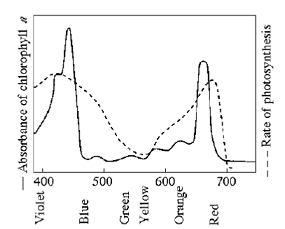
Following figure shows the absorption spectrum for chlorophyll a and the action spectrum for photosynthesis. Why are they different?
-
50%
a) Green and yellow wavelengths inhibit the absorption of red and blue wavelengths.
-
50%
b) Bright sunlight destroys photosynthetic pigments.
-
0%
c) Oxygen given off during photosynthesis interferes with the absorption of light.
-
0%
d) Other pigments absorb light in addition to chlorophyll a.
Q.25.
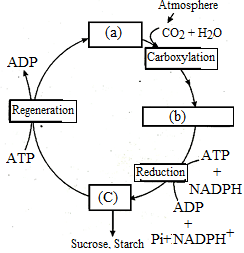
Choose the correct combinations of labelling the carbohydrate molecule involved in the Calvin cycle:
-
0%
a) (a) – RuBP, (b) – Triose phosphate, (c) – PGA.
-
0%
b) (a) – PGA, (b) – RuBP, (c) – Triose phosphate.
-
0%
c) (a) – PGA, (b) – Triose phosphate, (c) – RuBP.
-
100%
d) (a) – RuBP, (b) – PGA, (c) – Triose phosphate.
Q.26.
The alternative pathways of photosynthesis using the C4 or CAM systems are said to be compromises. Why?
-
0%
a) Each one minimizes both water loss and rate of photosynthesis.
-
0%
b) C4 compromises on water loss and CAM compromises on photorespiration.
-
0%
c) Each one both minimizes photorespiration and optimizes the Calvin cycle.
-
0%
d) CAM plants allow more water loss, while C4 plants allow less CO2 into the plant.
Q.27.
Which of the following is true regarding alignment of chloroplast in the cytoplasm in accordance with light availability?
| Align perpendicular to the incident light for maximum absorption. | Intermittent light in atmosphere. |
| Align perpendicular to the cell wall for maximum absorption. | Intermittent light in atmosphere |
| Align parallel to the cell wall for minimum absorption. | Continuous strong light in the atmosphere |
| Align parallel to the cell wall for maximum absorption. | Flashing light in the atmosphere |
| Align parallel to the incident light for maximum absorption. | Continuous weak light in the atmosphere. |
-
0%
a) 1 and 4.
-
0%
b) 2 and 5.
-
100%
c) 5 only.
-
0%
d) 3 only.
Q.28.
In a plant cell, where are the ATP synthase complexes located?
-
0%
a) thylakoid membrane
-
50%
b) plasma membrane
-
0%
c) inner mitochondrial membrane
-
50%
d) A and C
Q.29.
Which of the following pigments exhibit complementary chromatic adaptations? (i) Chlorophyll a only. (ii) Xanthophylls. (iii) Carotene. (iv) Phycobilins. (v) All chlorophylls.
-
0%
a) (v) only.
-
17%
b) (i) only.
-
50%
c) (iv) only.
-
33%
d) ii), (iii), (iv) and (v).
Q.30.
Photorespiration is different from respiration in which aspect:
-
0%
a) Photorespiration takes place in green plants but respiration occurs only in animals.
-
0%
b) Photorespiration is linked with ATP generation.
-
0%
c) Photorespiration is restricted only in C3 plants.
-
0%
d) Photorespiration is restricted only in CAM plants.