Q.1.
The Calvin cycle proceeds in three stages: (i) Reduction, during which carbohydrate is formed at the expense of the photochemically made ATP and NADPH. (ii) Regeneration, during which the carbon dioxide acceptor ribulose – 1, 5 – biphosphate is formed. (iii) Carboxylation, during which carbon dioxide combines with ribulose – 1, 5 – biphosphate is formed. The correct sequence is:
-
0%
a) (iii) → (i) → (ii).
-
0%
b) (iii) → (ii) → (i).
-
100%
c) (i) → (ii) → (iii).
-
0%
d) (ii) → (i) → (iii).
Q.2.
Which of the following statement is true regarding primary carboxylation enzyme in C4 plants: (i) Found only in cells having chloroplast without granum. (ii) Found only in cells having chloroplasts with granum. (iii) Found in chloroplasts with granum and without granum. (iv) Function → carboxylation of 4 carbon compound. (v) Found in the mesophyll cells in Bell pepper.
-
0%
a) Both (i) and (v).
-
0%
b) Both (ii) and (v).
-
33%
c) (i), (iv) and (v).
-
67%
d) Only (ii).
Q.3.
Consider the following statements regarding oxysomes: (i) CF1 is a catalytic site and composed of 5 different polypeptides. (ii) CF0 is embedded in the lipid bilayer and it is hydrophobic. (iii) CF0 is a proton pump. (iv) CF0 is a proton translocater through which proton flows under the pressure of the PMF. Of the above statements:
-
100%
a) Only (i) and (ii) are true.
-
0%
b) Only (i) is true.
-
0%
c) Only (iii) is true.
-
0%
d) Only (iv) is true.
Q.4.
Which of the following is false regarding non – cyclic electron transport?
-
0%
a) Electrons excited from PS II goes to PS I and then to Ferrodoxin and there is negligible chance to go to NADP but most probably electron returned back to PS I.
-
33%
b) Electrons from PS II goes to PS I and from PS I to Ferrodoxin and there is a chance to go to PS I but most probably electrons go to NADP.
-
67%
c) Electrons from PS II goes back to PS I and from PS I to Ferrodoxin and strictly go to NADP and there is no chance to return back to PS I.
-
0%
d) Electrons from PS II goes to PS I and from PS I to Ferrodoxin and there is equal chance to go to NADP and PS I.
Q.5.
How many of the following statements are false: (i) In both chloroplasts and mitochondria, ATP synthase complex have the same overall architecture and probably nearly identical catalytic sites. (ii) 3 – PGA is the connecting link between photorespiration and Calvin cycle in C3 plants. (iii) Photorespiration occurs predominantly in both C3 and C4 plants. (iv) Bell pepper possess Kranz anatomy in their leaves.
-
0%
a) One.
-
0%
b) Two.
-
100%
c) Three
-
0%
d) Four.
Q.6.
Consider the following statements regarding Chlorophyll a molecule: (i) Molecular formula of chlorophyll a is C55H72O5N4Mg. (ii) First developed in cyanobacteria. (iii) Found in all photosynthetic bacteria except green sulphur bacteria, purple sulphur bacteria and purple non sulphur bacteria. (iv) Found in the reaction centre, core and antenna region. Which of these statements are false?
-
100%
a) (i) and (iii) only.
-
0%
b) (iii) and (iv) only.
-
0%
c) (iii) only.
-
0%
d) (iv) only.
Q.7.
NADP is:
-
25%
a) An electron acceptor.
-
0%
b) A proton acceptor.
-
75%
c) Proton pumping channel.
-
0%
d) Both electron and proton acceptor.
Q.8.
The electron deficiency of PS II is compensated by:
-
0%
a) Splitting of water in the stroma and provided electrons to PS II.
-
0%
b) Splitting of water in periplastidal space of thylakoid and provided electrons to PS II.
-
100%
c) Photolysis of water in the lumen of thylakoid and provided electrons to PSII.
-
0%
d) Photolysis of water in the frets and provided electrons to PS II.
Q.9.
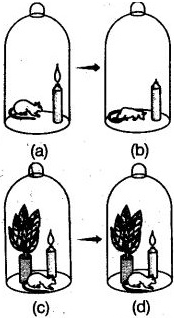
The figure given below represents an experimental set-up. What could be drawn as a conclusion from this experiment?
-
0%
a) Plants require chlorophyll for the complete liberation of gases for the animals to survive.
-
100%
b) Plants restore to air whatever breathing animals and burning candles remove.
-
0%
c) Light is a limiting factor and hence is required in a large quantity.
-
0%
d) Green plants and not purple sulphur and green sulphur bacteria release O2 as a reduced product of water.
Q.10.
In C4 plants, Calvin cycle operates in the:
-
0%
a) Grana of bundle sheath chloroplast.
-
100%
b) Grana of Mesophyll chloroplast.
-
0%
c) Stroma of bundle sheath chloroplast.
-
0%
d) Stroma of Mesophyll chloroplast.
Q.11.
hich of the following statements is not true with regard to the light reaction of photosynthesis? (i) In PS II, the reaction centre chlorophyll a has an absorption peak at 700nm, hence is called P (ii) In PS I, the reaction centre chlorophyll a has an absorption peak at 680nm, hence is called P (iii) The splitting of water molecule is associated with PS I. (iv) Photosystem I and II are involved in Z – scheme. (v) Lamellae of the grana have PS I and PS II and stroma lamellae membrane has only PS II.
-
0%
a) (i), (ii), (iv) and (v).
-
0%
b) (i), (ii), (iii) and (v).
-
0%
c) (ii), (iii) and (iv).
-
100%
d) (i), (ii) and (iii).
Q.12.
Compared to retinal, chlorophyll can be described as a pigment that has a
-
0%
a) narrow absorption range but high efficiency
-
0%
b) narrow absorption range but low efficiency
-
0%
c) wide absorption range but high efficiency
-
0%
d) wide absorption range but low efficiency
Q.13.
Which of the following statements is correct?
-
0%
a) Photorespiration is useful process
-
100%
b) C4 plants are more efficient than C3 plants.
-
0%
c) C3 plants are more efficient than C4 plants.
-
0%
d) Photorespiration is absent in C3 plants but present in C4 plants.
Q.14.
Photosynthetic bacteria have
-
0%
a) pigment system I
-
0%
b) pigment system II
-
100%
c) Both (1) and (2)
-
0%
d) some other kind of pigments, B890
Q.15.
Which of the following statement is incorrect?
-
0%
a) Electrons to PS-I are provided by PS-II
-
0%
b) Electrons to PS-II are provided by splitting of water
-
100%
c) Electrons to PS-I are provided by splitting of water
-
0%
d) PS-II is physically located on the inner side of the membrane of thylakoid.
Q.16.
In the C4 plants, C4 cycle occurs in the mesophyll cells and C3 cycle occurs in the bundle sheath cells, whereas in CAM plants:
-
0%
a) C4 and C3 cycles occurs only in the mesophyll cells.
-
100%
b) C3 cycle occurs in the mesophyll cells and C4 cycle occurs in the bundle sheath cells.
-
0%
c) C4 cycle occurs very rarely.
-
0%
d) C4 and C3 cycles occur only in the bundle sheath cells.
Q.17.
Phosphorylation mainly occurs due to:
-
0%
a) Expenditure of external ATP only.
-
100%
b) Proton motive force only.
-
0%
c) Both external ATP and proton motive force.
-
0%
d) Proton pumping only.
Q.18.
Following table summarize the difference between light reaction and dark reaction: Which of the above pairs of difference is/are correct?
| Light reactions | Dark reactions |
| (a)These are also called as biosynthetic phase | These are also called as photochemical phase |
| (b) These reactions occur over thylakoids. | These reactions occur in the stroma of chloroplasts. |
| (c) These produce assimilatory powers i.e., NADPH2 and ATP. | These consume NADPH2 and ATP. |
| (d) These are directly dependent upon light. | These depend upon the products synthesised during light reactions. |
-
0%
a) (a) and (d) only.
-
100%
b) (c) and (d) only.
-
0%
c) (d) only.
-
0%
d) (a) only.
Q.19.
How many of them are wrong? p. RuBisCO is the most abundant enzyme in plants only. q. RuBisCO has active site for O2 only s. C3 cycle in C4 plants occur in Bundle sheath cells.
-
0%
a) 2
-
100%
b) 3
-
0%
c) 1
-
0%
d) 0.
Q.20.
In chlorophyll a molecule, a third carbon of 2nd pyrol ring is attached to:
-
100%
a) Carboxyl group.
-
0%
b) Magnesium.
-
0%
c) Methyl group.
-
0%
d) Aldehyde group.
Q.21.
Consider the following statements regarding Calvin cycle: I. The carboxylation of the organic acceptor molecule followed by hydrolysis to generate two molecules of 3 – phosphoglyceric acid. II. The regeneration of the initial acceptor molecule thereby allowing continuous carbon assimilation. III. Calvin cycle operates in day time. IV. The required energy for Calvin cycle is obtained from both cyclic and non – cyclic electron transport reaction. Of the above statements:
-
0%
a) Only III is false.
-
0%
b) Both I and III are false.
-
0%
c) All except II are true.
-
0%
d) All statements are true.
Q.22.
How many of the following statements are true: (i) PS II is a strong oxidant. (ii) Chlorophyll are more stable pigments than Carotenoids. (iii) Proton pumping requires metabolic energy. (iv) Mg – Porphyrin head of chlorophyll is hydrophilic. (v) Oxygenic photosynthesis first started in photosynthetic protists.
-
0%
a) One.
-
0%
b) Two.
-
0%
c) Three.
-
0%
d) Five.
Q.23.
he rate oh photosynthesis decreases if the wavelength of visible light exceeds 680nm. This was shown by which scientist and what is its reason:
-
0%
a) Blackman – Limiting law.
-
0%
b) Calvin and Benson – Photo oxidation.
-
100%
c) Emerson and Arnold – Red drop.
-
0%
d) Ruben and Kamen – Photolysis.
Q.24.
In photosynthesis: 6CO2 + X → C6H12O6 + 6H22 + Y. X and Y respectively are:
-
0%
a) 12H2O and 2O2.
-
0%
b) 6H2O and 12O2.
-
100%
c) 12H2O and 6O2.
-
0%
d) 12H2O and 12O2.
Q.25.
The process of photosynthetic phosphorylation was described by:
-
100%
a) Blackman.
-
0%
b) Hill.
-
0%
c) Arnon.
-
0%
d) Benson.
Q.26.
Which stage of the Calvin Cycle utilizes ATP?
-
0%
a) Carboxylation
-
0%
b) Reduction
-
67%
c) Regeneration
-
33%
d) Both 1 and 2
Q.27.
C4 -plants are more efficient in photosynthesis than C3 -plants due to
-
0%
a) higher leaf area
-
100%
b) presence of larger number of chloroplasts in the leaf cells.
-
0%
c) presence of thin cuticle
-
0%
d) lower rate of photorespiration
Q.28.
Match following Which of the following shows the correct match?
| Column I | Column II |
| (i) Jan Ingenhousz. | (a) Discovery of O2. |
| (ii) Joseph Priestly | (b) Plants restore to the air, whatever breathing animals and burning candles remove. |
| (iii) T. W Engelmann | (c) Showed that only the green part of the plant could release oxygen. |
| (iv) Julius Von Sachs. | (d) Discovery of production of glucose in plants |
| - - - - | (e) Using a prism, he split light into its spectral components and then illuminated Cladophora, placed in a suspension of aerobic bacteria |
-
100%
a) i-c; ii-b; iii-a, e, f; iv-d
-
0%
b) i-a, b; ii-c; iii-d; iv- e, f.
-
0%
c) i-a; ii- b; iii- c, e; iv-f.
-
0%
d) i-c, ii-a, b; iii-e, f; iv-d;
Q.29.
If plant gene alterations cause the plants to be deficient in photorespiration, what would most probably occur?
-
0%
a) Cells would carry on more photosynthesis.
-
0%
b) Cells would carry on the Calvin cycle at a much slower rate.
-
0%
c) Less ATP would be generated.
-
0%
d) There would be more light-induced damage to the cells.
Q.30.
What is incorrect about bundle sheath cells-
-
0%
a) Multilayered
-
0%
b) large number of chloroplasts
-
100%
c) Intercellular spaces
-
0%
d) Thick walls