Q.1.
Isotopes employed to study photosynthesis are:
-
20%
a) 11C and 32P.
-
40%
b) 15C and 32P.
-
0%
c) 16C and 15O.
-
40%
d) 14C and 18O.
Q.2.
Bacteriochlorophyll differs from chlorophyll a in having:
-
0%
a) One pyrol with one hydrogen.
-
67%
b) One pyrol with two hydrogen.
-
33%
c) One pyrol with three hydrogen.
-
0%
d) One pyrol with four hydrogen.
Q.3.
Which of the following is not true regarding the light reaction of photosynthesis?
-
0%
a) Photolysis of water occurs due to the electron deficiency in PS II.
-
20%
b) The flow of electrons from water to NADP in non – cyclic electron transport produces one ATP.
-
0%
c) Involvement of two Photosystems are needed for the reduction of NADP.
-
80%
d) P680 and P700 are the reaction centres of PS I and PS II respectively.
Q.4.
Consider the following statements: (i) Glycolysis yield only 5% of the total ATP production and less than 7% of the total energy content of glucose. (ii) Primary electron acceptor of PS II is located only in outer surface of the thylakoid membrane. (iii) PAR is the best quality of light for efficient synthesis of glucose. Of the above statements:
-
50%
a) All statements are false.
-
50%
b) All statements are true.
-
0%
c) All except (i) are true.
-
0%
d) All except (iii) are true.
Q.5.
Emerson's enhancement effect and red drop have been instrumental in the discovery of
-
75%
a) two photo systems operating simultaneously
-
25%
b) photophosphorylation and cyclic electron transport.
-
0%
c) Oxidative phosphorylation
-
0%
d) photophosphorylation and non-cyclic electron transport
Q.6.
The C4 plants grow very efficiently in warm climates because they
-
20%
a) consume fewer ATP molecules for glucose synthesis
-
20%
b) minimize photorespiratory losses
-
20%
c) have more efficient chloroplasts
-
40%
d) contain enzymes which are not inactivated at high temperatures.
Q.7.
How statements are correct? i. Products of dark reaction are substrates of light reaction ii. Products of light reaction are substrates of dark reaction iii. In stroma, enzymatic reactions incorporate CO2 into the plant leading to the synthesis of sugar iv. dark reactions are light independent v. chloroplast is single membranous organelle.
-
33%
a) 2
-
0%
b) 3
-
67%
c) 4
-
0%
d) 1
Q.8.
When proton motive force degenerates, where does the conformational- changes take place?
-
75%
a) F0 of ATPase
-
25%
b) F1 of ATPase
-
0%
c) PS I
-
0%
d) PS II
Q.9.
A plant has a unique photosynthetic pigment. The leaves of this plant appear to be reddish yellow. What wavelengths of visible light are being absorbed by this pigment?
-
0%
a) red and yellow
-
33%
b) blue and violet
-
33%
c) green and yellow
-
33%
d) blue, green, and red
Q.10.
What wavelength of light in the figure is most effective in driving photosynthesis?
-
33%
a) 420 mm
-
0%
b) 475 mm
-
0%
c) 575 mm
-
67%
d) 625 mm
Q.11.
Photorespiration lowers the efficiency of photosynthesis by preventing the formation of
-
25%
a) carbon dioxide molecules.
-
75%
b) 3-phosphoglycerate molecules
-
0%
c) ATP molecules.
-
0%
d) RuBP carboxylase molecules.
Q.12.
Which of the following is the copper containing connecting plug between PS I and PS II?
-
0%
a) Pheophytin.
-
33%
b) PlastoQuinone – A.
-
0%
c) PlastoQuinone – B.
-
67%
d) Plastocyanin.
Q.13.
Match the phenomenon listed under column I with those listed under column II. Select the correct answer from the options given.
| column I | column II |
| A. Warburg effect | p. Change in gene frequency by chance |
| B. Pasteur effect | q. Postponing severance in the leaves by applying Cytokinin |
| C. Emerson effect | r. Decline in the consumption of respiratory substrate due to a change from anaerobic to aerobic respiration |
| D. Wright effect | s. Inhibitory effect of O2 on photosynthesis |
| t. Enhancement of photosynthesis by subjecting chlorophyll to the effect two different wavelengths of light |
-
0%
a) A = s, B = t, C = q, D = r
-
0%
b) A = s, B = r, C = t, D = p
-
0%
c) A = t, B =s, C = p, D = q
-
100%
d) A= t, B = r, C = p, D = s
Q.14.
Identify the cyclic process given below and label the parts:
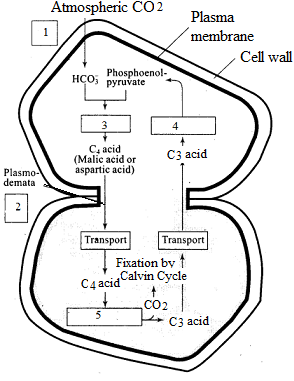
-
0%
a) 1 – Mesophyll cells, 2 – Bundle sheath cells, 3 – Regeneration, 4 – Fixation, 5 – Decarboxylation
-
0%
b) 1 – Bundle sheath cells, 2 – Mesophyll cells, 3 – Fixation, 4 – Regeneration, 5 - Decarboxylati
-
50%
c) 1 – Mesophyll cells, 2 – Bundle sheath cells, 3 – Decarboxylation, 4 – Fixation, 5 – Regeneration
-
50%
d) 1 – Mesophyll cells, 2 – Bundle sheath cells, 3 – Fixation, 4 – regeneration, 5 – Decarboxylatio
Q.15.
Photorespiration shows formation of
-
0%
a) sugar but not ATP
-
0%
b) ATP but not sugar
-
50%
c) both ATP and sugar
-
50%
d) neither ATP nor sugar.
Q.16.
Which of the following statement is true regarding the proton pump in thylakoid membrane?
-
100%
a) Only one type of proton pump is present which is located towards the inner surface of the membrane.
-
0%
b) More than one type of proton pumps are present which are found at the outer surface of the membrane.
-
0%
c) Only one type of proton pumps are present which is found at the outer surface of the membrane.
-
0%
d) More than one type of proton pumps are present which are found at the inner surface only
Q.17.
Which of the following statements is false regarding photosynthesis?
-
0%
a) The enzymes which are responsible for light independent reactions of photosynthesis are located in the stroma.
-
0%
b) In the process of photosynthesis, the first storage product is starch.
-
100%
c) C2 cycle is a universal process present in all green cells.
-
0%
d) A cell that lacks chloroplast does not evolve O2.
Q.18.
Assertion: Protons or hydrogen ions produced by photolysis of water accumulate in the lumen of thylakoid. Reason: Photolysis of water takes place in inner membrane of thylakoid.
-
50%
a) Both Assertion and Reason are true and Reason is the correct explanation of Assertion.
-
50%
b) Both Assertion and Reason are true but Reason is NOT the correct explanation of Assertion.
-
0%
c) Assertion is true but Reason is false.
-
0%
d) Both Assertion and Reason are false.
Q.19.
Where does the Calvin cycle take place?
-
50%
a) stroma of the chloroplast
-
0%
b) thylakoid membrane
-
0%
c) cytoplasm surrounding the chloroplast
-
50%
d) chlorophyll molecule
Q.20.
What is the relationship between wavelength of light and the quantity of energy per photon?
-
50%
a) They have a direct, linear relationship.
-
0%
b) They are inversely related.
-
0%
c) They are logarithmically related.
-
50%
d) They are separate phenomena.
Q.21.
Photorespiration is favoured by
-
50%
a) high O2 and low CO2 concentration
-
0%
b) low O2 and high CO2 concentration
-
50%
c) low light intensity
-
0%
d) low temperature.
Q.22.
At about what percentage of the full sunlight does light saturation occurs in photosynthesis?
-
100%
a) 10
-
0%
b) 25
-
0%
c) 70
-
0%
d) 95
Q.23.
Which one of the following organisms is correctly matched with its three characteristics?
-
50%
a) Pea- C3 -pathway, endospermic seed, Vexillary aestivation
-
0%
b) Tomato- twisted aestivation, axile placentation, and berry
-
0%
c) Onion- Bulb, imbricate aestivation, axile placentation
-
50%
d) Maize- C3 -pathway, closed vascular bundle, Scutellum
Q.24.
Reduction of NADP+ occurs during
-
0%
a) photosynthesis.
-
50%
b) respiration.
-
50%
c) both photosynthesis and respiration.
-
0%
d) neither photosynthesis nor respiration.
Q.25.
A plant in your garden avoids photorespiratory losses, has improved water use efficiency, shows high rates of photosynthesis at high temperatures and has improved efficiency of nitrogen utilization. In which of the following physiological groups would you assign this plant?
-
0%
a) C4
-
67%
b) CAM
-
33%
c) Nitrogen-fixer
-
0%
d) C3
Q.26.
Which of the following are the inhibitors of cyclic electron transport system? (i) Monuron. (ii) Diuron. (iii) DCMU. (iv) Antrazine. (v) Paraquat.
-
0%
a) All of these.
-
0%
b) (iii) only.
-
0%
c) (v) only.
-
100%
d) (i), (ii) and (iv).
Q.27.
Maximum fluorescence is exhibited by:
-
0%
a) Carotenoids.
-
33%
b) Chl a.
-
33%
c) Chl b.
-
33%
d) All of the above.
Q.28.
The basic feature of typical C4 plants showing Kranz anatomy is:
-
0%
a) The presence of chloroplasts in mesophyll and epidermal cells.
-
0%
b) The presence of chloroplasts in bundle sheath cells.
-
100%
c) The presence of agranal chloroplasts in bundle sheath cells and typical chloroplasts with well – formed grana in mesophyll cells.
-
0%
d) The presence of typical chloroplasts with well formed grana in bundle sheath cells and rudimentary chloroplasts in the mesophyll cells
Q.29.
Some photosynthetic bacteria (e.g., purple sulfur bacteria) have photosystem I but not II, while others (e.g. cyanobacteria) have both PSI and PSII. Which of the following might this observation imply?
-
0%
a) Photosystem II must have been selected against in some species.
-
50%
b) Photosystem I must be more ancestral.
-
50%
c) Photosystem II may have evolved to be more photoprotective.
-
0%
d) Cyclic flow must be more primitive than linear flow of electrons.
Q.30.
Which statement is correct?
-
100%
a) The relative levels of O2 and CO2 determine the occurrence of photorespiration.
-
0%
b) Increased CO2 level increases the photorespiration.
-
0%
c) Photorespiration occurs in C4 plants.
-
0%
d) Increased O2 level decreases the photorespiration.