Q.1.
In thylakoids, protons travel through ATP synthase from the stroma to the thylakoid space. Therefore the catalytic ʺknobsʺ of ATP synthase would be located
-
0%
a) on the side facing the thylakoid space.
-
0%
b) on the ATP molecules themselves.
-
50%
c) on the pigment molecules of PSI and PSII.
-
50%
d) on the stroma side of the membrane.
Q.2.
What is the primary function of the Calvin cycle?
-
0%
a) use ATP to release carbon dioxide
-
0%
b) use NADPH to release carbon dioxide
-
67%
c) split water and release oxygen
-
33%
d) synthesize simple sugars from carbon dioxide
Q.3.
Oxidative phosphorylation is
-
50%
a) formation of ATP by transfer of phosphate group from a substrate to ADP
-
0%
b) oxidation of phosphate group in ATP
-
50%
c) addition of phosphate group to ATP
-
0%
d) formation of ATP by energy release from electrons removed during substrate oxidation.
Q.4.
The most common isotope used for studying photosynthesis:
-
0%
a) C13.
-
100%
b) C14.
-
0%
c) C15.
-
0%
d) C16.
Q.5.
The correct sequence of cell organelles during photorespiration is
-
50%
a) chloroplast-Golgi bodies-mitochondria
-
0%
b) chloroplast-rough endoplasmic reticulum-dictyosomes
-
50%
c) chloroplast-mitochondria-peroxisomes
-
0%
d) chloroplast-vacuole-peroxisomes
Q.6.
Where does exactly the NADP reductase enzyme located?
-
0%
a) Thylakoid lumen
-
0%
b) Thylakoid luminal side of membrane
-
100%
c) Stromal side of thylakoid membrane
-
0%
d) Cytoplasm
Q.7.
Chloroplasts contain maximum of:
-
0%
a) RuBP carboxylase.
-
0%
b) PEPcase.
-
0%
c) hexokinase.
-
100%
d) All of these.
Q.8.
In mitochondria, chemiosmosis translocates protons from the matrix into the intermembrane space, whereas in chloroplasts, chemiosmosis translocates protons from
-
0%
a) the stroma to the photosystem II.
-
0%
b) the matrix to the stroma.
-
100%
c) the stroma to the thylakoid space.
-
0%
d) the intermembrane space to the matrix.
Q.9.
Generation of proton gradients across membranes occurs during ...
-
0%
a) photosynthesis.
-
100%
b) respiration.
-
0%
c) both photosynthesis and respiration.
-
0%
d) neither photosynthesis nor respiration.
Q.10.
Which of the following statements best represents the relationships between the light reactions and the Calvin cycle?
-
0%
a) The light reactions provide ATP and NADPH to the Calvin cycle, and the cycle returns ADP, Pi, and NADP+ to the light reactions.
-
0%
b) The light reactions provide ATP and NADPH to the carbon fixation step of the Calvin cycle, and the cycle provides water and electrons to the light reactions.
-
100%
c) The light reactions supply the Calvin cycle with CO2 to produce sugars, and the Calvin cycle supplies the light reactions with sugars to produce ATP.
-
0%
d) The light reactions provide the Calvin cycle with oxygen for electron flow, and the Calvin cycle provides the light reactions with water to split.
Q.11.
Produces NADH
-
0%
a) light reactions alone
-
0%
b) the Calvin cycle alone
-
100%
c) both the light reactions and the Calvin cycle
-
0%
d) neither the light reactions nor the Calvin cycle
Q.12.
Radioactive isotope of oxygen (O18) was used to know the source of oxygen released through photosynthesis by:
-
0%
a) Hill.
-
50%
b) Van Neil.
-
50%
c) Ruben and Kamen.
-
0%
d) Hatch and Slack.
Q.13.
Why proton pump are essential in thylakoid membrane?
-
0%
a) Membrane is differentially permeable with rich in galactose containing lipids.
-
50%
b) Membrane is selectively permeable with rich in galactose containing lipids.
-
0%
c) Membrane is semi permeable with rich in equal amounts of galactose containing lipids and phospholipids.
-
50%
d) All of these are true.
Q.14.
In any ecosystem, terrestrial or aquatic, what group(s) is (are) always necessary?
-
0%
a) autotrophs and heterotrophs
-
0%
b) producers and primary consumers
-
0%
c) photosynthesizers
-
0%
d) autotrophs
Q.15.
Electrons from excited chlorophyll molecule of Photosystem-II are accepted first by
-
0%
a) cytochrome-b
-
0%
b) cytochrome-f
-
100%
c) quinone
-
0%
d) Ferrodoxin
Q.16.
How many of the following are true? (i) Photosynthesis cannot continue for long if during light reaction only cyclic photophosphorylation takes place. This is because only ATP is formed. (ii) Photosystem II comprises equal amount of Chlorophyll a and chlorophyll b. (iii) In non – cyclic electron transport, only one ATP is formed during downhill electron transport because of the absence of Ferrodoxin. (iv) PS II is a strong oxidant.
-
0%
a) One.
-
0%
b) Two.
-
0%
c) Three.
-
0%
d) Four.
Q.17.
Kranz anatomy is:
-
0%
a) Wreath like arrangement of cells in which the vascular bundles are surrounded by mesophyll cells.
-
0%
b) Wreath like arrangement of cells in which the vascular bundles are surrounded by spongy parenchyma cells.
-
100%
c) Wreath like arrangement of cells in which the vascular bundles are surrounded by bundle sheath cells.
-
0%
d) Wreath like arrangement of cells in which the vascular bundles are surrounded by palisade parenchyma cells.
Q.18.
Which of the following are directly associated with photosystem I?
-
0%
a) harvesting of light energy by ATP
-
0%
b) receiving electrons from plastocyanin
-
100%
c) receiving electrons from plastocyanin
-
0%
d) extraction of hydrogen electrons from the splitting of water
Q.19.
How many of the following statements are true: (i) Carbon dioxide is the major limiting factor of photosynthesis. (ii) In monochromatic light, maximum photosynthesis occurs in red light followed by blue and least photosynthesis in green light. (iii) Water stress causes the stomata to close. (iv) In all plants, photosynthesis is inhibited at 0°C.
-
0%
a) 1
-
0%
b) 2
-
100%
c) 3.
-
0%
d) 4.
Q.20.
As a research scientist, you measure the amount of ATP and NADPH consumed by the Calvin cycle in 1 hour. You find 30,000 molecules of ATP consumed, but only 20,000 molecules of NADPH. Where did the extra ATP molecules come from?
-
0%
a) photosystem II
-
0%
b) photosystem I
-
100%
c) cyclic electron flow
-
0%
d) linear electron flow
Q.21.
Cyclic electron flow may be photoprotective (protective to light-induced damage). Which of the following experiments could provide information on this phenomenon?
-
0%
a) using mutated organisms that can grow but that cannot carry out cyclic flow of electrons and compare their abilities to photosynthesize in different light intensities
-
0%
b) using plants that can carry out both linear and cyclic electron flow, or only one or another of thee processes, and measuring their light absorbance
-
0%
c) using bacteria that have only cyclic flow and look for their frequency of mutation damage
-
0%
d) using bacteria with only cyclic flow and measuring the number and types of photosynthetic pigments they have in their membranes
Q.22.
Requires CO2
-
0%
a) light reactions alone
-
0%
b) the Calvin cycle alone
-
100%
c) both the light reactions and the Calvin cycle
-
0%
d) neither the light reactions nor the Calvin cycle
Q.23.
ATP synthesis is linked to-
-
0%
a) Development of electron gradient
-
0%
b) Development of atomic gradient
-
100%
c) Development of proton gradient
-
0%
d) Flow of electrons across the membrane
Q.24.
A plant is kept in 300ppm CO2 concentration. What will happen to it?
-
100%
a) Plant will die soon.
-
0%
b) Plant will grow but will not die.
-
0%
c) Plant will show normal photosynthesis.
-
0%
d) Respiration will be greatly decreased.
Q.25.
When oxygen is released as a result of photosynthesis, it is a by-product of which of the following?
-
0%
c) chemiosmosis
-
0%
a) reducing NADP+
-
100%
b) splitting the water molecules
-
0%
d) the electron transfer system of photosystem I
Q.26.
Find out the mismatched pair:
-
0%
a) Julius Von Sachs – Evidence for production of glucose when plants grow.
-
0%
b) Cornelius van Neil – Have studied photosynthesis in purple and green sulphur bacteria.
-
0%
c) Blackman – Law of limiting factors.
-
100%
d) Melvin Calvin – C4 cycle.
Q.27.
Photosynthetic bacteria do not contain
-
100%
a) quantasome
-
0%
b) PS-I and PS-II
-
0%
c) PS-II
-
0%
d) PS-I.
Q.28.
In photorespiration, glycolate is converted into serine and carbon dioxide in:
-
100%
a) Mitochondria
-
0%
b) Chloroplasts
-
0%
c) Vacuoles
-
0%
d) Peroxisomes
Q.29.
Absorption spectrum of chlorophyll- ‘a’ is shown by-
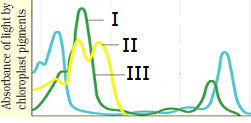
-
100%
a) i
-
0%
b) ii
-
0%
c) iii
-
0%
d) Not shown.
Q.30.
NADP is reduced to NADPH in:
-
0%
a) PS I.
-
0%
b) PS II.
-
0%
c) Calvin cycle.
-
100%
d) Non cyclic photophosphorylation.