Q.1.
With regarding to C4 plants, every C4 cycle requires 2 ATP due to:
-
0%
a) Phosphodikinase enzyme present in bundle sheath.
-
100%
b) Phosphodikinase enzyme present in mesophyll cells.
-
0%
c) Phosphoenol pyruvic acid present in mesophyll cells.
-
0%
d) RuBisco present only in bundle sheath cells.
Q.2.
Identify the true statements: I. Immediate emission of light energy → phosphorescence. II. Chlorophyll a molecule has maximum fluorescence activity. III. All photosynthetic pigments have fluorescence. IV. Fluorescence is essential for the excitation of reaction centres.
-
0%
a) I and III.
-
100%
b) I, III and IV only.
-
0%
c) All except I.
-
0%
d) I, II and III.
Q.3.
Which of the following is true regarding photo-oxidation?
-
0%
a) Destruction of chlorophyll due to high light intensity.
-
100%
b) Destruction of chlorophyll due to high wavelength of light.
-
0%
c) Destruction of chlorophyll due to high wavelength of light → above 700nm.
-
0%
d) Destruction of chlorophyll due to high wavelength of light → above 750nm.
Q.4.
Which of the following is true regarding Carotenoids? (i) Dissolved in lipids/fats. (ii) More stable than chlorophyll. (iii) Provide protection to chlorophyll from solarisation. (iv) β – carotene is found predominantly in higher plants.
-
0%
a) (iv) only.
-
0%
b) (iii) only.
-
100%
c) (i) and (iii) only.
-
0%
d) All of these.
Q.5.
Type of photophosphorylation in which PS I alone participates:
-
100%
a) Cyclic photophosphorylation.
-
0%
b) Non – cyclic photophosphorylation
-
0%
c) Oxidative photophosphorylation.
-
0%
d) Substrate level photophosphorylation.
Q.6.
In Chlorophyll molecule, phytol tail is present at the:
-
0%
a) 3rd carbon of IInd ring.
-
0%
b) 2nd carbon of IIIrd ring.
-
0%
c) 7th carbon of IVth ring.
-
0%
d) 3rd carbon of IVth ring.
Q.7.
What are the products of linear photophosphorylation?
-
0%
a) heat and fluorescence
-
0%
b) ATP and P700
-
0%
c) ATP and NADPH
-
0%
d) ADP and NADP
Q.8.
Where are the molecules of the electron transport chain found in plant cells?
-
0%
a) thylakoid membranes of chloroplasts
-
0%
b) stroma of chloroplasts
-
0%
c) inner membrane of mitochondria
-
0%
d) matrix of mitochondria
Q.9.
Nine-tenth of all photosynthesis in the world (85-90%) is carried out by:
-
0%
a) Large trees with millions of branches and leaves.
-
0%
b) Algae of the ocean.
-
0%
c) Chlorophyll containing ferns of the forest
-
0%
d) Scientists in laboratory conditions.
Q.10.
Which of the following statements are true? (i) Photochemical reaction centre directly produce chemical energy. (ii) Photochemical reaction centre indirectly produce chemical energy. (iii) The chemical energy produced during photochemical reactions are ATP and NADPH2.
-
0%
a) (i) only.
-
0%
b) (ii) and (iii).
-
0%
c) (i) and (iii) only.
-
0%
d) (iii) only.
Q.11.
What is the role of NADP+ in photosynthesis?
-
0%
a) As part of the electron transport chain, it manufactures ATP.
-
0%
b) It assists Photosystem II in the splitting of water.
-
0%
c) It acts as the hydrogen acceptor for the Photosystems.
-
0%
d) It carries electrons to the Calvin cycle.
Q.12.
In C4 plants, saturation point is about:
-
0%
a) 50% full sunlight and 500ppm of CO2.
-
0%
b) 50% full sunlight and 450ppm of CO2
-
0%
c) 360ppm of CO2
-
0%
d) 450ppm of CO2 only.
Q.13.
Which of the following statements are true: (i) In chloroplast, creation of proton gradient requires metabolic energy. (ii) LHC comprises of antenna and core pigments. (iii) Quantasomes of PS I consists of 230 chlorophyll a. (iv) NADP reductase found in the membrane of both grana and stroma lamellae. (v) Carotenoids are more stable than chlorophyll.
-
0%
a) All except (i).
-
100%
b) All except (iv).
-
0%
c) All except (ii) and (iv).
-
0%
d) Nil.
Q.14.
How many molecules of glycine are required for the evolution of one molecule of CO2 during photorespiration?
-
0%
a) One.
-
0%
b) Two.
-
0%
c) Three.
-
0%
d) Six.
Q.15.
In normal chloroplasts, the percentage of chlorophyll is:
-
0%
a) 5 – 10%.
-
0%
b) 20%.
-
0%
c) 55%.
-
0%
d) 98%.
Q.16.
he terminal process involved in the fixation of CO2 at the level of carbohydrate can be considered as:
-
0%
a) Carboxylation.
-
0%
b) Reduction.
-
0%
c) Regeneration.
-
0%
d) Product synthesis phase.
Q.17.
Decreased rate photosynthesis at high concentration of oxygen is referred as:
-
0%
a) Richard Lang effect.
-
0%
b) Warburg effect.
-
100%
c) Emerson effect.
-
0%
d) Pasteur effect.
Q.18.
There is double fixation of CO2 in C4 and CAM plants. Which of the following statements brings out the main difference between the two?
-
0%
a) Carboxylation enzymes are different
-
0%
b) Fixation pathways are different.
-
0%
c) CO2 fixation in C4 plants is separated by space whereas in CAM plants it is separated by time.
-
100%
d) The compensation points are different.
Q.19.
How statements are correct? i. chlorophyll-a , xanthophylls and Carotenoids are called as accessory pigments. ii. accessory pigments protect chlorophyll-a from photo-oxidation. iii. chlorophyll a are the major pigments responsible for trapping of light iv. chl-a and chl-b forms the reaction centre v. chl-a transfers the energy to accessory pigments.
-
0%
a) 2
-
100%
b) 3
-
0%
c) 4
-
0%
d) 5
Q.20.
What will happen to the rate of photosynthesis if sodium bicarbonate is added in the water having Hydrilla plant in a beaker:
-
0%
a) It will remain normal.
-
0%
b) It will be decreased.
-
0%
c) It will be stopped.
-
0%
d) It will be accelerated.
Q.21.
Given figure depict the light harvesting complex (LHC) of Photosystem I (PS I). Select the correct option for (a), (b) and (c).
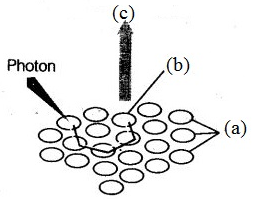
-
0%
a) (a) – Antenna molecule, (b) – P680, (c) – Primary electron acceptor.
-
0%
b) (a) – Antenna molecule, (b) – P700, (c) – Primary electron acceptor.
-
0%
c) (a) – Primary electron acceptor, (b) – P680, (c) – Reaction centre.
-
0%
d) (a) - Reaction centre, (b) – P700, (c) – Antenna molecules.
Q.22.
Identify (i), (ii) and (iii) in the following step of Calvin cycle:
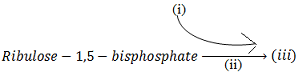
-
0%
a) (i) – Triose phosphate, (ii) ADP, (iii) Reduction.
-
0%
b) (i) ATP + NADPH, (ii) CO2, (iii) Starch.
-
0%
c) (i) Starch, (ii) Oxygenase, (iii) NADPH.
-
0%
d) (i) CO2 + H2O, (ii) Carboxylation, (iii) 3 – phosphoglycerate.
Q.23.
_______ are placed one above the other to form stack of coins
-
0%
a) oxysomes
-
0%
b) F1 particles
-
0%
c) cristae
-
0%
d) thylakoids
Q.24.
Rubisco is an enzyme for
-
0%
a) CO2 fixation in dark reaction
-
0%
b) photorespiration
-
0%
c) regeneration of RuBP
-
0%
d) photolysis of water
Q.25.
During dark reaction, for the fixation of carbon, the three carbon atoms of each molecule of 3 – phosphogylceric acid (PGA) are derived from
-
0%
a) RuBP only
-
0%
b) CO2 only
-
0%
c) RuBP + CO2
-
0%
d) RuBP + CO2 + PEP.
Q.26.
Plants are removed from patients room at night because
-
0%
a) they produce CO2 at night in more concentration
-
0%
b) they produce CO2 all the time but release O2 also in day time
-
0%
c) they consume O2 at night.
-
0%
d) they do not photosynthesize at night, therefore fail to deplete CO2 of the room, hence their presence will increase CO2
Q.27.
The process of ATP formation from ADP in the presence of light in chloroplast is called
-
0%
a) phosphorylation
-
0%
b) autophosphorylation
-
0%
c) photophosphorylation
-
0%
d) chemophosphorylation
Q.28.
Sugar moves in phloem vessels as ______.
-
0%
a) cellulose
-
0%
b) glucose
-
0%
c) starch
-
0%
d) sucrose
Q.29.
In which of the following light, rate of photosynthesis is maximum?
-
0%
a) white
-
0%
b) discontinuous white
-
0%
c) red
-
0%
d) blue
Q.30.
Which is sensitive to longer wavelength of light?
-
0%
a) Photolysis
-
0%
b) PSI
-
0%
c) PS II
-
0%
d) Photophosphorylation