Q.1.
Gibberrelin participate in which of the following process?
-
0%
a) Growth of internodes
-
50%
b) Removal of seed dormancy
-
0%
c) Developing seed less fruit
-
50%
d) All of the above
Q.2.
Movement of cilia in Drocera, depends on which factor ?
-
0%
a) Light
-
0%
b) Temperature
-
50%
c) Touch
-
50%
d) Osmosis
Q.3.
By which action a seed coat becomes permeable to water ... ...
-
0%
a) scarification
-
0%
b) stratification
-
50%
c) vernalization
-
50%
d) all of the above
Q.4.
Which hormone is responsible for fruit ripening?
-
100%
a) ethylene
-
0%
b) auxin
-
0%
c) ethyl chloride
-
0%
d) cytokinin
Q.5.
ABA is involved in ... ...
-
50%
a) shoot elongation
-
0%
b) increased cell division
-
50%
c) dormancy of seeds
-
0%
d) root elongation
Q.6.
The closing and opening of the leaves of Mimosa pudica is due to ... ....
-
50%
a) seismonastic movement
-
50%
b) chemonastic movement
-
0%
c) thermonastic movement
-
0%
d) hydrotropic movement.
Q.7.
Phytochrome becomes active in ....
-
50%
a) red light
-
50%
b) green light
-
0%
c) blue light
-
0%
d) none of these
Q.8.
A pigment which absorbs red and far-red light is ... ....
-
0%
a) Cytochrome
-
50%
b) xanthophyll
-
50%
c) phytochrome
-
0%
d) carotene.
Q.9.
The twining of tendrils around a support is a good example of
-
0%
a) phototropism
-
50%
b) chemotropism
-
50%
c) nastic movements
-
0%
d) thigmotropism.
Q.10.
If the growing plant is decapitated, then .... ....
-
0%
a) its growth stops
-
50%
b) leaves become yellow and fall down
-
0%
c) axillary buds are inactivated
-
50%
d) axillary buds are activated
Q.11.
Which is produced during water stress that brings stomatal closure?
-
50%
a) ethylene
-
50%
b) abscisic acid
-
0%
c) ferulic acid
-
0%
d) coumarin
Q.12.
Flowering dependent on cold treatment is ......
-
0%
a) cryotherapy
-
0%
b) cryogenics
-
0%
c) cryoscopy
-
100%
d) vernalisation
Q.13.
Twining of tendrils is due to ... ....
-
50%
a) thigmotropism
-
50%
b) seismonasty
-
0%
c) heliotropism
-
0%
d) diageotropism
Q.14.
Phytohormones are ... ...
-
0%
a) chemical regulation flowering
-
50%
b) chemical regulation secondary growth
-
0%
c) hormones regulating growth from seed to adulthood
-
50%
d) regulators synthesised by plants and influencing physiological processes.
Q.15.
Mowing grass lawn facilities better maintenance because ....
-
50%
a) wounding stimulates regeneration
-
50%
b) removal of apical dominance and stimulation of intercalary meristem
-
0%
c) removal of apical dominance
-
0%
d) removal of apical dominance and promotion of lateral meristem.
Q.16.
Which one increases in the absence of light?
-
0%
a) uptake of minerals
-
0%
b) uptake of water
-
50%
c) elongation of intemodes
-
50%
d) ascent of sap.
Q.17.
Bioassay for auxin is ... ... [ MPPMT 1999 ]
-
50%
a) Dwarf maize test
-
50%
b) Avena curvature test
-
0%
c) Cell division test
-
0%
d) Green leaf test
Q.18.
Apical dominance is caused by ... ... [ CEBSE 1992]
-
0%
a) Abscisic acid in lateral bud
-
0%
b) Cytokinin in leaf tip
-
50%
c) Gibberellin in lateral buds
-
50%
d) Auxin in shoot tip
Q.19.
What is the site of perception of photoperiod necessary for induction of flowering in plants? [NEET 2019]
-
0%
a) Lateral buds
-
0%
b) Pulvinus
-
100%
c) Shoot apex
-
0%
d) Leaves
Q.20.
Count the number of true statements: (i) Application of gibberellins help early seed production in conifers. (ii) All synthetic auxins are widely used as herbicides. (iii) Kinetin promotes cytokinesis. (iv) IAA acts antagonistic to GA. (v) Gibberellins delay senescence of fruits.
-
0%
a) 1
-
0%
b) 2
-
100%
c) 3
-
0%
d) 4
Q.21.
One of these is herbicide ... .... [ Manipal 2005]
-
0%
a) IAA
-
0%
b) NAA
-
0%
c) GA3
-
100%
d) 2,4-D
Q.22.
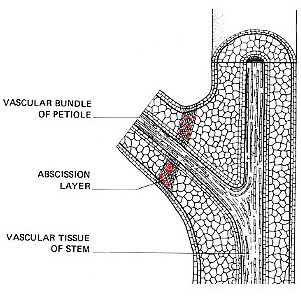
Leaf fall occurs when content of ... .. [ AIIMS 1990 ]
-
100%
a) Abscisic acid decreases
-
0%
b) Auxin decreases
-
0%
c) Auxin increases
-
0%
d) Gibberellin decreases
Explanation
Q.23.
Find out the true statements about vernalization: (i) It is the promotion of flowering by a period of low temperature (ii) It prevents precocious reproductive development early in the growing season (iii) It is a process of shortening of the reproductive phase. (iv) In vernalization by cold treatment, winter varieties can be transformed into spring or autumn varieties.
-
0%
a) (i), (ii) and (iii).
-
50%
b) (i) and (iii).
-
50%
c) (ii) (iii) and (iv)
-
0%
d) (i), (iii) and (iv)
Q.24.
ead the following statements: (i) Cytokinin help in lateral shoot growth. (ii) Ethylene influences horizontal growth of seedlings. (iii) ABA plays an important role in seed development. (iv) Ethylene promotes root growth and shoot hair formation. Of the above statements:
-
0%
a) (i), (ii) and (iii) are correct.
-
0%
b) (iii) and (iv) are correct
-
50%
c) (ii), (iii) and (iv) are correct
-
50%
d) (ii) and (iii) are correct
Q.25.
One hormone promotes abscission of flowers while the other delay senescence of fruits. These are respectively:
-
50%
a) Auxin and Cytokinin.
-
0%
b) Ethylene and Abscisic acid
-
50%
c) Abscisic acid and Ethylene
-
0%
d) Ethylene and Gibberellic acid
Q.26.
Flowering in short day plants is induced by:
-
0%
a) Short days and interrupted long nights
-
100%
b) Short days and uninterrupted long nights
-
0%
c) Long days and interrupted short nights
-
0%
d) Long days and uninterrupted short nights
Q.27.
Geometrical growth rate is expressed mathematically as W1 = W0ert, where (i) W1 = final size. (ii) W0 = initial size. (iii) r = growth rate. (iv) t = time of growth. (v) e = exponential growth. How many of the above are correct:
-
0%
a) 5
-
0%
b) 3
-
100%
c) 2
-
0%
d) 4
Q.28.
Arithmetic growth curve is linear because:
-
100%
a) One daughter cell remains meristematic and others differentiates and mature
-
0%
b) Both daughter cells remains meristematic.
-
0%
c) Both daughter cells get matured
-
0%
d) None of the above
Q.29.
On the basis of the information mentioned, select the correct name of phytohormones for a,b and c respectively: (i) Hormone (a) helps in initiation of root and root hair formation at low concentration. (ii) Hormone (b) helps in increasing the size of apple. (iii) Hormone (c) helps in initiation of senescence and bud dormancy.
-
0%
a) a-auxin, b-Gibberellin, c-Ethylene
-
50%
b)a-Cytokinin, b-Zeatin, c-ABA.
-
0%
c) a-IAA, b-Ethylene, c-Cytokinin.
-
50%
d) a-Ethylene, b-Gibberellin, c-ABA.
Q.30.
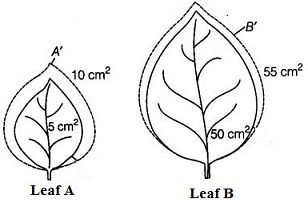
The figure below shows growth of two leaves in one week. Select the correct option, if RGR = relative growth rate and AGR = Absolute growth rate.
-
100%
a) RGR of A = 5%, AGR of A = 100%, RGR of B= 5%, AGR of B = 100%
-
0%
b) RGR of A = 50%, AGR of A = 5%, RGR of B= 50%, AGR of B = 5%.
-
0%
c) RGR of A = 10%, AGR of A = 5%, RGR of B= 100%, AGR of B = 5%.
-
0%
d) RGR of A = 100%, AGR of A = 5%, RGR of B= 10%, AGR of B = 5%
Q.31.
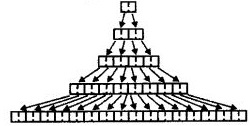
The figure represents which type of growth:
-
0%
a) Arithmetic.
-
100%
b)Geometric.
-
0%
c) Linear
-
0%
d) Hyperbolic
Q.32.
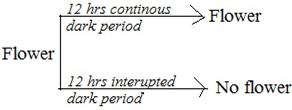
In which category will you place this flower?
-
100%
a) SDP
-
0%
b) LDP
-
0%
c) DNP
-
0%
d) L-SDP.
Q.33.
In geometrical growth (from beginning to last), the correct sequence of growth phases and their occurrence are:
-
0%
a) Log phase → Lag phase → Asymptote.
-
0%
b) Asymptote → Log phase → Lag phase
-
50%
c) Lag phase → Exponential phase → Asymptote
-
50%
d) Lag phase → Exponential phase → Log phase.
Q.34.
Rate of growth stops and plants die at a temperature of
-
0%
a) 20-30°C
-
0%
b) 10-20°C
-
0%
c) 35-40°C
-
100%
d) 5-10°C
Q.35.
Effect of auxin diffusing from apical bud on lateral shoots is known as
-
50%
a) promoting effect
-
0%
b) compensatory effect
-
0%
c) inhibitory effect
-
50%
d) supporting effect
Q.36.
All of the following are plant growth inhibitors except;
-
0%
a) ABA
-
0%
b) Dormin
-
50%
c) Ethylene
-
50%
d) IAA
Q.37.
The changes that tracheary elements undergo to conduct water to long distances;
-
0%
a) Lose protoplasm.
-
100%
b) Develop very strong lignocellulosic secondary walls
-
0%
c) Develops very strong lignocellulosic primary walls
-
0%
d) Both A and B.
Q.38.
What is the maximum period of growth:
-
50%
a) Slow growth rate
-
0%
b) Steady growth rate
-
50%
c) Speedy growth rate
-
0%
d) Senescence
Q.39.
In some plants, the leaves of juvenile plant are different in shape from those in mature plants. This is the Heterophylly due to phase of life and seen in:
-
100%
a) Cotton, coriander, buttercup
-
0%
b) Butter cup and larkspur.
-
0%
c) Buttercup only
-
0%
d) Cotton, coriander, larkspur
Q.40.
he PGRs can be broadly classified into two groups based on their functions in living plant body. One group of PGRs are involved in growth promoting activities, such as cell division, cell enlargement, pattern formation, tropic growth flowering, fruiting and seed formation. These are also called:
-
50%
a) Plant growth regulators
-
50%
b) Plant growth promoters
-
0%
c) Plant growth inhibitors
-
0%
d) Plant growth supporters
Q.41.
If requisite period of low temperature treatment is followed by a period of high temperature, the expected acceleration of flowering did not occur. This process is known as:
-
0%
a) Photophosphorylation
-
0%
b) Dedifferentiation
-
50%
c) Devernalization
-
50%
d) Vernalization
Q.42.
Consider the following statements: (i) In climacteric fruits, ethylene production is high. (ii) Gibberellin is present in a healthy stem causes some of the new cells to differentiate as phloem. (iii) Loss of turgor in guard cell indicates the formation of Abscisic acid. Which of the following statements given above are correct?
-
50%
a) (i) and (ii) only.
-
0%
b) (ii) and (iii) only
-
50%
c) (i) and (iii) only
-
0%
d) (i), (ii) and (iii)
Q.43.
Match the list I with list II and select the correct answer using the codes given below:
| List I | List II |
| a) Increase in wall elongation | Gibberellins |
| b) Bolting and flowering | Auxins |
| c) Phloem transport | Abscisic acid |
| d) Stoppage of cambium activity | Cytokinin. |
-
0%
a) a → 2 , b →1 , c →3 , d →4
-
50%
b) a → 2 , b →1 , c →4 , d →3
-
50%
c) a → 1 , b →2 , c →4 , d →3
-
0%
d) a → 1 , b → 2 , c →3 , d →4
Q.44.
One set of a plant was grown at 8 hours day and 16 hours night period cycles and it flowered while in the other set night phase was interrupted by flash of light and it did not produce flower. Under which one of the following categories will you place this plant?
-
50%
a) Darkness neutral
-
0%
b) Day neutral
-
50%
c) Short day
-
0%
d) Long day
Q.45.
Study the statements (i) – (iv) given below and select the two correct ones out of them: (i) Mathematical expression of geometric growth rate is W1 = W0ert. (ii) Photoperiodism does not affect reproduction in plants. (iii) Mathematical expression of arithmetic growth is Lt = L0 + L1 – rt. (iv) The cells of meristematic region is rich in protoplasm, possess large nucleus and having lignocellulosic cell wall. The two correct statements are:
-
0%
a) (ii) and (iii).
-
0%
b) (i) and (iv)
-
100%
c) (iii) and (iv)
-
0%
d) (i) and (ii)
Q.46.
hat causes a green plant exposed to the light on only one side, to bend towards the source of light as it grows?
-
50%
a) Green plants seek light because they are phototropic
-
0%
b) Light stimulates plant cells on the lighted side to grow faster
-
0%
c) Auxin accumulates on the shaded side, stimulating greater cell elongation there
-
50%
d) Green plants need light to perform photosynthesis
Q.47.
You are given a tissue with its potential for the differentiation in an) artificial culture. Which of the following pairs of hormones would you add to the medium to secure shoots as well as roots?
-
50%
a) IAA and Gibberellin
-
50%
b) Auxin and Cytokinin
-
0%
c) Auxin and Abscisic acid
-
0%
d) Gibberellin and Abscisic acid
Q.48.
Dr. F.W Went noticed that if coleoptile tips were removed and placed on agar for one hour, the agar would produce a bending when placed on one side of freshly cut coleoptile stumps. Of what significance is this experiment?
-
0%
a) It demonstrated the polar movement of auxin.
-
100%
b) It made possible the isolation and exact identification of auxin
-
0%
c) It is the basis for quantitative determination of small amount of growth promoting substances
-
0%
d) It supports the hypothesis that IAA is auxin
Q.49.
A few normal seedlings of tomato were kept in a dark room. After a few days, they were found to have become white coloured like albinos. Which of the following will terms will you use to describe them?
-
0%
a) Defoliated
-
50%
b) Mutated
-
0%
c) Embolised
-
50%
d) Etiolated
Q.50.
The avena curvature test is used for bioassay of:
-
0%
a) GA3
-
100%
b) IAA
-
0%
c) Ethylene
-
0%
d) ABA