Q.1.
Glycolysis is … … [ AIIMS 1996]
-
54%
a) C6H12O6 + 6O2 → 6CO2 + 6H2O
-
16%
b) C6H12O6 → 2 C2H5OH + 2CO2
-
20%
c) C6H12O6 → 2C3H4O3 + 4H+
-
9%
d) C3H4O3 + NADH → C2H5OH + CO2 + NAD+
Q.2.
oxygenation activity of RuBisCo enzyme in photorespiration leads to the formation of [NEET 2020]
-
15%
a) 1 molecule of 6-C compound
-
30%
b) 1 molecule of 4-C compound and 1 molecule of 2-C compound
-
40%
c) 2 molecules of 3-C compound
-
15%
d) 1 molecule of 3-C compound
Q.3.
Conversion of glucose to glucose-6-phosphate, the first irreversible reaction of glycolysis, is catalyzed by .... [NEET 2019]
-
12%
a) Aldolase
-
58%
b) Hexokinase
-
9%
c) Enolase
-
21%
d) Phosphofructokinase
Q.4.
What is the role of NAD+ in cellular respiration ? [NEET 2018]
-
27%
a) It is a nucleotide source for ATP synthesis.
-
38%
b) It functions as an electron carrier.
-
9%
c) It functions as an enzyme.
-
26%
d) It is the final electron acceptor for anaerobic respiration.
Q.5.
Which of these statements is incorrect ? [NEET 2018]
-
13%
a) Glycolysis operates as long as it is supplied with NAD that can pick up hydrogen atoms.
-
25%
b) Glycolysis occurs in cytosol.
-
22%
c) Enzymes of TCA cycle are present in mitochondrial matrix.
-
40%
d) Oxidative phosphorylation takes place in outer mitochondrial membrane.
Q.6.
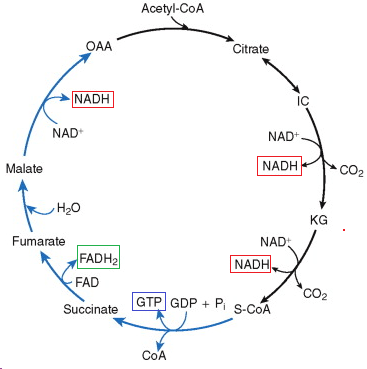
The number of substrate level phosphorylations in one turn of citric acid cycle is .... [NEET 2020]
-
43%
a) Two
-
26%
b) Three
-
8%
c) Zero
-
23%
d) One
Q.7.
n mitochondria, protons accumulate in … .. [ CBSE mains 2011]
-
28%
c) inner membrane
-
9%
a) outer membrane
-
44%
b) Intermembrane space
-
19%
d) matrix
Q.8.
Oxidative phosphorylation refers to .. .. [ DPMT 2009]
-
12%
a) Anaerobic production of ATP
-
35%
b) Citric acid cycle production of ATP
-
44%
c) Production of ATP by chemiosmosis
-
9%
d) Alcoholic fermentation
Q.9.
Match the columns … … [ kerla 2008]
| a) 4C compound | 1.Acetyl CoA |
| b) 2C Compound | 2.Pyruvate |
| c) 5C Compound | Citric acid |
| d) 3C Compound | α-ketoglutaric acid |
| -- -- | 5.Malic acid |
-
8%
a) a – 2, b – 5, c – 3, d – 1
-
56%
b) a – 5, b – 1, c – 4, d – 2
-
27%
c) a – 3, b – 1, c – 4, d – 2
-
8%
d) a – 5, b – 3, c -1, d – 2
Q.10.
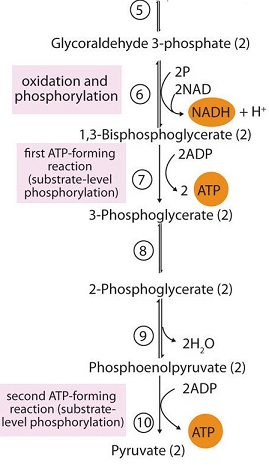
How many molecules of NADH are produced when four molecules of phosphoglyceraldehyde are converted into four molecules of pyruvate … .. [ Bih PMT 2006]
-
25%
a) 2
-
7%
b) 6
-
30%
c) 8
-
39%
d) 4
Explanation
Q.11.
Cell respiration is carried out by … .. [ Odisha 2004]
-
78%
a) mitochondria
-
11%
b) Golgi bodies
-
7%
c) Ribosomes
-
4%
d) Chloroplasts
Q.12.
Which one is the last electron acceptor over ETC in oxidative phosphorylation … ..[ AIIMS 2002]
-
10%
a) H2
-
48%
b) Cyt a3
-
22%
c) Cytb
-
20%
d) CO2
Q.13.
When malic acid is respiratory substrate, the amount of CO2 released is … ..[ EAMCET 2002]
-
41%
a) More than O2 consumed
-
24%
b) Less than O2 released
-
19%
c) Equal to O2 consumed
-
16%
d) CO2 is not released
Q.14.
The number of ATP molecules produced by electron transport system from Krebs cycle intermediates in a single turn is … …[ AMU 1999]
-
18%
a) 11
-
39%
b) 12
-
29%
c) 14
-
14%
d) 16
Explanation
Q.15.
Krebs cycle forms an important product .. .. [ AIIMS 1996]
-
24%
a) Acetyl CoA
-
14%
b) ADP
-
61%
c) ATP
-
2%
d) Water
Q.16.
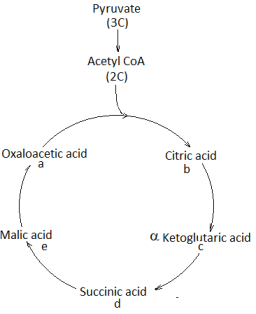
Choose the correct combination of labeling the number of carbon compounds in the substrate molecules involved in citric acid cycle … [ kerala 2006]
-
54%
a) a – 4C, b – 6C, c – 5C, d -4C, e – 4C
-
29%
b) a – 6C, b – 5C, c – 4C, d – 3C, e – 2C
-
9%
c) a – 2C, b – 3C, c – 4C, d- 5C, e – 6C
-
9%
d) a – 4C, b – 5C, c – 4C, d – 5C, e – 4C
Q.17.
Mitochondrial electron transport chain is … ..[ JIPMER 2003]
-
35%
a) Cyclic phosphorylation
-
48%
b) Oxidative phosphorylation
-
10%
c) Matrix of mitochondria
-
6%
d) Oxysomes
Q.18.
What is R.Q. of the reaction? .. ..[ Manipal 2005] 2C51H98O6 +145O2 → 102CO2 + 98 H2O
-
70%
a) 0.7
-
19%
b) 1.0
-
4%
c) 1.45
-
7%
d) 1.62
Q.19.
Which of the following statements is /are not true? … [ Kerala 2006] a) One ATP yields 32Kj of energy b) Pentose phosphate pathway was discovered by Dickens c) When tripalmitin is used as substrate, R.Q. is 0.7 d) Energy released by one molecule of glucose on complete oxidation corresponds to 1292KJ
-
31%
a) a, b and d
-
35%
b) a and d
-
27%
c) c and d
-
8%
d) a, c and d
Q.20.
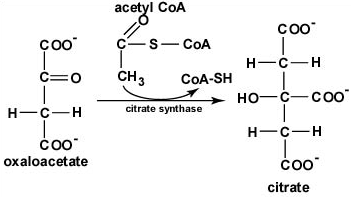
Acetyl CoA forms a 6-C compound after combining with … .. [ BHU 2007]
-
7%
a) Malic acid
-
30%
b) Citric acid
-
10%
c) Succinic acid
-
53%
d) Oxaloacetic acid
Explanation
Q.21.
A reaction catalysed by an enzyme not found in mitochondrial matrix … …[ EAMCET 2008]
-
44%
a) Conversion of pyruvic acid to acetyl CoA
-
16%
b) Oxidative decarboxylation of α-ketoglutaric acid
-
28%
c) Oxidation of succinic acid
-
12%
d) Cleavage of succinyl CoA
Q.22.
Which is product of oxidative pentose phosphate pathway .. ..[ kerala 2007]
-
29%
a) Pyruvic acid
-
29%
b) Acetyl CoA
-
25%
c) NADH2
-
17%
d) NAD(P)H
Q.23.
Energy releasing process in which substrate is oxidized without an external electron acceptor is … … [ CBSE 2008]
-
4%
a) Aerobic respiration
-
44%
b) Fermentation
-
24%
c) Photorespiration
-
28%
d) Glycolysis
Q.24.
Citric acid cycle is … … step in carbohydrate metabolism … .. [ CET Chd. 2010]
-
24%
a) First
-
52%
b) Second
-
24%
c) Third
-
0%
d) Fourth
Q.25.
Which processes of Krebs cycle are associated with both decarboxylation and dehydrogenation … ..[ Guj CET 2010]
-
8%
a) Succinate → Fumarate, Fumarate → Malate
-
21%
b) Malate → Oxaloacetate, Succinate → Fumarate
-
29%
c) α-Ketoglutaric acid → Succinate, Malate → Oxaloacetate
-
42%
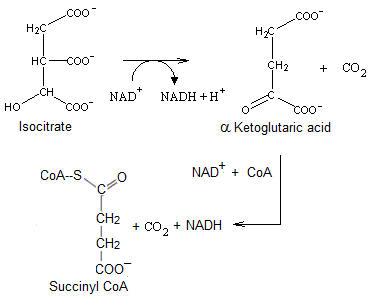
d) Isocitrate → α-Ketoglutaric acid, α-Ketoglutaric acid → Succinate
Explanation
Q.26.
What is correct about the following statements …[ kerala 2012] a) Glycolysis occurs in cytoplasm of the cell b) Aerobic respiration occurs inside mitochondria c) ETS occurs in outer mitochondrial membrane d) C51H98O6 is tripalmitin e) RQ = volume of CO2 eliminated/volume of O2 consumed
-
18%
a) a, b and d are correct
-
18%
b) b,c and d are correct
-
0%
c) c,d and e are correct
-
64%
d) a,b,d and e are correct
Q.27.
TCA cycle is named after … … [AFMC 2012]
-
5%
a) Embden
-
5%
b) Emerson
-
82%
c) Krebs
-
9%
d) Calvin
Q.28.
Enzyme helping in oxidative decarboxylation of pyruvic acid is … … [ AMU 1992]
-
4%
a) Pyruvic kinase
-
88%
b) Pyruvic dehydrogenase
-
4%
c) Malate dehydrogenase
-
4%
d) Succinic dehydrogenase
Q.29.
Oxidation of a molecules of acetyl CoA produces … ..[ RPMT 1990]
-
56%
a) 12 ATP
-
7%
b) 15 ATP
-
30%
c) 6 ATP
-
7%
d) 19 ATP
Q.30.
R.Q. for glucose/ carbohydrate is … ..[ Bih. PMT 1990]
-
62%
a) 1
-
17%
b) 0.5
-
17%
c) 2
-
4%
d) 0.05