Q.1.
End product of glycolysis is .. .. [ JIPMER 1990]
-
24%
a) Acetyl CoA
-
71%
b) Pyruvic Acid
-
5%
c) Glucose 1-phosphate
-
0%
d) Fructose 1-phosphate
Q.2.
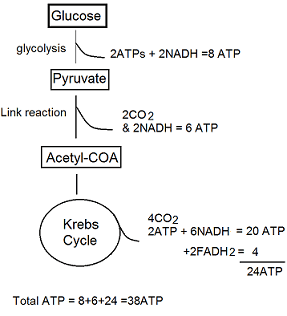
Out of 36ATP molecules produced per glucose molecule during respiration … … [ CBSE 1991]
-
33%
a) 2 are produced outside glycolysis and 34 during respiratory chain
-
33%
b) 2 are produced outside mitochondria and 34 inside mitochondria
-
14%
c) 2 during glycolysis and 34 during Krebs cycle
-
19%
d) All are formed inside mitochondria
Explanation
Q.3.
Glycolysis and TCA cycle operate respectively in … … [ CBSE 1994]
-
52%
a) Cytosol and matrix of mitochondrion
-
14%
b) Cytosol and stroma of chloroplast
-
10%
c) Cytosol and oxysomes of mitochondrion
-
24%
d) Matrix of mitochondrion and inner membrane of mitochondrion
Q.4.
Mitochondrial matrix has enzyme for .. .. [ AMU 1996]
-
26%
a) Krebs cycle
-
47%
b) TCA cycle and electron transport
-
0%
c) Glycolysis and TCA cycle
-
26%
d) Both b and c
Q.5.
Which theory explains ATP synthesis in chloroplasts and mitochondria? … ..[ CBSE 1997]
-
18%
a) Lipman and Lohmann theory
-
12%
b) Lock and Key theory of Fischer
-
12%
c) Induced fit theory of Koshland
-
59%
d) Chemi-osmotic theory of Mitchell
Q.6.
General formula for aerobic respiration is … .. [ JIPMER 1998]
-
20%
a) 6CO2 + 6H2O → C6H12O6 + 6O2
-
53%
b) C6H12O6 + 6O2 → 6CO2 + 6H2O + 686 kcal
-
13%
c) C6H12O6 → 2C2H5OH + 2CO2 + 2ATP
-
13%
d) C6H12O6 → 2C3H6O3 + 2ATP
Q.7.
Oxidative phosphorylation occurs during … ..[ Manipal 2001]
-
18%
a) Photosynthesis
-
18%
b) Protein synthesis
-
65%
c) Respiration
-
0%
d) Lipid synthesis
Q.8.
Anaerobic respiration following glycolysis is … ..[ BHU 2006]
-
6%
a) Krebs cycle
-
12%
b) Oxidative phosphorylation
-
59%
c) Fermentation
-
24%
d) Both a and b
Q.9.
In respiration .. .. [ Manipal 2002]
-
71%
a) 2PGAL are formed in glycolysis and none in Krebs cycle
-
24%
b) 6 PGAL in glycolysis, 3 PGAL in Krebs cycle
-
0%
c) 8 PGAL in glycolysis, 3 PGAL in Krebs cycle
-
6%
d) PGAL formation does not occur in respiration
Q.10.
Pasteur effect is … .. [ Wardha 2005]
-
38%
a) Stoppage of fermentation in presence of oxygen
-
38%
b) Increase of fermentation in presence of oxygen
-
8%
c) Decrease in fermentation is presence of oxygen
-
15%
d) No effect of fermentation
Q.11.
During which stage in the complete oxidation of glucose are the greatest number of ATP molecules formed from ADP .. ..[ CBSE 2005]
-
31%
a) Glycolysis
-
12%
b) Krebs cycle
-
31%
c) Conversion of pyruvic acid to acetyl CoA
-
25%
d) Electron transport chain
Q.12.
There is no transfer of electron from cty b to cyt c as … … [ MHT CET 2007]
-
7%
a) Energy is not available
-
40%
b) The two are not nearby
-
27%
c) Electrons are transported in pairs
-
27%
d) Electrons have no affinity for cyto-chromes
Q.13.
End product of citric acid/Krebs cycle is … .. [ CBSE 1993]
-
41%
a) Citric acid
-
6%
b) Lactic acid
-
0%
c) Pyruvic acid
-
53%
d) CO2 + H2O
Q.14.
Which is rich in energy .. .. [ CET Chd 2003]
-
21%
a) NAD+
-
36%
b) Mitochondria
-
7%
c) FAD
-
36%
d) ATP
Q.15.
Coenzyme NAD+ and FAD are connected with respiratory reaction as they … … [ Tamilnadu 2001]
-
7%
a) Are involved in each step of ATP synthesis
-
57%
b) Function in Krebs cycle and terminal oxidative phosphorylation
-
36%
c) Act as hydrogen carrier
-
0%
d) Are reducing agent
Q.16.
Site of glycolysis/EMP is … .. [ JKCET 2012]
-
8%
a) Chloroplast
-
8%
b) Chromosome
-
83%
c) Cytoplasm
-
0%
d) Nucleus
Q.17.
ADP → ATP → ADP system was found by Lipmann in … .. [ Pb PMT 1997]
-
45%
a) 1940
-
0%
b) 1950
-
36%
c) 1960
-
18%
d) 1970
Q.18.
Respiration is … . [ AIIMS 1996]
-
31%
a) Catabolic process that uses carbon dioxide, produces oxygen and converts released energy to ATP
-
23%
b) Anabolic process that uses oxygen and carbon dioxide to form ATP
-
15%
c) Anabolic process that uses oxygen, produces carbon dioxide and converts released energy into ATP
-
31%
d) Catabolic process that uses oxygen, produces carbon dioxide and converts released energy into ATP
Q.19.
Life without air would be … … [ CBSE 1993]
-
8%
a) Reduction
-
0%
b) Free from oxidative damage
-
54%
c) Impossible
-
38%
d) Anaerobic
Q.20.
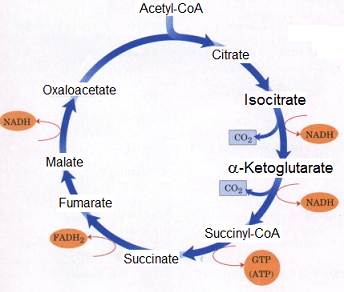
Sequence in Krebs cycle is … … [ MHTCET 2010]
-
9%
a) αKetoglutaric acid → Isocitric acid → Oxalosuccinic acid
-
9%
b) Isocitric acid → Oxalosuccinic acid → αKetoglutaric acid
-
73%
c) Isocitric acid → αKetoglutaric acid → Oxalosuccinic acid
-
9%
d) Oxalosuccinic acid → Isocitric acid → αKetoglutaric acid
Explanation
Q.21.
In succulents, respiratory quotient is less than one due to … .. [ RPMT 2006]
-
64%
a) Incomplete oxidation
-
18%
b) Incomplete reduction
-
18%
c) Complete reduction
-
0%
d) Complete oxidation
Q.22.
In the process of respiration in plants 180g of glucose plus 192g of oxygen produce … ..[ AIIMS 2001]
-
11%
a) 132g of CO2, 54g of water and 343 Cal. Of energy
-
56%
b) 264g of CO2 , 108g of water and 686 Cal, of energy
-
22%
c) 528g of CO2, 216 g of water and 1372 Cal. Energy
-
11%
d) Large amount of CO2, no water and no energy
Q.23.
Most of the biological energy is supplied by mitochondria through … ..[ MPPMT 1994]
-
17%
a) Breaking of proteins
-
42%
b) Reduction of NADP+
-
33%
c) Breaking of sugar
-
8%
d) Oxidising TCA substrates
Q.24.
Both ATP and Mg2+ are involved in the activity of … … [ AIIMS 1992]
-
57%
a) Pyruvic Kinase
-
14%
b) Glucokinase
-
14%
c) Phosphoglucoisomerase
-
14%
d) PGA dehydrogenase
Q.25.
During passage of electron over ETC … … [BHU 2012]
-
8%
a) Electron undergoes resonance
-
8%
b) Electron undergoes fluorescence
-
42%
c) Electron undergoes active transport
-
42%
d) pH of inner mitochondrial membrane increases
Q.26.
ATP molecules formed on complete oxidation of 40 moles of glucose … ..[ WB 2012]
-
23%
a) 3040
-
31%
b) 380
-
15%
c) 190
-
31%
d) 1520
Q.27.
In citric acid cycle, the step not using dehydrogenase enzymes is .. ..[ AMU 2011]
-
8%
a) Malic acid to oxaloacetate
-
25%
b) Succinate to fumarate
-
33%
c) Oxaloacetate to citric acid
-
33%
d) Citric acid to α-ketoglutarate
Q.28.
In Krebs cycle., OAA accepts acetyl CoA to form … .. [ Odisha 2010]
-
73%
a) Citric acid
-
18%
b) Oxalosuccinate
-
9%
c) Fumarate
-
0%
d) Succinyl CoA
Q.29.
Conversion of pyruvic acid to acetyl CoA is … ..[ AFMC 2009]
-
6%
a) Reductive carboxylation
-
62%
b) Oxidative decarboxylation
-
19%
c) Oxidative carboxylation
-
12%
d) Reductive decarboxylation
Q.30.
Which enzyme converts glucose into alcohol .. ..[ CPMT 2008]
-
58%
a) Invertase
-
0%
b) Lipase
-
33%
c) Zymase
-
8%
d) Diastase