Q.1.
NAD+ of Krebs cycle functions as … … [ AIIMS 1993]
-
71%
a) Acceptor of hydrogen ion and electrons
-
14%
b) Oxygen acceptor
-
14%
c) Oxygen donor
-
0%
d) Donor of phosphate ions
Q.2.
Respiration is … .. [ KCET 1993]
-
14%
a) Anabolic process
-
29%
b) Physical process
-
57%
c) Catabolic process
-
0%
d) Biophysical process
Q.3.
At a temperature above 35°C … … [ CBSE 1992]
-
60%
a) Rate of photosynthesis will decline earlier than that of respiration
-
40%
b) Rate of respiration will decline earlier than that of photosynthesis
-
0%
c) There is no fixed pattern
-
0%
d) Both decline simultaneously
Q.4.
Final electron acceptor in respiration is … ..[ AMU 2001]
-
0%
a) Hydrogen
-
25%
b) Oxygen
-
50%
c) Cytochromes
-
25%
d) Dehydrogenases
Q.5.
End product of fermentation of sugars is … ..[ CPMT 1998]
-
25%
a) Water and carbon dioxide
-
75%
b) Alcohol and carbon dioxide
-
0%
c) Carbon dioxide
-
0%
d) Alcohol
Q.6.
Link between glycolysis, Krebs cycle and β-oxidation of fatty acid or carbohydrate and fat metabolism is … .. [ CBSE 1992]
-
0%
a) Oxaloacetic acid
-
20%
b) Succinic acid
-
0%
c) Citric acid
-
80%
d) Acetyl CoA
Q.7.
Common immediate source of energy in cellular activity is … [ BHU 1991]
-
33%
a) DNA
-
33%
b) ATP
-
33%
c) RNA
-
0%
d) NAD
Q.8.
read the statement a – d, How many of them are correct. … [ CBSE 2012] a) Both oxidative and photo-phosphorylation involves uphill transport of protons across the membrane b) In dicot stem cambium originates from cells of pericycle c) Stamens of Gloriosa and Petunia are polyandrous d) Symbiotic nitrogen fixers also occur in free living state in soil
-
50%
a) One
-
25%
b) Two
-
25%
c) Three
-
0%
d) Four
Q.9.
In Krebs cycle, second decarboxylation occurs during .. ..[ MHTCET 2011] Explanation is provided please clcik on
-
0%
a) Pyruvate → Acetyl CoA
-
100%
b)α-Ketoglutarate → Succinyl CoA
-
0%
c) Oxalosuccinic acid → α-Ketoglutarate
-
0%
d) Malic acid → Fumaric acid
Explanation
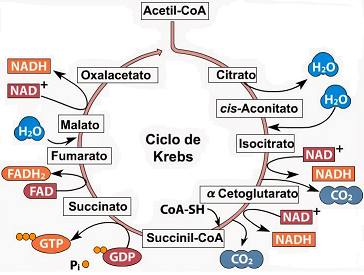
Q.10.
Which is a 4-carbon compound … ..[ kerala 2010]
-
100%
a) Oxaloacetic acid
-
0%
b) Citric acid
-
0%
c) phosphoglyceric acid
-
0%
d) Phosphoenolpyruvate
Q.11.
Differences between photophosphorylation (PP) and oxidative phosphorylation (OP) is
-
50%
a) In PP, synthesis is of ATP while in OP it is of ADP
-
50%
b) In PP, oxygen is evolved while in OP oxygen is taken up
-
0%
c) Both cannot take place in light
-
0%
d) PP can take place in green leaves while OP cannot occur in green leaves
Q.12.
NADH is produced in … .. [ BHU 2002]
-
0%
a) Photosystem II
-
0%
b) Photosystem I
-
67%
c) Glycolysis
-
33%
d) Both a and b
Q.13.
Biological oxidation in Krebs cycle involves .. … [ MPPMT 1994]
-
50%
a) N2
-
50%
b) O2
-
0%
c) SO2
-
0%
d) CO2
Q.14.
Mitochondria are store house of … .. [ AIIMS 1996]
-
25%
a) Glycogen
-
25%
b) Glucose
-
50%
c) ATP
-
0%
d) Fats
Q.15.
In case NADH is oxidized in a single step to form water … .. [ MPPMT 1996]
-
0%
a) Cell will burn
-
50%
b) Most energy is liberated as heat
-
50%
c) 3 ATP are formed
-
0%
d) 5 ATP are formed
Q.16.
Protein is respiratory substrate in … .. [ JIPMER 1997]
-
0%
a) Seedling state
-
75%
b) Anaerobic respiration
-
25%
c) Protoplasmic respiration
-
0%
d) Floating respiration
Q.17.
Fructose 6-phosphate is changed to fructose 1,6-diphosphate by … .. [ CBSE 1997]
-
33%
a) Phosphoglycerate
-
0%
b) Phosphatase
-
67%
c) Phosphofructo-kinase
-
0%
d) Enolase
Q.18.
Excess of ATP inhibits respiration by inhibiting one of the following enzymes … … [ JIPMER 1999]
-
50%
a) Phosphofructokinase
-
25%
b)Hexokinase
-
25%
c) Pyruvic decarboxylase
-
0%
d) Aldolase
Q.19.
Respiration differs from combustion in … . [ Pb PMT 2000]
-
33%
a) Liberating more energy as compared to combustion
-
0%
b) Liberating of all the energy at once in contrast to combustion
-
67%
c) Liberation of energy gradually insteps in contrast to combustion
-
0%
d) Carbohydrates take part as the combustion substance
Q.20.
The reaction involved in reduction of NAD+ is .. .. [ MPPMT 1991]
-
0%
a) Glucose → Glucose 6-P
-
0%
b) Fructose 1, 6-diphosphate → PGAL+DiHAP
-
67%
c) Glucose 6-P → Fructose 6-P
-
33%
d) PGAL → PGA
Q.21.
R.Q. of respiratory substrate C39H72O8 would be … …. [ CPMT 1992]
-
67%
a) 0.718
-
33%
b) 1.34
-
0%
c) 2.71
-
0%
d) 3.250
Q.22.
Hydrogen released from substrate by dehydrogenase requires one of the following before reducing coenzyme NAD … .. [ AMU 1993]
-
75%
a) Electrons
-
0%
b)Protons
-
0%
c) Photons
-
25%
d) Both b and c
Q.23.
Oxidation of glucose to CO2 and water occurs during … ..[RPMT 1995]
-
75%
a) Glycolysis
-
0%
b) Pentose phosphate pathway
-
0%
c) Krebs cycle
-
25%
d) All the above
Q.24.
Krebs cycle is … .. [ AFMC 1996]
-
33%
a) Aerobic
-
67%
b) Anaerobic
-
0%
c) Anabolic
-
0%
d) None of the above
Q.25.
FAD is electron acceptor during oxidation of … .. [ JIPMER 2000]
-
67%
a) α-Ketoglutarate → Succinyl CoA
-
33%
b) Succinic acid → Fumaric acid
-
0%
c) Succinyl CoA → Succinic acid
-
0%
d) Fumaric acid → Malic acid
Q.26.
R.Q. for organic acid is … .. [ RPMT 1998]
-
67%
a) 1
-
33%
b) > 1
-
0%
c) < 1
-
0%
d) 0
Q.27.
Enzyme pair common to both EMP and C3 cycle is … .. [ AMU 1999]
-
0%
a) Aldolase and enolase
-
67%
b) Aldolase and triose phosphate isomerase
-
33%
c) Phosphoglyceromutase and triose phosphate isomerase
-
0%
d) Cytochrome oxidase and enolase
Q.28.
Which can readily respire without oxygen? … ..[ JKCMEE 2000]
-
0%
a) Anabaena
-
75%
b) Saccharomyces
-
25%
c) Mushroom
-
0%
d) Fish
Q.29.
Oxygen is reduced to water in .. ..
-
0%
a) Fermentation
-
33%
b) Calvin cycle
-
33%
c) Electron transport
-
33%
d) Krebs cycle
Q.30.
For their functioning, cytochromes possess … … [ AMU 2001]
-
0%
a) Mg
-
100%
b) Fe
-
0%
c) Mn
-
0%
d) Na