Q.1.
Anaerobic respiration of yeast produces … ..[ AFMC 2000]
-
50%
a) N2
-
0%
b) O2
-
50%
c) CO2
-
0%
d) H2O
Q.2.
Bond between first phosphate and adenosine in ATP is .. ..[ KCET 2001]
-
100%
a) Phosphoester bond
-
0%
b) Nitrophosphate bond
-
0%
c) Phosphoanhydride bond
-
0%
d) Adenophosphate bond
Q.3.
Arrange the enzyme in increasing order of carbon number of substrate on which they act a) Enolase (b) Aconitase (c) Fumarase (d) Alcohol dehydrogenase
-
0%
a) d, a, b, c
-
50%
b) b, d, c, a
-
50%
c) a, d, c, b
-
0%
d) d, a, c, b
Q.4.
Direct ATP yield during Krebs cycle per glucose molecule is .. … [ WB 2009]
-
0%
a) NADH dehydrogenase
-
50%
b) ATP synthetase
-
0%
c) Succinate dehydrogenase
-
50%
d) Ubiquinone
Q.5.
Chemiosmotic hypothesis given by Peter Mitchell process the mechanism of … .. [ KCET 2011]
-
100%
a) Synthesis of ATP
-
0%
b) Synthesis of FADH2
-
0%
c) Synthesis of NADH
-
0%
d) Synthesis of NADPH
Q.6.
Link reaction between glycolysis and Krebs cycle is … .. [ MHTCET 2011]
-
100%
a) Pyruvate → Acetyl CoA
-
0%
b) PGAL → 1:3-diPGA
-
0%
c) Citric acid → Isocitric acid
-
0%
d) Malate → OAA
Q.7.
When one molecule of glucose undergoes glycolysis aerobically, last stable product will be … .. [ Chd. CET 2012]
-
0%
a) One pyruvic
-
100%
b) Two pyruvic
-
0%
c) Three pyruvic
-
0%
d) Four pyruvic
Q.8.
The substrate for pentose phosphate pathway is … .. [ BHU 2012]
-
50%
a) Glucose 6-phosphate
-
0%
b) Glucose 1-phosphate
-
50%
c) Fructose 6-phosphate
-
0%
d) Fructose 1-phosphate
Q.9.
In Krebs cycle .. .. [ MPPMT 2004]
-
0%
a) Pyruvic acid is converted into ATP
-
50%
b) ADP is converted into ATP
-
0%
c) Glucose is converted into CO2
-
50%
d) Pyruvic acid is converted into ADP
Q.10.
When one glucose molecule is completely oxidized, it changes … .. [ CBSE 1992]
-
50%
a) 36 ADP molecules into 36 ATP molecules
-
0%
b) 38 ADP molecules into 38 ATP molecules
-
0%
c) 30 ADP molecules into 30 ATP molecules
-
50%
d) 32 ADP molecules into ATP molecules
Q.11.
R.Q. is ratio of .. .. [ CBSE 1990]
-
50%
a) CO2 produced to substrate consumed
-
0%
b) CO2 produced to O2 consumed
-
0%
c) Oxygen consumed to water produced
-
50%
d) Oxygen consumed to CO2 produced
Q.12.
Fermentation products of Yeast are … .. [ JIPMER 2005]
-
50%
a) H2O + CO2
-
50%
b) Methyl alcohol + CO2
-
0%
c) Methyl alcohol + Water
-
0%
d) Ethyl alcohol + CO2
Q.13.
Anaerobic process after glycolysis is known as … ..[ AFMC 1997]
-
50%
a) TCA cycle
-
0%
b) Krebs cycle
-
0%
c) Calvin cycle
-
50%
d) None of the above
Q.14.
Which of the following enzymes is absent in mitochondria? … … [ CPMT 1998]
-
50%
a) Aconitase
-
50%
b) Malic dehydrogenase
-
0%
c) Fumarase
-
0%
d) Hexokinase
Q.15.
Component of ETC of mitochondria is … ..[ DPMT 2001]
-
0%
a) Carotenoids
-
50%
b) Plastocyanin
-
50%
c) Phytochrome
-
0%
d) Cytochrome oxidase
Q.16.
Maximum number of ATP is synthesized during oxidation of … .. [ RPMT 1990]
-
0%
a) β-amino acid
-
50%
b) Malic acid
-
0%
c) Palmitic acid
-
50%
d) Glucose
Q.17.
The site of Krebs cycle in bacteria is …..
-
0%
a) Nucleoid
-
50%
b) Cytoplasm
-
50%
c) Plasma membrane
-
0%
d) Ribosomes
Q.18.
Complete oxidation of one gram mol. Of glucose gives rise to .. .. [ MPPMT 1991]
-
0%
a) 6860,000 cal
-
50%
b) 686,000 cal
-
0%
c) 68,600 cal
-
50%
d) 6,860 cal
Q.19.
Net gain of ATP in glycolysis … [ CBSE 1990]
-
0%
a) 6
-
0%
b) 2
-
50%
c) 4
-
50%
d) 8
Q.20.
In ETS, complexes I and IV are respectively .. .. [ kerala 2011]
-
50%
a) NADH dehydrogenase and FADH2
-
0%
b) FASH2 and NADH dehydrogenase
-
50%
c) NADH dehydrogenase and cytochrome oxidase complex
-
0%
d) NADH dehydrogenase and ATP synthase
Q.21.
RQ is more than one indicating … .. [ AMU 2002]
-
0%
a) Aerobic respiration
-
0%
b) Anaerobic respiration
-
100%
c) Both a and b
-
0%
d) None of the above
Q.22.
Products of anaerobic respiration are .. .. [ Manipal 2001]
-
0%
a) Ethyl alcohol and carbon monoxide
-
50%
b) Ethyl alcohol and lactic acid
-
50%
c) Lactic acid and glycogen
-
0%
d) Acetic acid and carbon dioxide
Q.23.
ATP is synthesized in … ..[ CPMT 2010]
-
0%
a) Ion channels
-
0%
b) Plasmalemma
-
0%
c) F0 particles
-
100%
d) F1 Particles
Q.24.
Calorific value of carbohydrates, protein and fats are … .. [ WB PMT 2007]
-
0%
a) 4.1 kcal/g, 5.65 kcal/g, 9.45 kcal/g
-
50%
b) 5.65 kcal/g, 10 kcal/g, 2.3 kcal/g
-
50%
c) 3.1 kcal/g, 9 kcal/g, 6 kacl/g
-
0%
d) none of the above
Q.25.
Which of the following processes makes direct use of oxygen? … .. [ CPMT 2010]
-
0%
a) Glycolysis
-
100%
b) Fermentation
-
0%
c) Electron transport
-
0%
d) Krebs citric acid cycle
Q.26.
How many ATPs are formed per glucose molecule in Krebs cycle? .. ..[ Bih PMT 2006]
-
0%
c) 6
-
0%
a) 2
-
100%
b) 24
-
0%
d) 28
Explanation
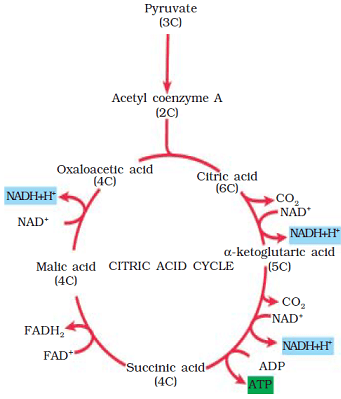
Q.27.
Which of the following is incorrect for glycolysis? .. ..[ Manipal 2005]
-
0%
a) It produces ATP
-
50%
b) It uses ATP
-
50%
c) End products are CO2 and H2O
-
0%
d) None of the above
Q.28.
In glycolysis, electrons are removed by .. .. [ CBSE 2004]
-
0%
a) ATP
-
50%
b) NAD
-
50%
c) Glyceraldehyde 3-phosphate
-
0%
d) Molecular oxygen
Q.29.
The reaction forming 3-phosphoglyceric acid is glycolysis is … .. [ MHTCET 2007]
-
0%
a) Cleavage
-
50%
b) Oxidative phosphorylation
-
50%
c) Dephosphorylation
-
0%
d) Oxidative decarboxylation
Q.30.
Which of the following is the first step of glycolysis? … .[ CPMT 2004]
-
0%
a) Conversion of glucose into fructose
-
0%
b) Dehydration of glucose
-
50%
c) Breakdown of glucose
-
50%
d) Phosphorylation of glucose