Q.1.
The process responsible for facilitating loss of water in liquid form from the tip of grass blades at night and in early morning is ... .. [NEET 2020]
-
7%
a) Imbibition
-
14%
b) Plasmolysis
-
44%
c) Transpiration
-
36%
d) Root pressure
Q.2.
What is the direction of movement of sugars in phloem? [NEET 2019]
-
15%
a) Non-multidirectional
-
22%
b) Upward
-
17%
c) Downward
-
46%
d) Bi-directional
Q.3.
Xylem translocates. ... [NEET 2019]
-
8%
a) Water only
-
22%
b) Water and mineral salts only
-
22%
c) Water, mineral salts and some organic nitrogen only
-
48%
d) Water, mineral salts, some organic nitrogen and hormones
Q.4.
Assertion Dried seeds of Pea are kept in tin, water is poured over them up to upper level. A lid is put tight over it. Within an hour the lid is blown off Reason Due to rapid cell division in Pea seeds ... ..... [ AIIMS 2007]
-
25%
a) If both the assertion and reason are true and reason explains the assertion.
-
30%
b) If both the assertion and reason are true but reason does not explain the assertion
-
38%
c) If assertion is true but reason is false
-
7%
d) If assertion is false but reason is true.
Q.5.
Guttation is mainly due to ... .... [ AIIMS 1999 ]
-
46%
a) Root pressure
-
25%
b) Osmosis
-
16%
c) Transpiration
-
12%
d) Imbibition
Q.6.
Which one is not connected with transport across the cell membrane ... .....[ BHU 2003]
-
9%
a) Osmosis
-
12%
b) Active transport
-
16%
c) Diffusion
-
62%
d) Surface tension
Q.7.
A semipermeable membrane allows the diffusion of ... .. [ CPMT 1991]
-
25%
a) Solutes
-
26%
b) Solvent
-
43%
c) Both solvent and solutes
-
7%
d) None of above
Q.8.
Exchange of substances between a cell and its environment is due to ... ...[ BHU 2002]
-
16%
a) Osmosis
-
9%
b) Active transport
-
26%
c) Diffusion
-
50%
d) All the above
Q.9.
Loss of water from tips of leaves is .... ...[ AFMC 1998]
-
48%
a) Transpiration
-
34%
b) Guttation
-
9%
c) Bleeding
-
9%
d) Respiration
Q.10.
Stomata open when guard cells swell due to ... .....[ Odisha 2011]
-
21%
a) Decreased water potential
-
44%
b) Increased water potential
-
23%
c) Endosmosis by efflux of K+ ions
-
11%
d) Endosmosis by influx of hydrogen ions
Q.11.
To initiate cell plasmolysis, salt solution should be ..... .... [ MPPMT 2002]
-
7%
a) Isotonic
-
27%
b) Hypotonic
-
61%
c) Hypertonic
-
5%
d) None of the above
Q.12.
Stomatal opening is influenced by ... ..
-
12%
a) N2 concentration, CO2 concentration and light
-
61%
b) CO2 concentration, temperature and light
-
8%
c) N2 concentration, light and temperature
-
20%
d) CO2 concentration, N2 concentration and temperature
Q.13.
Adding solute to pure water will cause development of ... ... [ MPPMT 2001]
-
33%
a) Positive water potential
-
21%
b) More positive potential
-
24%
c) More negative water potential
-
22%
d) Negative water potential
Q.14.
With rise in turgidity, wall pressure will ... .... [ CBSE 1997]
-
18%
a) Decrease
-
48%
b) Increase
-
20%
c) Fluctuate
-
14%
d) Remain unchanged
Q.15.
Water will enter a cell if it is placed in solution less concentrated than sap due to .... ... [ Manipur 2005]
-
40%
a) Endosmosis
-
24%
b) Diffusion
-
19%
c) Imbibition
-
17%
d) Plasmolysis
Q.16.
Rate of transpiration is dependent upon ... .... [ MPPMT 1990 ]
-
21%
a) Negative turgor pressure
-
55%
b) Temperature
-
13%
c) D.P.D
-
11%
d) Vapour pressure deficit
Q.17.
In pickles infection is rare due to .... .... [ JIPMER 2004]
-
29%
a) Plasmolysis
-
26%
b) Decrease in osmotic potential by salt
-
26%
c) Increase in osmotic potential by salt
-
20%
d) Decrease in temperature by salt
Q.18.
Guard cells differ from epidermal cells in having ... ...[ CBSE 2011]
-
24%
a) Mitochondria
-
9%
b) Vacuoles
-
15%
c) Cell wall
-
52%
d) Chloroplasts
Q.19.
Turgor pressure develops in epiblema cells of root due to ... ...[ Tamilnadu 2002]
-
15%
a) High water potential of cortical cells
-
41%
b) Entry of water into root hairs and increase in volume of cell sap
-
15%
c) Filling of large vacuole in root hair with cell sap
-
29%
d) Osmotic diffusion of water into pericycle through passage cells
Q.20.
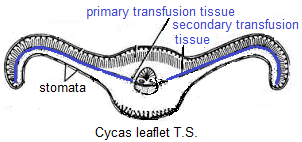
The direction of water in Cycas leaflets is .... ..[ CPMT 1998]
-
29%
a) Upward
-
12%
b) Downward
-
38%
c) Lateral
-
21%
d) Both a and b
Explanation
Q.21.
Force of cohesion develops due to ... ...[ MHTCET 2009]
-
34%
a) Attraction between similar molecules
-
22%
b) Attraction between different molecules
-
22%
c) Surface tension at the interface
-
22%
d) All the above
Q.22.
Temporary wilting is due to ... ... [ CPMT 1994]
-
24%
a) Photosynthesis
-
48%
b) Transpiration
-
7%
c) Respiration
-
21%
d) Absorption of water
Q.23.
For a plasmolysed cell which equation is correct .... ... [ BHU 2012]
-
40%
a) DPD = OP + TP
-
17%
b) DPD = -TP
-
10%
c) DPD = OP
-
33%
d) DPD = OP - TP
Q.24.
Water is absorbed from outside solution only when it is ... ..[ AFMC 1993]
-
14%
a) Isotonic
-
39%
b) Hypotonic
-
36%
c) Hypertonic
-
11%
d) None of these
Q.25.
Which of the following statements are not true ... ...[ kerla 2008] a) In CAM plants, stomata open during dark and remain closed during day b) Role of Na+ in stomatal opening is now universally accepted c) Water potential of root cells is higher than water potential of soil d) Capillarity theory is most accepted theory of water movement through plants e) Wall of xylem vessels made up of lignocellulose has strong affinity for water molecules
-
29%
a) b, c and e
-
33%
b) b, c and d
-
29%
c) a, b and c
-
8%
d) b and c
Q.26.
Conversion of starch to organic acids is required for ... .... [ CBSE 1992]
-
50%
a) Stomatal opening
-
14%
b) Stomatal closing
-
21%
c) Stomatal formation
-
14%
d) Stomatal activity
Q.27.
A plant cell becomes turgid due to .... ...[ kerala 2004]
-
41%
a) Plasmolysis
-
15%
b) Exosmosis
-
44%
c) Endosmosis
-
0%
d) Electrolysis
Q.28.
Cell 'A' with O.P = 10 atm and T.P. = 5 atm is in contact with cell 'B' having O.P = 15 atm and T.P. = 12 atm. The flow of water will be ... ...[ AIIMS 1992]
-
27%
a) From A to B
-
27%
b) Equal flow
-
38%
c) From B to A
-
8%
d) No flow
Q.29.
If turgor pressure becomes equal to osmotic pressure ... ... [ AIIMS 2002]
-
8%
a) Water leaves the cells
-
28%
b) Water enter the cell
-
48%
c) No exchange of water takes place
-
16%
d) Solute pass out of the cell
Q.30.
Dry seeds when placed in water swell up due to ... ... [ BHU 1999 ]
-
62%
a) Imbibition
-
27%
b) Absorption
-
4%
c) Diffusion
-
8%
d) Adsorption