Q.1.
Risk of spoilage is less in salted pickles as it causes ... ...[ EAMCET 2002]
-
33%
a) Guttation
-
17%
b) Imbibition
-
17%
c) Diffusion
-
33%
d) Plasmolysis
Q.2.
Which one is most efficient imbibant? ... ...[ KCET 2008]
-
67%
a) Pectin
-
0%
b) Agar
-
33%
c) Cellulose
-
0%
d) Lignin
Q.3.
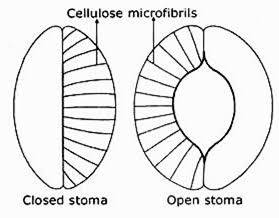
In cell wall of guard cells, cellulose microfibrils are arranged ... .... [ AMU 2009]
-
67%
a) Transversely
-
17%
b) Tangentially
-
17%
c) Radially
-
0%
d) Obliquely
Explanation
Q.4.
Prolonged water-logging kills plants due to .... ....[ CBSE 1997]
-
20%
a) Stoppage of root respiration
-
40%
b) Dilution of soil nutrients
-
40%
c) Dilution of plant cells sap
-
0%
d) Leaching of nutrients
Q.5.
Assertion: Water entering a plant cell makes it turgid Reason: Entry of water into cell develops wall pressure inside the cell .... ..[ AIIMS 2011]
-
75%
a) Both Assertion and Reason are true and Reason is the correct explanation of Assertion
-
0%
b) The Assertion and Reason are true but Reason is not correct explanation of Assertion
-
25%
c) Assertion is true but, Reason is false
-
0%
d) Assertion is false but, Reason is true
Q.6.
Diffusion of water through selectively permeable membrane is ... .... [ CPMT 1993]
-
50%
a) Diffusion
-
0%
b) Imbibition
-
25%
c) Osmosis
-
25%
d) Translocation
Q.7.
Passive water absorption by root system is due to .... .... [ KCET 2006]
-
50%
a) Forces created in the cells of the root
-
25%
b) Osmotic force in the shoot system
-
25%
c) Increased respiratory activity in cells of the root
-
0%
d) Tension in the sap due to transpiration
Q.8.
In fully turgid cell ... ...
-
0%
a) ψs is negative and ψp is positive
-
75%
b) ψp is negative and ψs is positive
-
25%
c) Both ψp and ψs are positive
-
0%
d) Both ψs and ψp are negative
Q.9.
In tall trees water is absorbed due to ... ..... [ Guj CET 2011]
-
50%
a) Transpiration/suction pull
-
50%
b) Root pressure
-
0%
c) Capillary action
-
0%
d) Photosynthesis
Q.10.
When beet root cylinders are washed and then palced in cold water, anthocyanin does not come out. This indicates that most likely the plasma membrane is .... .... [ AFMC 1990]
-
75%
a) Permeable to anthocyanin
-
25%
b) Impermeable to anthocyanin
-
0%
c) Differentially permeable to anthocyanin
-
0%
d) Dead structure
Q.11.
Rate of transpiration higher than rate of water absorption shall cause ... ... [ JIPMER 2003 ]
-
50%
a) Growth
-
50%
b) Guttation
-
0%
c) LEaf fall
-
0%
d) Wilting
Q.12.
Arrange root hair cell, inner cortical cell and mesophyll cell in ascending order of DPD ... ...[ JIPMER 2000 ]
-
33%
a) Mesophyll cell, Root hair cell and Cortical cell
-
33%
b) Cortical cell, Mesophyll cell and Root hair cell
-
33%
c) Root hair cell, Cortical cell and Mesophyll cell
-
0%
d) Root hair cell, Mesophyll cell and Cortical cell
Q.13.
Colligative property is Osmotic pressureVapour pressure loweringCohesive force Surface tension .... ..[ BHU 2008]
-
33%
a) 1, 2, 3
-
67%
b) 1, 2
-
0%
c) 2, 4
-
0%
d) 1, 3
Q.14.
Root hair absorbs water from soil though ... ..[ BHU 2006]
-
0%
a) Turgor pressure
-
100%
b) exchange
-
0%
c) Osmosis
-
0%
d) DPD
Q.15.
Movement of water from higher water potential to lower water potential through a semipermeable membrane is called ... ..... [ JKCMEE 2010]
-
17%
a) Osmosis
-
17%
b) Diffusion
-
0%
c) Plasmolysis
-
67%
d) Imbibition
Q.16.
Plasmolysis is due to ... ... [ CPMT 1995]
-
100%
a) Exosmosis
-
0%
b) Endosmosis
-
0%
c) Osmosis
-
0%
d) Adsorption
Q.17.
Oozing out of water drops from injured edges or tips is ... ...[ Odisha 2006]
-
50%
a) Bleeding
-
0%
b) Guttation
-
0%
c) Transpiration
-
50%
d) Oozation
Q.18.
In hot summer day, plant cooling occurs due to ... .... [ BHU 1991 ]
-
100%
a) Transport of water from root to all parts of the plant
-
0%
b) Loss of liquid water
-
0%
c) Water loss from entire plant
-
0%
d) Loss of water vapours from foliar surface
Q.19.
The following percentage of water absorbed by herbaceous plants is lost in transpiration ... .... [ JIPMER 2002]
-
100%
a) 80
-
0%
b) 60
-
0%
c) 99
-
0%
d) 40
Q.20.
Match the columns and find the correct combination ,,, ,,,[ kerala 2005]
| a) Hypotonic | i) Water |
| b) Hypertonic | ii) Sucrose |
| c) Solute | iii) Lower tonicity |
| d) Solvent | iv) Higher tonicity |
-
100%
a) a - i, b - ii, c - iii, d - iv
-
0%
b) a - iii, b - ii, c - i, d - iii
-
0%
c) a - iii, b - ii, c - iii, d - i
-
0%
d) a - iii, b - iv, c - ii, d - i
Q.21.
When concentration of solutes is low in the soil, absorption of water is ... .....[ KCET 2007]
-
100%
a) Stopped
-
0%
b) Increased
-
0%
c) Retarded
-
0%
d) Normal
Q.22.
Cell a and cell b are adjacent plant cells. In cell a ψs = -20 bars and ψp = 8 bars. In cell b ψs = -12 bars and ψp = 2 bars. Then ... ...[ KCET 2010]
-
0%
a) Water moves from cell a to cell b
-
50%
b) There is no movement of water between cell a and cell b
-
0%
c) Water moves from cell b to cell a
-
50%
d) Equal amount of water is simultaneously exchanged between cell a and cell b
Q.23.
Root pressure helps in ascent of sap by ... ..... [ Bihar PMT 2000 ]
-
50%
a) Pumping food in phloem
-
50%
b) Pumping sap into xylem in roots
-
0%
c) Pumping sap in stem for sending in to roots
-
0%
d) All the above
Q.24.
An RBC and a plant cell having same O.P. are placed in distilled water ... ..[ KCET 2009]
-
50%
a) None undergoes any change
-
50%
b) Plant cell swells up and bursts but there is no change in RBC
-
0%
c) RBC swells up and bursts plant cell remains about the same size
-
0%
d) Both decrease in size and collapse
Q.25.
Cohesion theory of ascent of sap was proposed by .... .... [ AFMC 1993]
-
0%
a) Munch
-
50%
b) Stephen Hales
-
0%
c) Dixon and Joly
-
50%
d) Bose
Q.26.
Guttation differs from transpiration in ... ... [ HPPMT 2012]
-
100%
a) Control by stomata
-
0%
b) Occurrence during daytime
-
0%
c) Occurrence in vapour form
-
0%
d) Occurrence in liquid form
Q.27.
During absorption of water by roots, the water potential of cell sap is lower than that of ... ...[ BHU 1994]
-
100%
a) Pure water and soil solution
-
0%
b) Neither pure water nor soil solution
-
0%
c) Pure water but higher than that of soil solution
-
0%
d) Soil solution but higher than that of pure water
Q.28.
Plasmolysis occurs when cells are kept in ... ...[ HPPPMT 2010]
-
50%
a) Hypotonic solution
-
50%
b) Hypertonic solution
-
0%
c) Isotonic solution
-
0%
d) None of the above
Q.29.
Wilting in plants occurs when .... .... [ AFMC 2005 ]
-
50%
a) Phloem is blocked
-
50%
b) Xylem is removed/blocked
-
0%
c) Pith is removed
-
0%
d) A few leaves are removed
Q.30.
Potometer works on the principle of ... ... [ CBSE 2005]
-
0%
a) Osmotic pressure
-
100%
b) Amount of water absorbed equals the amount transpired
-
0%
c) Root pressure
-
0%
d) Potential difference between tip of tube and that of plant