Q.1.
The total interacting animals and plants in any well defined area which as field or a pond is known as
-
21%
a) biosphere
-
25%
b) biome
-
21%
c) community
-
33%
d) ecosystem
Q.2.
Select the incorrect statement:
-
41%
a) An overwhelming majority of animals and all plants maintain a constant internal temperature.
-
29%
b) An orchid growing as an epiphyte on a mango branch is an example of commensalism.
-
6%
c) In brood parasitism, the parasitic bird lays its eggs in the nest of its host and lets the host to incubate them.
-
24%
d) Very small animals are rarely found in Polar Regions.
Q.3.
Natality is the characteristics of a population which means:
-
18%
a) The total number of individuals present per unit area at a given time.
-
71%
b) The increase in number of individuals in a population through reproduction under given environmental conditions.
-
12%
c) Loss of individuals due to death in a population through reproduction under the given environmental conditions.
-
0%
d) The movement of individuals into and out of population.
Q.4.
Choose the correct option for the given adaptations: (i) Biochemical adaptations are seen in organisms living in greater depths of the ocean to face crushing pressure. (ii) Allen’s rule explains mammals living in colder climates. (iii) Altitude sickness is caused because of body not getting enough oxygen due to low atmospheric pressure at high altitudes. (iv) Desert lizards lack behavioural means to manage their body temperature.
-
64%
a) (i), (ii) and (iii).
-
7%
b) (i), (ii) and (iv).
-
14%
c) (ii), (iii) and (iv).
-
14%
d) (i), (iii) and (iv).
Q.5.
The type of benthic animals in aquatic environment is determined by:
-
29%
a) Presence of light.
-
19%
b) Sediment characters of soil.
-
29%
c) Water requirements.
-
24%
d) Levels of thermal tolerance.
Q.6.
Mac Arthur’s observation on closely related species of warblers is an excellent demonstration of how:
-
57%
a) Behavioural differences in foraging activities can avoid interspecific competition.
-
21%
b) Competitively inferior species will be eliminated eventually.
-
0%
c) The distribution range of one species expands in the absence of another.
-
21%
d) The fitness of one species is significantly lower in the presence of another species.
Q.7.
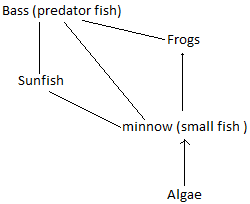
Which of the following condition will occur if the bass disappeared due to over fishing?
-
33%
a) The algae population would increase.
-
25%
b) The frogs and sunfish would disappear.
-
17%
c) The minnow population would increase and the sunfish population would decrease.
-
25%
d) The frog and sunfish populations would increase.
Explanation
Q.8.
carrying capacity of a population is determined by ... ...(BHU 2001)
-
18%
a) Birth rate
-
6%
b) Death rate
-
53%
c) limiting resources
-
24%
d) Reproductive ability
Q.9.
Organism with very high intrinsic growth rates have
-
31%
a) Long generation times
-
25%
b) Short generation times
-
0%
c) No courtship behaviour
-
44%
d) No carrying capacities
Q.10.
In order to find out VITAL INDEX in Rampur Village, following information was gathered Death Rate = 1/x Birth Rate = z Average population = 1/y What is the Vital Index ?
-
29%
a) xyz × 100
-
29%
b) z/xy =100
-
36%
c) xy/z × 100
-
7%
d) 100/xyz
Q.11.
If ‘+’ sign is assigned to beneficial interaction ’-‘ sign to detrimental and ‘0’ sign to neutral interaction, then the population interaction represented by ‘+’ ‘-‘ refers to
-
12%
a) mutualism
-
6%
b) amensalism
-
12%
c) commensalism
-
69%
d) parasitism
Q.12.
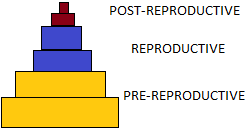
The given age pyramid represents a
-
65%
a) Fast expanding population
-
17%
b) Slowly expanding population
-
9%
c) Stable population
-
9%
d) Declining population
Q.13.
In a tide pool, 15 species of invertebrates were reduced to 8 after one species was removed. The removed species may be a
-
25%
a) Parasite
-
6%
b) Mutualist
-
50%
c) Top predator
-
19%
d) Herbivore
Q.14.
Which of the following is correct for r-selected species?
-
71%
a) Large number of progeny with small size
-
5%
b) Large number of progeny with large size
-
14%
c) Small number of progeny with small size
-
10%
d) Small number of progeny with large size
Q.15.
Just as a person moving from Delhi to Shimla to escape the heat for the duration of hot summer, thousands of migratory birds from Siberia and other extremely cold Northern regions move to
-
15%
a) Western Ghat
-
0%
b) Meghalaya
-
15%
c) Corbett National Park
-
69%
d) Keolado National Park
Q.16.
Consider the following four statements (A-D) about certain desert animals such as kangaroo rat a) they have dark colour and high rate of reproduction and excrete solid urine b) they do not drink water, breathe at slow rate to conserve water and have their body covered with thick hairs c) they feed on dry seeds and do not require drinking water d) they excrete very concentrated urine and do not use water to regulate body temperature Which two of the above statements for such animals are true?
-
56%
a) C and D
-
6%
b) B and C
-
31%
c) C and A
-
6%
d) A and B
Q.17.
The population dynamics of a species is basically regulated by
-
7%
a) climate
-
0%
b) food supply
-
7%
c) competition between and within the species
-
87%
d) all of the above
Q.18.
Which one of the following do not correctly represents an organism and its ecological niche?
-
9%
a) Vallisneria and Pond
-
0%
b) Desert locust (Scistocerca) and desert
-
45%
c) Plant lice (aphids) and leaf
-
45%
d) Vultures and dense forest
Q.19.
Sinking of zooplankton during the day and rising to the surface at night is an example of
-
15%
a) circinal rhythm
-
38%
b) circadian rhythm
-
15%
c) tidal rhythm
-
31%
d) None of these
Q.20.
When all the starfish were removed from an enclosed intertidal area, more than 10 species of invertebrates became extinct within a year. This experiment explains:
-
5%
a) Biological control method.
-
9%
b) Predator is too efficient and overexploits its prey.
-
86%
c) Predator helps in maintaining species diversity.
-
0%
d) Energy transfer.
Q.21.
In an aquarium, two herbivorous species of fish are living together and feeding on phytoplankton. As per the Gause’s principle, one of the species to be eliminated in due course of time. But both are surviving well in the aquarium. Give possible reasons: (i) Predator free environment. (ii) Resources (food, protection, space) are not limited. (iii) Limited resource. (iv) Competitive release. (v) Resource partitioning
-
58%
a) Only (i), (iii) and (v).
-
26%
b) Only (i) and (ii) and (v).
-
5%
c) Only (i), (ii) and (iv).
-
11%
d) Only (ii), (iv) and (v).
Q.22.
Assertion: With increase in population size, environmental resistance tend to increases. Reason: This is nature’s way to check the expression of biotic potential.
-
74%
a) Both Assertion and Reason are true and Reason is the correct explanation of Assertion.
-
5%
b) Both Assertion and Reason are true but Reason is NOT the correct explanation of Assertion.
-
16%
c) Assertion is true but Reason is false.
-
5%
d) Both Assertion and Reason are false.
Q.23.
What is true for the following statements ? Statement X : Marine fishes have chlorine secretory cells.while riverine fishes have chlorine cells. Statement Y : Compared to marine water, fluid present in fish is hypotonic while reverine water is hypertonic compared to fluid present in fish.
-
29%
a) X=True ; Y= True
-
5%
b) X=True; Y= False
-
10%
c) X=False; Y= False
-
57%
d) X=False; Y= True
Q.24.
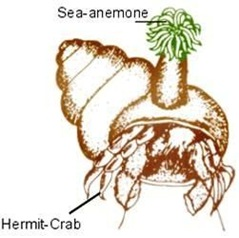
Association of a sea-anemone with hermit crab living in a gastropod shell is an example of
-
14%
a) mutualism
-
57%
b) commensalism
-
21%
c) symbiosis
-
7%
d) parasitism
Explanation
Q.25.
From the following statements: (i) Many fishes thrive in Antarctic water where temperature is always below zero. (ii) Microbes can survive in hot springs where temperature exceeds 100°C. (iii) Many fishes can survive even at a depth where pressure exceeds 100 atm. (iv) Desert lizards have marvellous physiological ability to survive scorching heat of desert. (v) Many desert plants have a thick cuticle on their leaf surfaces and have their stomata arranged in surface to minimise water loss.
-
67%
a) All are correct.
-
17%
b) Only (i), (ii), (iii) and (iv) are correct.
-
17%
c) Only (i), (ii), (iii) and (v) are correct.
-
0%
d) Only (i), (ii) and (iii) are correct.
Q.26.
iche of an organism consists of: (i) Range of tolerance and functional role. (ii) Resource it utilises only. (iii) Small living area within the habitat. (iv) Large living area and the functional role. (v) Adaptation and the large living area.
-
71%
a) (i), (ii), (iii) and (v) are correct.
-
29%
b) (i), (ii) and (iii) are correct.
-
0%
c) (i), (iii) and (v) are correct.
-
0%
d) (i), (iii) and (iv) are correct.
Q.27.
A stage of suspended development in many zooplanktons under unfavourable conditions:
-
15%
a) Suspension.
-
54%
b) Diapause.
-
15%
c) Conformers.
-
15%
d) Adaptation.
Q.28.
Population density refers to:
-
23%
a) Number of women per thousand men.
-
69%
b) Number of individuals per square kilometer at any given time
-
8%
c) Number of men per thousand women
-
0%
d) Number of men died in a year
Q.29.
In snakes realised (actual) natality is less than potential natality; because.....
-
9%
a) all the eggs are not incubated
-
9%
b) enviornmental boomrang (resistance)
-
0%
c) Though eggs are incubated they donot reach upto adult stage.
-
82%
d) All of these.
Q.30.
Which is appropriate for the following statement ? Statement X : Pacific salmon fish reproduces only once in its life time. Statement Y : In a reproductive season it lays 280,000,000 eggs.
-
64%
a) X=True; Y=True
-
0%
b) X=False; Y= False
-
36%
c) X=True; Y= False
-
0%
d) X=False; Y= True