Q.1.
Which of the following is true with reference to temperature diffrence ?
-
62%
a) 1. Terrestrial Habital > Aquatic Habitat 2. Sea < Deep fresh water lakes
-
0%
b) 1. Aquatic Habitat > Terrestrial Habitat 2. Sea < Deep fresh water lake
-
12%
c) 1. Terrestrial Habital = Aquatic Habitat 2. Sea < Deep fresh water lake
-
25%
d) 1. Terrestrial Habital < Aquatic Habital 2. Sea = Deep fresh water lake
Q.2.
Which is appropriate option if we take ‘T’ for correct statement and’F’ for wrong statement ? (i) Energy pyramids are always upright. (ii) Detritus food chain begins with dead organic matter (iii) C4 path is the only path seen in xerophytes (iv) Biodiversity is less in equatorial region because of more sunlight (v) At normal Temperature daphnis lays parthenogenetic eggs. which develops into male(♂)
-
12%
a) T F T T F
-
62%
b) T T F F F
-
25%
c) F F F T F
-
0%
d) T F T F F
Q.3.
In the section of lichen which layer is seen just below “ upper cortex”
-
18%
a) Medulla
-
9%
b) Algal layer
-
36%
c) lower cortex
-
36%
d) All of these
Q.4.
Give correct option for the given true and false statements (i) Some insects, birds and mammals living in warm and dry climate have more darker black pigments than the races of same species living in cold and humid climate. (ii) Temperature variation is much lesser in aquatic habitat compared to terrestrial habitat (iii) In deep fresh water lakes, there is gradual increase in temperature from surface to the bottom (iv) In an aquatic habitat production increases with increasing depth. (T =True, F = False)
-
12%
a) F F F F
-
38%
b) T F T F
-
25%
c) T T F T
-
25%
d) F T F T
Q.5.
What is correct for the given statement ? Statement X : Ascaris are permanent parasites Statement Y : Ascaris lives inside the host’s body
-
70%
a) Both X&Y are correct
-
10%
b) Both x & Y are wrong
-
0%
c) X is wrong Y is true
-
20%
d) X is correct & Y is true
Q.6.
What is true for the members of same species [CBSC, PMT - 2002]
-
56%
a) Capacity of inter breeding
-
33%
b) shows same ecological niche
-
11%
c) show different type of ecological niche
-
0%
d) They have different Habitat
Q.7.
Which of the following is incorrect if ‘O’ sign is used for beneficial and ‘+’ sign for harmful ?
-
71%
a) Penicillium ↔ Gram +ve bacteria ; Penicillium: ‘+’
-
0%
b) Rhizobium ↔ palnt - leguminosae family : Both ‘O’
-
14%
c) Tiger ↔ Rabbit ; Tiger : ‘O’
-
14%
d) Shank fish ↔ Suckerfish ; Suckerfish ; ‘O’
Q.8.
Consider the following two statements I. Red algae are red because of the presence of pigment phycoerythrin; this pigment reflects red light and absorbs blue light II. Because blue light penetrates water to grater depth than light of longer wavelengths, these pigments allow red algae to photosynthesize and live at somewhat greater depth than most other “algae:
-
100%
a) Both I and II are correct and II explains I
-
0%
b) Both I and II are correct but II does not explain I
-
0%
c) I is correct but II is incorrect
-
0%
d) I is incorrect but II is correct
Q.9.
Darwinian fitness is represented by
-
22%
a) Low r value
-
44%
b) High r value
-
33%
c) High K value
-
0%
d) Low K value
Q.10.
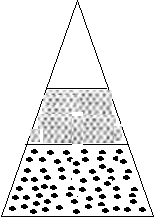
The country with the given population pyramid is likely to have
-
14%
a) Low birth rate
-
86%
b) High birth rate
-
0%
c) Declining Population in future
-
0%
d) More females than males
Q.11.
Which one of the following is categorised as a parasite in true sense?
-
14%
a) Human foetus developing inside the uterus draws nourishment from the mother
-
43%
b) Head louse living on the human scalp as well as laying eggs on human hair
-
29%
c) The cuckoo (koel) lays its eggs in crow’s nest
-
14%
d) The female Anopheles bites and sucks blood from humans
Q.12.
The population of an insect species shows an explosive increase in number during rainy season followed by its disappearance at the end of the season. What does this show?
-
43%
a) S-shaped or sigmoid growth of this insect
-
14%
b) The food plants mature and die at the end of the rainy season
-
43%
c) Its population grows curve is of J-type
-
0%
d) The population of its predators increases enormously
Q.13.
Which of the following animals are osmoconformers?
-
0%
a) Hagfishes
-
12%
b) Sharks
-
0%
c) Rays
-
88%
d) All the above
Q.14.
Bacteria, fungi, lower plants survive in adverse conditions by
-
33%
a) diapause
-
11%
b) suspended growth
-
11%
c) migration
-
44%
d) formation of thick walled spores
Q.15.
Biotic factors are:
-
14%
a) chemical factors of soil which affect life
-
0%
b) physical factors of soil which affect life
-
71%
c) all living organisms which influence other organisms
-
14%
d) factors of atmosphere which affect life
Q.16.
A population growing in a habitat with limited resources shows phase of growth in the following sequence:
-
25%
a) Acceleration → Deceleration → Lag phase → Asymptote.
-
12%
b) Lag phase → Acceleration → Log phase → Deceleration.
-
62%
c) Lag phase → Acceleration → Deceleration → Asymptote.
-
0%
d) Acceleration → Log phase → Crash phase.
Q.17.
Assertion: Bell shaped age pyramids represents a stable population. Reason: Proportion of individuals in reproductive age group is higher than the individuals in the pre – reproductive age group.
-
71%
a) Both Assertion and Reason are true and Reason is the correct explanation of Assertion.
-
0%
b) Both Assertion and Reason are true but Reason is NOT the correct explanation of Assertion.
-
29%
c) Assertion is true but Reason is false.
-
0%
d) Both Assertion and Reason are false.
Q.18.
(i) Mango tress cannot grow in temperate countries like Canada and Germany. (ii) Tuna fish are rarely caught beyond tropical latitudes in the ocean. (iii) Snow leopards are not found in Kerala. Which of the following factor is responsible for the above observation?
-
14%
a) Light.
-
0%
b) Water.
-
71%
c) Temperature.
-
14%
d) Soil.
Q.19.
The best explanation for the change in the distribution of Chathamalus observed 33 months after removal of the larger Balanus individuals is that :
-
86%
a) Balanus feeds on Chathamalus larvae
-
0%
b) Balanus does not reproduce as quickly as Chathamalus.
-
14%
c) Balanus has less tolerance for wet conditions.
-
0%
d) Balanus adults are mobile.
Q.20.
Crustacian Astacus = Green gland Marine turtle = X what is ‘X’ accroding to the information given ?
-
38%
a) Salt gland
-
25%
b) Kidney
-
25%
c) chlorine secretory cells
-
12%
d) None of these
Q.21.
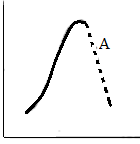
In a population of frog ‘J’ type of population growth curve is seen than which information from the given graph can be true for “ point A” (i) Vital Index < 100 (ii) Birth rate < death rate (iii) Birht rate > death rate
-
43%
a) I
-
29%
b) II, III
-
14%
c) I, III
-
14%
d) I, II
Q.22.
Which path is followed by plants as a part of adaptation in an ecosystem where Kangaroo rat is living ?
-
25%
a) C3 Path
-
0%
b) C4 Path
-
62%
c) CAM Path
-
12%
d) TCA Path
Q.23.
From the given option find out the correct pair ?
-
38%
a) Mesofauna - Earthworm
-
38%
b) Macrofauna - spider
-
12%
c) Microfauna - fungi
-
12%
d) None of these
Q.24.
Recently a village was badly affected by jaundice and Dengue,which of the following will decrease due to this ?
-
75%
a) No. of persons
-
0%
b) area
-
12%
c) Birthrate
-
12%
d) Death rate
Q.25.
The turtle of Galapagus island and the goats living there both were eating tender grass, state the relationship.
-
100%
a) Interspecific competition
-
0%
b) Emigration
-
0%
c) predation
-
0%
d) None of these
Q.26.
Many freshwater animals cannot live for long in sea water and vice versa because of
-
50%
a) Buoyancy related problem
-
0%
b) Lack of impermeable skins
-
0%
c) Thermolabile enzymes
-
50%
d) Osmotic consideration
Q.27.
In a field experiment, when all Pisaster starfish were removed from an enclosed intertidal area, the result was
-
29%
a) Increase in diversity of invertebrates
-
57%
b) Extinction of many invertebrate species
-
14%
c) Inability of Pisaster to enter the area again
-
0%
d) Replacement of Pisaster by other starfish
Q.28.
Very small animals are rarely found in polar region mainly because
-
29%
a) Smaller animals have a relatively slower heart rate
-
43%
b) Smaller animals have more surface area relative to their volume
-
0%
c) Smaller animals are invariably herbivores
-
29%
d) Smaller animals rely on diffusion for exchange of gases with the environment
Q.29.
A population interaction where one species is harmed whereas the other is unaffected is called as
-
22%
a) Mutualism
-
11%
b) Competition
-
0%
c) Predation
-
67%
d) Amensalism
Q.30.
Intraspecific competition is strongest when the
-
29%
a) Species overlap in their distribution
-
14%
b) Populations overlap in their ranges
-
57%
c) Population is at its carrying capacity
-
0%
d) Reproductive rate is at its maximum