Q.1.
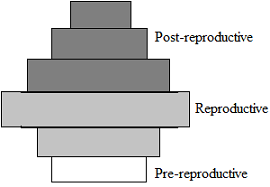
What type of human population is represented by the following age pyramid?
-
14%
a) Stable population
-
57%
b) Declining population
-
29%
c) Expanding population
-
0%
d) Vanishing population
Q.2.
Which one of the following pairs of organisms are exotic species introduced in India
-
29%
a) Ficus religiosa , Lantana camara
-
29%
b) Lantana camara, Water hyacinth
-
43%
c) Water hyacinth, Prosopis cineraria
-
0%
d) Nile perch, Ficus religiosa
Q.3.
Which one of the following is a matching pair of certain organism(s) and the kind of association? a) Shark and suckers fish – commensalism b) Algae and fungi in lichens – mutualism c) Orchids growing on trees – parasitism d) Cuscuta (dodder) growing in other flowering plants – epiphytism
-
71%
a) (a) and (b).
-
29%
b) (a) and (c).
-
0%
c) (c) and (d).
-
0%
d) (b) and (c).
Q.4.
Monarch butterfly escapes from predators by
-
12%
a) foul smell
-
50%
b) bitter taste
-
38%
c) colour combination
-
0%
d) rough skin
Q.5.
The soils transported by water are called
-
33%
a) peat
-
44%
b) alluvial
-
22%
c) colluvial
-
0%
d) none of these
Q.6.
An organism which lives at the expense of another organism is called
-
50%
a) predator
-
12%
b) prey
-
12%
c) host
-
25%
d) parasite
Q.7.
Assertion: Small sized animals are rarely found in Polar Regions. Reason: Small sized animals have larger surface area relative to their volume and they have to spend much energy to generate body heat through metabolism.
-
86%
a) Both Assertion and Reason are true and Reason is the correct explanation of Assertion.
-
14%
b) Both Assertion and Reason are true but Reason is NOT the correct explanation of Assertion.
-
0%
c) Assertion is true but Reason is false.
-
0%
d) Both Assertion and Reason are false.
Q.8.
What is the composition of soil with high waterlogging capicity ?
-
25%
a) Sandy soil
-
75%
b) Black soil (loan soil)
-
0%
c) Rocky soil
-
0%
d) Any one of these
Q.9.
Choose the combination of correct options: (i) Many xerophytic plants have thick cuticle on leaf epidermis and sunken stomata. (ii) Some xerophytic plants have specialised photosynthetic pathway (CAM) that enables their stomata close during day. (iii) Opuntia has spines (modified leaves), photosynthetic phylloclade (stem). (iv) Adaptations are genetically fixed in organisms. (v) Adaptations are not genetically fixed.
-
50%
a) (i), (ii), (iii) and (iv).
-
33%
b) (ii), (iii), (iv) and (v).
-
0%
c) (i), (iii), (iv) and (v).
-
17%
d) (i), (ii), (iii) and (v).
Q.10.
Gause’s exclusion principle is related to:
-
29%
a) Resource partitioning.
-
57%
b) Totally unrelated species, competing for the same resource.
-
14%
c) Closely related species growing in the same habitat.
-
0%
d) Maintains species diversity.
Q.11.
Which animal is capable of obtaining water by oxidation of lipid.
-
25%
a) Rat
-
12%
b) Earthworm
-
12%
c) Mole
-
50%
d) Kangaroo rat
Q.12.
Parasitic animal which is part of bio-geo community and included as zoo planktons and mesofauna of terrestrial ecosystem is ....
-
33%
a) Moles
-
17%
b) mites
-
50%
c) Earthworms
-
0%
d) leech
Q.13.
What is correct for the given statement ? Statement P : Environmental study is linked with ecology StatementQ : Ecology is included in environmental study.
-
67%
a) Both statement are true
-
17%
b) Both statement are wrong
-
17%
c) P is right and Q is wrong
-
0%
d) P is wrong and Q is right
Q.14.
A plant formed by the combination of algae and fungi is a pioneer of which type of succession ?
-
67%
a) Xerosere
-
17%
b) Hydrosere
-
17%
c) Mesosere
-
0%
d) None of these
Q.15.
In a population of salmon fish, potential Natality is 10,000 while realised mortality is 200, then the Vitlal Index =
-
33%
a) 50,
-
67%
b) less then 50
-
0%
c) mor then 50
-
0%
d) None of these
Q.16.
In which of the following organism water is stored in its transformed from and not water as such ?
-
33%
a) camel
-
17%
b) uromatrix
-
17%
c) spiny tailed lizard
-
33%
d) rat
Q.17.
What is true for the given statements ? Statement X : Protopterus aestivate during winter to overcome dry period Statement Y : The process of aestivation in protopterus is to overcome unfavourable condition
-
67%
a) Both statements are true
-
17%
b) X-Correct Y- wrong
-
0%
c) Both statements are wrong
-
17%
d) X- wrong Y- correct
Q.18.
Whats percentage of earth is occupied by marine habitat ? (1) 71% (2) 4 % (3) 67% (4) 29%
-
25%
a) 1,2
-
25%
b) 2,3
-
25%
c) 1,4
-
25%
d) 1
Q.19.
Under unfavourable conditions, many zooplankton species in lakes and ponds are known to enter a stage of suspended development called as
-
17%
a) Dormancy
-
17%
b) Hibernation
-
17%
c) Asestivation
-
50%
d) Diapause
Q.20.
Which of the following are important biotic factors that can affect the structure and organization of biological communities?
-
40%
a) Temperature and rainfall
-
20%
b) Nutrient availability and soil pH
-
40%
c) Predation and competition
-
0%
d) Light intensity and seasonality
Q.21.
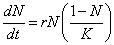
When does the growth rate of a population following the logistic model equal zero? The logistic model is given as
-
50%
a) When N nears the carrying capacity of the habitat
-
0%
b) When N/K equals zero
-
0%
c) When death rate is greater than birth rate
-
50%
d) When N/K is exactly one
Q.22.
Study the four statements (1-4) given below and select the two correct ones out of them a) A lion eating a deer and a sparrow feeding on grain are ecologically similar in being consumers b) Predator star fish Pisaster helps in maintaining species diversity of some invertebrates c) Predators ultimately lead to the extinction of prey species d) Production of chemicals such as nicotine, strychnine by the plants are metabolic disorders The two correct statements are
-
17%
a) (2) and (3)
-
33%
b) (3) and (4)
-
0%
c) (1) and (4)
-
50%
d) (1) and (2)
Q.23.
Niche overlap indicates
-
33%
a) active co-operation between two species
-
50%
b) two different parasites on the same host
-
0%
c) sharing of one or more resources between the two species
-
17%
d) mutualism between two species
Q.24.
Mutualism is found in
-
20%
a) hermit crab and sea anemone
-
20%
b) ox pecker and rhinoceros
-
60%
c) zoochlorellae and Hydra
-
0%
d) E.Coil and man
Q.25.
Match column I with column II and select the correct option from the codes given below
| Column I | Column II |
| A. Commensalism | (i) One inhibited other unaffected |
| B. Parasitism | (ii) One benefitted, other unaffected |
| C. Mutualism | (iii) Both are benefitted |
| D. Amensalism | (iv) One benefitted, other harmed |
-
33%
a) A = (iv), B = (ii), C – (iii), D =(i)
-
17%
b) A = (iii), B = (iv), C – (ii), D =(i)
-
33%
c) A = (ii), B = (iv), C – (iii), D =(i)
-
17%
d) A = (ii), B = (iv), C – (i), D =(iii)
Q.26.
Animals which live at the bottom of the sea are called
-
17%
a) leutic
-
83%
b) benthic
-
0%
c) pelagic
-
0%
d) none of these
Q.27.
Which of the following organisms are involved in Connell’s elegant field experiment?
-
17%
a) Balanus and warblers.
-
17%
b) Warblers and Abingdon tortoise.
-
0%
c) Flamingos and warblers.
-
67%
d) Balanus and Chathamalus.
Q.28.
Population A has an intrinsic rate of natural increase of 0.Population B has an intrinsic rate of natural increase of 0. Population C has an intrinsic rate of natural increase of 0.4 and Population D has an intrinsic rate of natural increase of 0. Which population will increase fastest among all the population given:
-
20%
a) D.
-
40%
b) C.
-
20%
c) B.
-
20%
d) A.
Q.29.
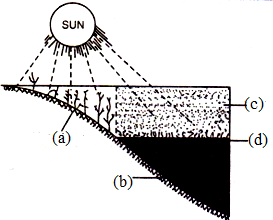
Choose the correct combination of labelling of the zones of water in a lake:
-
40%
a) (a) – Limnetic zone, (b) – Profundal zone, (c) Littoral zone, (d) – Light compensation level.
-
20%
b) (a) – Littoral zone, (b) – Profundal zone, (c) Limnetic zone, (d) – Light compensation level.
-
20%
c) (a) – Limnetic zone, (b) – Littoral zone, (c) – Profundal zone, (d) – Light compensation level.
-
20%
d) (a) – Littoral zone, (b) – Limnetic zone, (c) Profundal zone, (d) – Light compensation level.
Q.30.
Problems faced by small sized animals like shrews and humming birds is/are:
-
17%
a) Small surface are to volume ratio.
-
17%
b) They tend to lose body heat when it is cold outside.
-
0%
c) Thermoregulation in cold condition is highly expensive for them.
-
67%
d) Both (B) and (C).