Q.1.
Select the correct answers for "P" and "Q" P. Many organs of aquatic plants float in water Q. Large air gaps occur in the collenchymatous tissue K.C.E.T. 2011
-
100%
a) Q is correct, P is wrong
-
0%
b) P is correct, Q is wrong
-
0%
c) Both P are Q is correct
-
0%
d) Both P are Q is wrong
Q.2.
Lichen is pioneer in succession .... .... [R.P.M.T. 2011]
-
33%
a) Hydrosere
-
33%
b) Lithosere
-
0%
c) Psammosere
-
33%
d) Xerosere
Q.3.
Shallow lakes with abundant organic matter are .... .... [B.H.U.2002]
-
0%
a) Saprotrophic
-
0%
b) Oligotrophic
-
100%
c) Eutrophic
-
0%
d) Heterotrophic
Q.4.
Littoral zone is found along .... .... [D.P.M.T. 2011]
-
0%
a) High mountain
-
67%
b) Sea
-
33%
c) River
-
0%
d) Desert
Q.5.
Warm blooded animals of cold climate have small extremities. This was stated by .... .... [C.E.T.Chd.2006]
-
0%
a) Bergman
-
100%
b) Gloger
-
0%
c) Dollo
-
0%
d) Allen
Q.6.
Micro-organisms having optimum temperature for growth below 15° C which cannot grow above 20° C are called .... .... [A.M.U.P.M.D.C.2006]
-
0%
a) Mesophiles
-
67%
b) Thermophiles
-
33%
c) Psychrophiles
-
0%
d) None of the above
Q.7.
Soil rich in Fe and Al due to excessive leaching is .... .... [D.P.M.T.2002]
-
0%
a) Alluvial
-
100%
b) Laterite
-
0%
c) Loam
-
0%
d) Both A and B
Q.8.
Phytoplankton are dominant in ..... ..... [D.P.M.T.2011]
-
33%
a) Limnetic zone
-
0%
b) Profundal zone
-
33%
c) Littoral zone
-
33%
d) Benthic zone
Q.9.
Feature of xerophytic leaves is .... .... [Odisha 2011]
-
0%
a) Waxy cuticle
-
33%
b) Sunken stomata on upper epidermis
-
67%
c) Large surface area
-
0%
d) Leathery surface
Q.10.
Most populous country of the world is .... .... [M.H.T.C.E.T.2008]
-
0%
a) Bangladesh
-
0%
b) Indonesia
-
33%
c) India
-
67%
d) China
Q.11.
Consequences of population explosion were explained for the first time by ..... ..... [M.H.T.C.E.T. 2009]
-
50%
a) Darwin
-
0%
b) De Vries
-
50%
c) Lamarck
-
0%
d) Malthus
Q.12.
Study of inter-relationships between groups of organisms/an entire community and its environment is .... .... [B.H.U.1990]
-
67%
a) Autecology
-
0%
b) Resource ecology
-
0%
c) Species ecology
-
33%
d) Synecology
Q.13.
What is correct .... .... [A.I.I.M.S. 2011]
-
33%
a) Natural selection is responsible for extinction of dinosaurs
-
33%
b) Lion and leopard have convergent evolution
-
33%
c) Homo habilis and Homo erectus are closely related
-
0%
d) Biston betularia shows cryptic camouflage
Q.14.
Ozone protects biosphere from high energy .... .... [D.P.M.T.2005]
-
0%
a) Infra-red rays
-
100%
b) Ultraviolent rays
-
0%
c) X-rays
-
0%
d) Gamma rays
Q.15.
Phase of population growing having equal natality and mortality is .... .... [Wardha 2003]
-
0%
a) Lag phase
-
0%
b) Plateau phase
-
100%
c) Exponential phase
-
0%
d) Log phase
Q.16.
Halophytes occur in .... .... [C.P.M.T. 2009]
-
67%
a) Salty soil
-
33%
b) Desert
-
0%
c) Near river
-
0%
d) Rainy water
Q.17.
Sigmoid curve is .... ..... [Wardha 2002]
-
50%
a) Rate of transpiration
-
0%
b) Rate of respiration
-
0%
c) Rate of photosynthesis
-
50%
d) Growth of population
Q.18.
A successful parasite is the one which .... .... [A.F.M.C.2000]
-
0%
a) Grows rapidly
-
33%
b) Reproduces fast
-
33%
c) Sticks to host for long
-
33%
d) Makes minimum demands from its host
Q.19.
Animals have shorter and smaller extremities in colder areas. It is .... .... [J.I.P.M.E.R.2000]
-
0%
a) Allen's law
-
33%
b) Cope's law
-
67%
c) Dollo's law
-
0%
d) Bergman's law
Q.20.
Psammophytes are plants growing on soil .... .... [M.P.P.M.T. 2007]
-
0%
a) Alluvial
-
33%
b) Sandy
-
67%
c) Alkaline
-
0%
d) Acidic
Q.21.
A condition in which body's internal environment remains relatively constant within limits is .... .... [Chd. C.E.T. 2012]
-
0%
a) Hematoma
-
50%
b) Haemopoiesis
-
50%
c) Homeostasis
-
0%
d) Hemostasis
Q.22.
In a population of 1000 individuals360 belong to genotype AA, 480 to Aa and the remaining 160 to aa. Based on this data, the frequency of allele A in the population is : .. [AIPMT 2014]
-
100%
a) 0.6
-
0%
b) 0.7
-
0%
c) 0.4
-
0%
d) 0.5
Q.23.
f 20 J of energy is trapped at producer level, then how much energy will be available to peacock as food in the following chain ? …[AIPMT 2014] plant → mice → snake → peacock
-
100%
a) 0.2 J
-
0%
b) 0.0002 J
-
0%
c) 0.02 J
-
0%
d) 0.002 J
Q.24.
A species facing extremely high risk of extinction in the immediate future is called: ….[AIPMT 2014]
-
100%
a) Critically Endangered
-
0%
b) Extinct
-
0%
c) Vulnerable
-
0%
d) Endemic
Q.25.
Match the following and select the correct option : ….[AIPMT 2014]
| (a)Earthworm | (i) Pioneer species |
| (b) Succession | (ii)Detritivore |
| (c) Ecosystem service | (iii)Natality |
| (d) Population growth | (iv)Pollination |
-
0%
a) a → (iii); b → (ii); c → (iv); d → (i)
-
50%
b) a → (ii); b →(i); c →(iv); d → (iii)
-
0%
c) a → (i); b →(ii); c →(iii); d →(iv)
-
50%
d) a → (iv) b →(i) c →(iii); d →(ii)
Q.26.
Vertical distribution of different species occupying different levels in a biotic community is known as : …[AIPMT 2015]
-
100%
a) Pyramid
-
0%
b) Divergence
-
0%
c) Stratification
-
0%
d) Zonation
Q.27.
Which one of the following statements in not true? …[AIPMT 2015]
-
0%
a) Honey is made by bees by digesting pollen collected from flowers
-
50%
b) Pollen grains are rich in nutrients, and they are used in the form of tablets and syrups
-
0%
c) Pollen grains of some plants cause severe allergies and bronchial afflictions in some people
-
50%
d) The flowers pollinated by flies and bats secrete foul odour to attract them
Q.28.
The following graph depicts changes in two populations (A and B) of herbivores in a grassy field. A possible reason for these changes is that: …[AIPMT 2015]
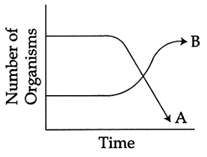
-
50%
a) Population A consumed the members of population B
-
0%
b) Both plant populations in this habitat decreased
-
0%
c) Population B competed more successfully for food than population A
-
50%
d) Population A produced more offspring than population B
Q.29.
Most animals are tree dwellers in a: …[AIPMT 2015]
-
0%
a) tropical rain forest
-
50%
b) coniferous forest
-
50%
c) thorn woodland
-
0%
d) temperate deciduous forest
Q.30.
Gause's principle of competitive exclusion states that : …[AIPMT-2016]
-
100%
a) More abundant species will exclude the less abundant species through competition.
-
0%
b) Competition for the same resources excludes species having different food preferences.
-
0%
c) No two species can occupy the same niche indefinitely for the same limiting resources.
-
0%
d) Larger organisms exclude smaller ones through competition.