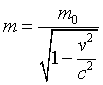
Q.1.
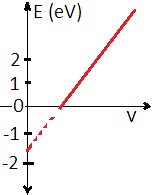
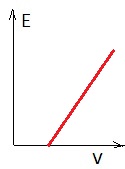
Figure shows graph of kinetic energy of electrons emitted verses ν for a material exhibiting photoelectric effect. The work function of the material is ..
-
0%
a) 1eV
-
100%
b) 1.5eV
-
0%
c)2eV
-
0%
d)3eV
Q.2.
If in a photoelectric experiment, the wavelength of incident radiation is reduced from 6000Å to 4000Å, then [ MPPMT 1999]
-
0%
a) Stopping potential will decrease
-
0%
b) Stopping potential will increase
-
100%
c) Kinetic energy of emitted electrons will decrease
-
0%
d) The value of work-function will decrease
Q.3.
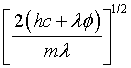
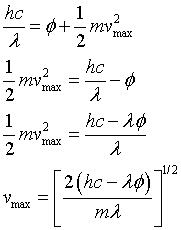
the maximum velocity of an electron emitted by light of wavelength λ incident on the surface of metal of workfunction Φ is [ h=plank constant, m=mass of electron, and c=speed of light] [ MPPMT 1998]
-
100%
a)
-
0%
b)

-
0%
c)
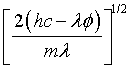
-
0%
d)

Explanation
Q.4.
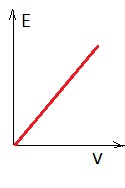
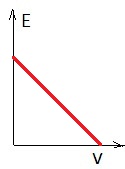
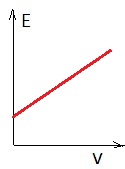
Maximum kinetic energy E of photo-electron varies with the frequency (ν) of the incident radiation as one of the following graphs:[ MPPMT 1994]
-
0%
a)
-
100%
b)
-
0%
c)
-
0%
d)
Q.5.
A gold leaf electroscope is negatively charged and the leaves are observed to diverged by a certain amount. A beam of X-ray is allowed to fall upon the electroscope for a short period. The effect is as follows
-
100%
a)The leaves will diverge further
-
0%
b) There will be no chnage in the divergence of leaves
-
0%
c) The leaves will collapse
-
0%
d)The gold leaves will melt
Q.6.
According to Einstein's interpretation of the photoelectric effect, the maximum K.E. of photoelectrons depends on ( hν -W) where ν is the frequency of incident radiation and W is the work function. For three different metals graph plotted between maximum K/E. and the frequency of incident radiations. The three graphs obtained:
-
0%
a) Have different slopes but a constant intercept on y-axis
-
100%
b) Are all parallel to y-axis but at different heights
-
0%
c) same slope but different intercept on y-axis
-
0%
d) none of these
Q.7.
According to the modern theory for nature of light, the light has..[ MPPMT 1998]
-
0%
a)Wave nature only
-
100%
b) Particle nature only
-
0%
c)Both wave and particle ( dual) nature
-
0%
d)neither particle nature nor wave nature
Q.8.
The energy of photon is 10eV. The momentum of a photon is
-
0%
a) 5.33×10⁻²⁵ kg×m /s
-
100%
b) 5.33×10⁻²⁷ kg×m /s
-
0%
c)5.33×10⁻²⁹ kg×m /s
-
0%
d)5.33×10⁻²³ kg×m /s
Q.9.
When the light of wavelength 2537Å is made incident over the surface of copper slab, the stopping voltage 0.24 volt obtained. The threshold frequency for copper will be .. [ Raj.PMT 1996]
-
100%
a) 1.124×10¹⁵ Hz
-
0%
b) 1.414×10¹⁴ Hz
-
0%
c)2.248×10¹⁵ Hz
-
0%
d)None of the above
Q.10.
Given h=6.6×10⁻³⁴ joules×sec. the momentum of each photon in a given radiation is 3.3×10⁻²⁹ kg×metre / sec .. [ CBSE 1990]
-
0%
a) 3×10⁻² hz
-
100%
b) 6×10¹⁰ hz
-
0%
c) 7.5×10¹² hz
-
0%
d) 1.5×10¹³hz
Q.11.
According to de Broglie, the waves are associated with
-
0%
a)Moving charged particles only
-
0%
b) Moving neutral particles only
-
100%
c)Electrons only
-
0%
d)All moving particles
Q.12.
The duration of laser pulse is 10-8 sec. The uncertainty in its energy will be (ΔE.Δt ≥ h)
-
0%
a) 6.6 × 10⁻²⁶ J
-
0%
b) 6.6 × 10⁻³⁴ J
-
100%
c)6.6 × 10-42 J
-
0%
d)1 /(6.6×1026) J
Q.13.
Matter waves
-
0%
a) Are electromagnetic waves
-
0%
b) are transverse waves
-
100%
c)are longitudinal waves
-
0%
d)exhibit diffraction
Q.14.
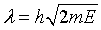
If the kinetic energy of moving particle is E, then de Broglie wavelength is
-
0%
a)
-
100%
b)

-
0%
c)

-
0%
d)

Q.15.
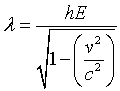
de Broglie wave length associated with a moving particle of mass m, velocity v is given by ( c=speed of light)
-
0%
a)λ hmv
-
100%
b) λ=h/mv
-
0%
c)λ=v/mh
-
0%
d)
Q.16.
Neglecting variation of mass with energy the wavelength associated with an electron having a kinetic energy E is proportional to
-
0%
a) √E
-
0%
b) E
-
100%
c)E-1/2
-
0%
d)E-2
Q.17.
Of the following, moving with the same velocity, the one which has largest wavelength λ is
-
0%
a) an electron
-
0%
b) a proton
-
0%
c)an alpha particle
-
100%
d)all have same de Broglie wave length
Q.18.
The energy of photon is 10eV. The momentum of a photon is
-
0%
a) 5.33 × 10⁻²⁵ kg×m/s
-
0%
b) 5.33 × 10⁻²⁷ kg×m/s
-
0%
c) 5.33 × 10⁻²⁹ kg×m/s
-
100%
d) 5.33 × 10⁻²³ kg×m/s
Q.19.
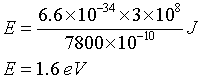
The energy of photon corresponding to the visible light of a maximum wavelength is approximately [ MPPMT 1985]
-
0%
a)1 eV
-
0%
b) 1.6 eV
-
100%
c)3.2 eV
-
0%
d)7.0 eV
Explanation
Q.20.
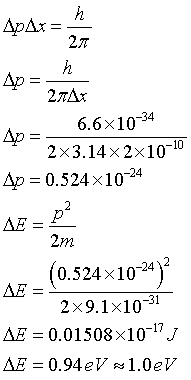
If position uncertainty of an electron is 2 Å, the uncertainty in energy will be [ raj. PET 1996]
-
0%
a) 0.1 eV
-
100%
b) 1.0 eV
-
0%
c)9.0 eV
-
0%
d)94.0 eV
Explanation
Q.21.
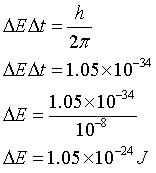
The period of laser is 10-8 sec. The uncertainty in energy
-
0%
a) 1.05 × 10⁻²⁶ J
-
0%
b) 1.5 × 10⁻²⁵ J
-
0%
c)6.62 × 10⁻²⁶ J
-
100%
d)zero
Explanation
Q.22.
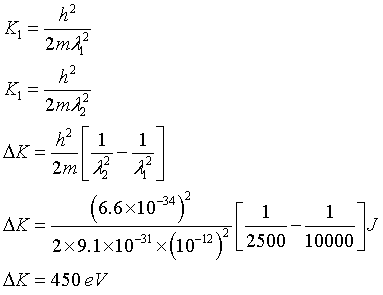
To reduce the de Broglie wave length of an electron from 100pm to 50pm, the required increase in energy will be [ Raj PET 1997]
-
0%
a) 600 eV
-
0%
b) 450 eV
-
0%
c) 300 eV
-
100%
d) 150 eV
Explanation
Q.23.
The ratio of de Broglie wavelength for a proton and an α-particle of same energy is [ raj-PET 1996]
-
0%
a)2:1
-
0%
b) 1:2
-
100%
c)4:1
-
0%
d)1:4
Q.24.
If a photon has velocity c and frequency ν, then its wave length is equal to [ CBSE 1996]
-
0%
a) hc/E
-
0%
b) hν/c
-
0%
c)hν/ c2
-
100%
d)hν
Q.25.
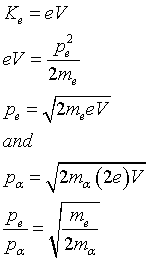
An electron and α particle are accelerated by potential V. The masses are me and malpha then ratio of their momentums will be [ raj. PET 1997]
-
0%
a) me / malpha
-
0%
b)√(me / malpha)
-
100%
c)√(me / 2malpha)
-
0%
d)√(2me / malpha)
Explanation
Q.26.
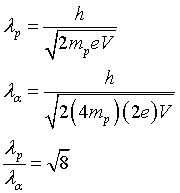
A proton and an α particle are accelerated through the same potential difference. The ratio of their de Broglie wavelengths ( λp / λα) is
-
0%
a) 1
-
0%
b) 2
-
0%
c) √8
-
100%
d) 1 / √8
Explanation
Q.27.
If Plank's constant is larger than its present value. The de-Broglie wavelength associated with material particles would have been
-
0%
a)unchanged
-
0%
b) larger
-
0%
c)smaller
-
100%
d)larger for some particles and smaller for others
Q.28.
Given Plank's constant h=6.6×10⁻³⁴ J-sec. The momentum of each photon in a given radiation is 3.3 ×10⁻²⁹ kg-m/sec. The wave-length of radiation is
-
0%
a) 3 × 10⁻³ m
-
100%
b) 6 × 10⁻¹⁰ m
-
0%
c)7.5 × 10⁻² m
-
0%
d)2 × 10⁻⁵ m
Q.29.
When electrons are accelerated through potential difference of V volts, the de Broglie wavelength associated is given by
-
0%
a) √(150/V) Å
-
0%
b) √(150/V) m
-
0%
c)(150/ √V) Å
-
100%
d)(√150/V) Å
Q.30.
A material particle with a rest mass mo is moving with speed of light c. The de-Broglie wavelength associated is given by
-
0%
a) h/moc
-
0%
b) moc / h
-
0%
c) 0
-
100%
d) ∞
Explanation