Q.1.
If E1, E2 and E3 are the respective kinetic energies of an electron, an alpha particle and a proton each having the same de Brogli wavelength then
-
0%
a)E1 > E3 > E2
-
50%
b) E2 > E3 > E1
-
50%
c)E1 > E2 > E2
-
0%
d)E1=E2=E3
Q.2.
A particle of mass 10-31 kg is moving with velocity equal to 105 m/sec. The wavelength of the particle is equal to
-
0%
a) 0
-
33%
b) 6.6 ×10⁻⁸ m
-
67%
c)0.66 m
-
0%
d)1.5 × 10⁷
Q.3.
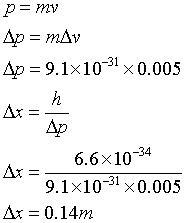
An electron has a speed of 100 m/s with an accuracy of 0.005%. The uncertainty in position will be
-
33%
a) 0.14 m
-
33%
b) 1.4 m
-
0%
c)0.014 m
-
33%
d)14.0 m
Explanation
Q.4.
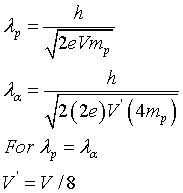
A proton when accelerated through a potential difference of V volts has a wavelength λ associated with it. An α-particle in order to have the same λ must be accelerated through a potential difference of
-
33%
a) V volt
-
67%
b) 4V volt
-
0%
c) 2V volt
-
0%
d) V/8 volt
Explanation
Q.5.
The momentum of photon ( in kgms-1) of frequency 109 cycles per second is
-
0%
a)7.3 ×10⁻²⁹
-
33%
b) 2.2 × 10⁻³³
-
67%
c)6.6 ×10⁻²⁶
-
0%
d)3.1
Q.6.
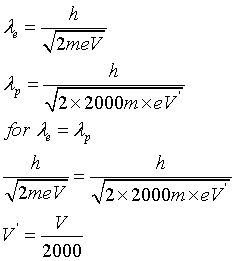
An electron accelerated through a potential difference of V volts has wavelength λ associated with it. Mass of proton is nearly 2000 times that of electron. In order to have the same λ for proton, it must accelerate through a potential difference o
-
67%
a) V volts
-
0%
b) 2000 V volt
-
0%
c)V/20000 volt
-
33%
d)√(2000) v volt
Explanation
Q.7.
A tiny particle of mass 10-13 kg moving with a velocity of 10 cm/sec is associated with the wavelength
-
0%
a) 6.62 × 10⁻²⁰ m
-
0%
b)6.62 × 10⁻²⁰ cm
-
67%
c)6.62 × 10⁻³⁴ cm
-
33%
d)6.62 × 10⁻¹³ m
Q.8.
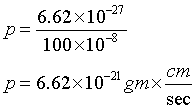
The momentum of electrons having a wavelength of 100 A.U. is
-
20%
a) 6.6 ×10⁻³² gm ×cm / sec
-
40%
b) 6.6 ×10⁻²⁹ gm ×cm / sec
-
40%
c) 6.6 ×10⁻²⁵ gm ×cm / sec
-
0%
d) 6.6 ×10⁻²¹ gm ×cm / sec
Explanation
Q.9.
In Bohr's atom the number of de Broglie waves associated with an electron moving in nth permitted orbit is
-
0%
a)n
-
33%
b) 2n
-
67%
c)n/2
-
0%
d)n2
Q.10.
A moving particle is associated with a wave packet or group of waves. The group velocity is equal to
-
0%
a) velocity of light
-
0%
b) velocity of sound
-
100%
c)velocity of particle
-
0%
d)1/ particle velocity
Q.11.
According to wave mechanics, a material particle is associated with
-
33%
a) a single wave
-
0%
b) a wave packet
-
67%
c)two progressive waves
-
0%
d)a ripple
Q.12.
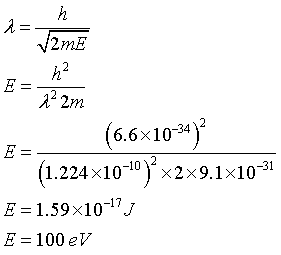
The de Broglie wavelength of an electron in 1.224 Å. The energy of electron is eV is
-
0%
a) 1 eV
-
0%
b) 10eV
-
67%
c) 100eV
-
33%
d) 1224eV
Explanation
Q.13.
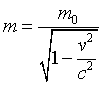
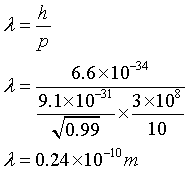
The de Broglie wave length associated with an electron moving with (1/10)th of the velocity of light is
-
0%
a)0.24 ×10⁻¹⁹ m
-
0%
b) 0.24 ×10⁻¹⁰ m
-
100%
c)1.24 ×10⁻¹⁰ m
-
0%
d)0.48 ×10⁻¹⁰ m
Explanation
Q.14.
The uncertainty principle is applicable to
-
0%
a) Large system only
-
0%
b) small system only
-
67%
c)sub atomic particles only
-
33%
d)both sub-atomic and large particle
Q.15.
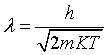
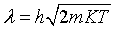
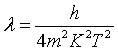
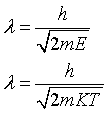
The de-Broglie wavelength of a molecule of thermal energy KT ( K is Boltzmann constant and T is absolute temperature) is
-
0%
a)

-
33%
b)
-
33%
c)
-
33%
d)
Explanation
Q.16.
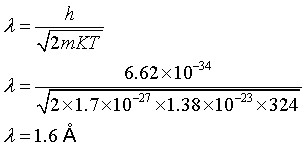
The de-Broglie wavelength associated with thermal neutron ( t=51°C say) is of the order of the
-
0%
a) Distance between the atoms in the crystal
-
67%
b) size of the nucleus
-
0%
c) Bohr's radius
-
33%
d) size of grain
Explanation
Q.17.
An electron, proton and a car all have same wavelength. The one possessing highest velocity is
-
67%
a)electron
-
0%
b) proton
-
0%
c)car
-
33%
d)all have same velocity
Q.18.
The de Broglie wavelength of 150 eV electron will be
-
0%
a) 1 Å
-
33%
b) 12.27 Å
-
0%
c)0.5 Å
-
67%
d)1.5 Å
Q.19.
In the hydrogen atom an electron is moving in nth orbit. The circumference s of the orbit and the de Broglie wavelength, λ of the moving electron are related by the equation
-
33%
a) s=nλ
-
0%
b) s=n/λ
-
67%
c)s=λ/n
-
0%
d)s=1/ nλ
Q.20.
The uncertainty in the location of a particle is equal to its de Broglie wavelength then the uncertainty in its velocity will be
-
25%
a) Its velocity
-
17%
b) Half of its velocity
-
33%
c) Twice its velocity
-
25%
d) Four times its velocity
Q.21.
What is the de Broglie wave length of an electron accelerated through 40kV?
-
0%
a)614 pm
-
0%
b) 61.4 pm
-
33%
c)6.14 pm
-
67%
d)0.614 pm
Q.22.
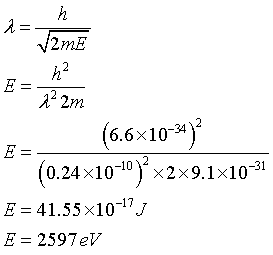
The de-Broglie wavelength associated with moving electrons is 0.24×10⁻¹⁰ m. The voltage applied between grids to bring it to rest is
-
67%
a) 1000 volts
-
0%
b) 2597 volts
-
0%
c)2597 volts
-
33%
d)none of above
Explanation
Q.23.
Matter waves are similar in nature to
-
33%
a) X-rays
-
0%
b) γ-rays
-
0%
c)Cathode rays
-
67%
d)none of the above
Q.24.
The propagation constant of the de Broglie waves associated with an electron is
-
0%
a) Proportional to its mass
-
33%
b) Proportional to its momentum
-
33%
c) Proportional to its energy
-
33%
d) Inversely proportional to its energy
Q.25.
The wavelength of the matter wave is independent of
-
33%
a)mass
-
33%
b) velocity
-
0%
c)momentum
-
33%
d)charge
Q.26.
An electron accelerated by a potential difference of V volt posses a de Broglie wave length λ. If the accelerating potential is increased by a factor of 4, the de-Broglie wavelength of the electron will be
-
0%
a) Remains unchaged
-
67%
b) Becomes 4 times
-
33%
c)Becomes Half
-
0%
d)Becomes double
Q.27.
A photon and electron have same wave length then
-
0%
a) photon has greater momentum
-
67%
b) electron has greater momentum
-
0%
c)they have the same momentum
-
33%
d)none of the above
Q.28.
The function of the crystal in Davisson and Germer experiment is
-
33%
a) To reflect the electron beam
-
0%
b) To refract the electron beam
-
33%
c) To diffract the electron beam
-
33%
d) To focus the electron beam
Q.29.
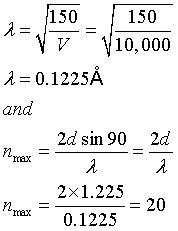
The interplanar spacing of crystal is 1.225 Å. the maximum order of diffraction of electrons accelerated through a potential difference of 10 kV is
-
0%
a) 1
-
67%
b) 20
-
33%
c)100
-
0%
d)1000
Explanation
Q.30.
A particle of mass 1kg is moving with a velocity of 1m/s. The de-broglie wavelength associated with it will be
-
33%
a) h
-
0%
b) h/2
-
33%
c) h/4
-
33%
d) 2h