Q.1.
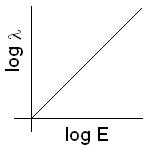
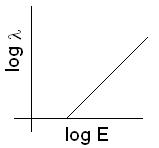
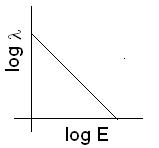
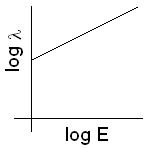
Which of the following graph is correct
-
100%
a)
-
0%
b)
-
0%
c)
-
0%
d)
Q.2.
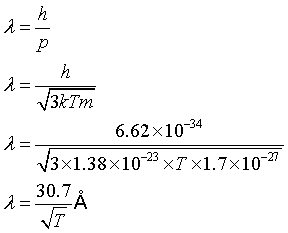
de-Broglie wavelength associated with a neutron at T degree Kelvin is
-
0%
a) (1.82 / T )Å
-
0%
b) (1.82/√T) Å
-
100%
c)(30.7/T ) Å
-
0%
d)(30.7/√T ) Å
Explanation
Q.3.
The stopping potential for electron beam of de-Broglie wavelength of 1 Å
-
0%
a)12.3Volts
-
0%
b) 123 Volts
-
100%
c)151 Volts
-
0%
d)1505 Volts
Q.4.
The pulse duration of radar is 0.25µs. The uncertainty in the frequency of photons is
-
0%
a) 4.2 × 10⁻²⁸
-
0%
b) 6.6 × 10⁴
-
0%
c) 6.4 × 10⁵
-
100%
d) 4.2 × 10⁻⁴
Q.5.
Uncertainty Principle states that the error in measurement is due to
-
0%
a)Dual nature of particles
-
0%
b) Due to small size of particles
-
100%
c)Due to large size particles
-
0%
d)Due to error in measurement
Q.6.
Work function of a photoelectric material is 3.3eV. The threshold frequency will be equal to [ CPMT 1986]
-
0%
a) 8 × 10¹⁰Hz
-
100%
b) 4 × 10¹⁴ Hz
-
0%
c)8×10¹⁴ Hz
-
0%
d)4 × 10²⁰ Hz
Q.7.
For light of wavelength 5000Å , the photon energy is nearly 2.5 V. For X-rays of wavelength 1Å, the photon energy will be close to [ CPMT 1987]
-
100%
a)2.5 ÷ 5000 eV
-
0%
b) 2.5 ÷ (5000)2 eV
-
0%
c)2.5 × 5000 eV
-
0%
d)2.5 × (5000)2 eV
Q.8.
In order to increase the kinetic energy of ejected photoelectrons, there should be an increases in [ PMT 1987]
-
0%
a) intensity of radiation
-
100%
b) wavelength of radiation
-
0%
c) frequency of radiation
-
0%
d) both the wavelength and intensity of radiation
Q.9.
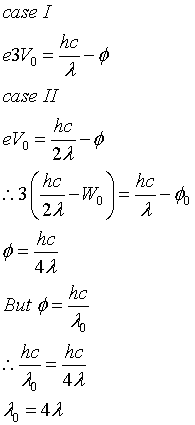
When a certain metallic surface is illuminated with monochromatic light of wavelength λ, the stopping potential for photoelectric current is 3Vo. When the same surface is illuminated with the light of wavelength 2λ, the stopping potential is Vo. The threshold wavelength for the surface for photoelectric effect is [ MPPMT 1987]
-
0%
a)4λ/3
-
100%
b) 4λ
-
0%
c)6λ
-
0%
d)8λ
Explanation
Q.10.
The specific charge for positive rays is much less than that for cathode rays. This is because [ C.P.M.T 1990]
-
0%
a) Positive rays are positively charged
-
0%
b) charge on positive rays is less
-
0%
c)mass of positive rays is much larger
-
100%
d)experimental method is wrong
Q.11.
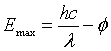
Light of wavelength 4000Å is incident on a metal plate whose work function is 20eV. The maximum kinetic energy of the emitted photoelectrons would be [ CPMT 1990]
-
0%
a) 0.5 eV
-
0%
b) 1.1 eV
-
100%
c)1.5 eV
-
0%
d)2.0 eV
Explanation
Q.12.
A proton is accelerated through one volt the increase in its kinetic energy is approximately [ CPMT 1993]
-
0%
a) 1/1870 eV
-
0%
b) 1870 eV
-
0%
c) 1 eV
-
100%
d) 300 eV
Q.13.
An electron enters a region where magnetic induction B and electric field E are mutually perpendicular to one another then..
-
0%
a)it will always move in the direction of B
-
0%
b) it will always move in the direction of E
-
100%
c)it always possessses circular motion
-
0%
d)it can go undeflected also
Q.14.
The threshold wavelength for photoelectric effect of a metal is 6500Å. The work function of the metal is approximately
-
0%
a) 2 eV
-
0%
b) 1 eV
-
100%
c)0.1 eV
-
0%
d)3 eV
Explanation

Q.15.
The de-Broglie wavelength of an electron moving with speed of 6.6×10⁵ m/s is approximately [ CPMT 1993]
-
0%
a) 10-11 m
-
0%
b) 10-9 m
-
100%
c)10-7 m
-
0%
d)10-5 m
Q.16.
Threshold frequency for photoelectric effect on sodium corresponds to a wavelength 5000 Å. Its work function is ..
-
0%
a) 15 joule
-
0%
b) 10 × 10-10 joule
-
0%
c) 4 × 10-19 joule
-
100%
d) 4 ×10+19 joule
Q.17.
Number of ejected photoelectrons increases with increase
-
0%
a)in intensity of light
-
0%
b) in wavelength of light
-
0%
c)in frequency of light
-
100%
d)never
Q.18.
The ratio of momentum of electron and an alpha particle which are accelerated from rest through a potential difference of 100 volt is [ CEE 1994]
-
0%
a) 1
-
0%
b) √(2me / mα)
-
0%
c)√( me / mα)
-
100%
d)√(me /2mα)
Q.19.
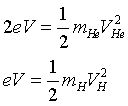
Doubly ionised Helium atoms and Hydrogen ions are accelerated from rest through the same potential drop. The ratio of the final velocities of the Helium and the Hydrogen ions is
-
0%
a)2
-
0%
b) √2
-
100%
c)1/2
-
0%
d)1/√2
Explanation
Q.20.
Gases begin to conduct electricity at low pressure because
-
0%
a) the lectrons in atoms can move freely at low pressures
-
0%
b) atoms break up into electrons and protons
-
0%
c) colliding electrons can acquire higher kinetic energy due to increased mean free path leading to ionization of atoms
-
100%
d) at low pressure gases turn into plasma
Q.21.
Photoelectric effect is due to
-
0%
a)wave nature of light
-
0%
b) particle nature of light
-
0%
c)both a and b
-
100%
d)none of these
Q.22.
If the frequency of light in a photoelectric experiment is doubled the stopping potential will [ CPMT 1994]
-
0%
a) be doubled
-
0%
b) be halved
-
50%
c)become more than double
-
50%
d)become less than double
Q.23.
In photoelectric effect, the photoelectric current
-
0%
a) increases when frequency of incident photons increases
-
0%
b) decreases when frequency of incident photons increases
-
100%
c)does not depend on photon frequency but only on intensity of incident beam
-
0%
d)depends both on intensity and frequency of incident beam
Q.24.
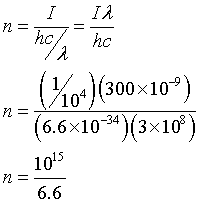
Ultra violet light of wavelength 300 nm and intensity 1.0 watt/m2 falls on the surface of a photosensitive material. If one percent of the incident photon produce photoelectron then the number of photoelectrons emitted per second from an area 1.0 cm2 of the surface is nearly [ AMU PMT 1995]
-
0%
a) 2.13 × 10¹¹
-
100%
b) 1.51 × 10¹²
-
0%
c) 4.12 × 10¹³
-
0%
d) 9.61 ×10¹⁴
Explanation
Q.25.
If we consider electrons and photons of the same wavelength, then they will have the same
-
0%
a)velocity
-
0%
b) angular momentum
-
0%
c)energy
-
100%
d)momentum
Q.26.
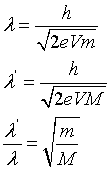
An electron of mass m when accelerated through a potential difference V, the de-Broglie wavelength λ. The de-Broglie wavelength associated with a proton of mass M accelerated through the same potential difference, will be [ pre medical/ dental 1995]
-
0%
a) λm/M
-
0%
b) λ√(m/M)
-
100%
c)λM/m
-
0%
d)λ√(M/m)
Explanation
Q.27.
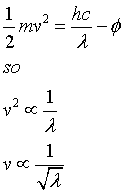
Assuming photo emission to continue to take place, the factor by which the maximum velocity of the emitted photo electron changes approximately when the wavelength of the incident radiation is increased four times is [ Haryana CET 1996]
-
0%
a) 1/4
-
0%
b) 1/2
-
0%
c)2
-
100%
d)4
Explanation
Q.28.
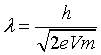
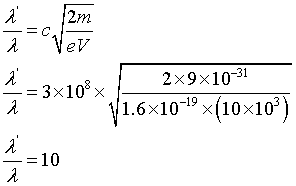
An X-ray tube operates at 10kV. The ratio of X-ray wavelength to that of de-Broglie is [ CPMT 1996]
-
0%
a) 10:1
-
0%
b) 1:10
-
100%
c) 1:100
-
0%
d) 100:1
Explanation

Q.29.
In de_broglie's equation wave-length 'λ' depends upon mass 'm' and energy 'E' according to the relation represented as [ CPMT 1996]
-
0%
a)mE1/2
-
0%
b) m-1/2E1/2
-
0%
c)m-1/2 E-1/2
-
100%
d)m1/2E-1/2
Explanation

Q.30.
The velocity of the most energetic electrons emitted from a metallic surface is doubled when frequency ν of incident radiation is double. The work function of this metal is [ Pb.CET 1997]
-
0%
a) zero
-
0%
b) hν/3
-
0%
c)hν/2
-
100%
d)2hν/3
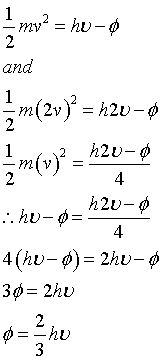
Explanation