Q.1.
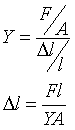
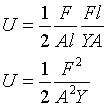
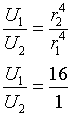
Two wires of same material and length but diameter in the ratio 1 : 2 are stretched by the same force. the potential energy per unit volume for the two wires when stretched will be in the ratio [ CPMT 1998]
-
0%
a) 16 : 1
-
0%
b) 4 : 1
-
100%
c) 2 : 1
-
0%
d) 1 : 1
Explanation

Q.2.
A fixed volume of iron is drawn in to a wire of length l. The extension x produced in the wire by a constant force F is proportional to [ MPPMT 1999]
-
0%
a)1 / l2
-
0%
b) 1/l
-
100%
c)l2
-
0%
d)l
Q.3.
The elastic energy stored in a wire of Youngs modulus Y is [ MPPMT 1999]
-
0%
a) Y×(strain)2 / volume
-
0%
b) stress × strain × volume
-
50%
c)(stress)2 × volume / 2Y
-
50%
d)½ Y × stress × strain × volume
Q.4.
When there are no external force, the shape of liquid drop is determined by [ CPMT 1999]
-
0%
a) surface tension of the liquid
-
50%
b) Density of liquid
-
0%
c)viscosity of liquid
-
50%
d)temperature of air only
Q.5.
An iron needle slowly placed on the surface of water floats on it because [ MNR 1993]
-
0%
a) When inside the water it will displace water more than its weight.
-
0%
b) The density of the material of needle is less than that of water
-
100%
c) its surface tension
-
0%
d) Of its shape
Q.6.
The work in splitting a drop of water of 1mm radius into 106 droplets is ( surface tension of water=72×10-3 J /m2 ) [ MPPMT 1994]
-
0%
a)9.98×10⁻⁵ Joule
-
0%
b) 8.95×10⁻⁵ Joule
-
100%
c)5.89×10⁻⁵ Joule
-
0%
d)5.98×10⁻⁵ Joule
Q.7.
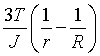
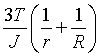
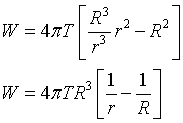
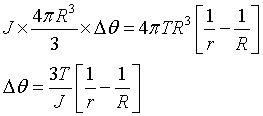
A number of water droplets each of radius r collusion to form a droplet of radius R, the rise in temperature dθ is : [ MPPMT 1994]
-
0%
a)

-
0%
b)

-
100%
c)
-
0%
d)
Explanation
Q.8.
Water rises in a capillary tube to a certain height such that the upward force due to surface tension is balanced by 75×10-4N force due to the weight of the liquid. If the surface tension of water is 6×10⁻²Nm-1, the inner circumference of the capillary must be [ CPMT 1988]
-
0%
a) 1.25×10⁻² m
-
0%
b) 0.50 ×10⁻² m
-
100%
c)6.5×10⁻² m
-
0%
d)12.5×10⁻²
Q.9.
More liquid rises in a thin tube because of [ CPMT 1987]
-
0%
a) Larger value of radius
-
0%
b) Larger value of surface tension
-
100%
c) small values of surface tension
-
0%
d) small value of radius
Q.10.
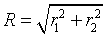
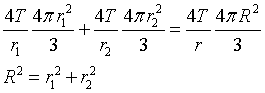
Two spherical soap bubbles of radii r1 and r2 in vacuum collapses under isothermal conditions. the resulting bubble has a radius R such that
-
0%
a)

-
100%
b)

-
0%
c)
-
0%
d)

Explanation
Q.11.
When soap bubble is charged [ Raj.PMT 1997]
-
0%
a) It contracts
-
0%
b) It expands
-
100%
c)It does not undergo any change in size
-
0%
d)None of these
Q.12.
Small droplets of a liquid are usually more spherical in shape than the larger drop of the same liquid because [ EAMCET 1988]
-
0%
a)Force of surface tension is equal and opposite to the force of gravity
-
0%
b)Force of surface tension predominates the force of gravity
-
100%
c)Force of gravity predominates the force of surface tension
-
0%
d)Force of gravity and force of surface tension act in the same direction and are equal
Q.13.
With a rise in temperature, the surface tension of liquid [ MPPMT 199]
-
0%
a) Increases
-
0%
b) Decreases
-
100%
c) Does not change
-
0%
d) Changes erratically
Q.14.
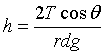
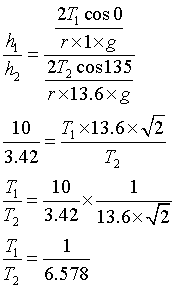
Water rises to a height of 10 cm in a capillary tube, and mercury falls to a depth of 3.42 cm in the same capillary tube. if the density of mercury is 13.6 and the angle of contact is 135°, the ratio of surface tension for water and mercury is [ MPPMT 1988]
-
0%
a)1 : 0.5
-
0%
b) 1 : 3
-
100%
c)1 : 6.5
-
0%
d)1.5 : 1
Explanation
Q.15.
Surface tension may be defined as
-
50%
a) The work done per unit area in increasing the surface area of liquid under isothermal condition
-
0%
b) The work done per unit area in increasing the surface area of a liquid under adiabatic condition
-
50%
c) the work done per unit area in increasing the surface area of liquid under both isothermal and adiabatic conditions
-
0%
d)free surface energy per unit volume
Q.16.
in case of liquids which do not wet the walls of the containing vessel, the force of adhesion is
-
0%
a) Less than √2 times the force of cohesion
-
0%
b) More than √2 times the force of cohesion
-
100%
c)Less than 1/√2 times the force of cohesion
-
0%
d)More than 1/√ times the force of cohesion
Q.17.
A capillary tube is dipped in a water container, so that loss in weight of the capillary tube is
-
0%
a) Equal to the upward buoyant force
-
0%
b) Less than the upward buoyant force
-
100%
c) More than the upward buoyant force
-
0%
d) Half of the buoyant force
Q.18.
The lower end of a capillary tube is at a depth of 12cm and the water rises 3cm in it. the mouth pressure required to blow an air bubble at the lower end will be X cm of water column, where X is
-
0%
a)3
-
0%
b) 9
-
100%
c)12
-
0%
d)15
Q.19.
Water proofing agent changes the angle of contact
-
0%
a) from an obtuse to acute value
-
0%
b) from an acute to obtuse value
-
0%
c)from obtuse to π/2
-
100%
d)from acute to π/2
Q.20.
What will be the height of the liquid column in a capillary tube on the surface of moon
-
0%
a) six times that on the surface of earth
-
0%
b) (1/6) of what was on earth's surface
-
100%
c)It will remain unchanged
-
0%
d)None of the preceding is true
Q.21.
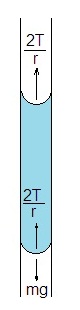
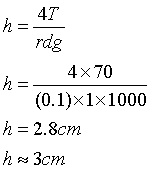
A long capillary tube with both ends open is filled with water and then set in a vertical position in air. What is the length of the liquid column remaining in the tube? ( surface tension of water is 70 dyne/cm and the radius of the capillary bore is 1mm)
-
0%
a) 1.5 cm
-
0%
b) 3 cm
-
100%
c) zero
-
0%
d) 4.5 cm
Explanation
Q.22.
A given mass of a metal is moulded into solids of different shapes. Its surface area is least when it is
-
0%
a)A circular disc
-
0%
b) A parabolic of revolution
-
0%
c)A right cone
-
100%
d)A sphere
Q.23.
Two water droplets merge with each other to form a large droplet. In this process [ Raj.PMT 1997]
-
0%
a) Energy is liberated
-
0%
b) Energy is absorbed
-
100%
c)Energy is neither liberated nor absorbed
-
0%
d)Some mass is converted into energy
Q.24.
Under a pressure head, the rate of orderly volume flow of liquid through capillary tube is Q, if the length of the capillary is doubled and the diameter of the bore is halved, the rate of flow would become [ MPPMT 1988]
-
0%
a) Q/4
-
0%
b) Q/16
-
100%
c)Q/32
-
0%
d)Q/8
Q.25.
A ring is cut from a platinum tube having 8.5 cm internal and 8.7 cm external diameter. it is supported horizontally from a pair of balance so that it comes in contact with the water in glass vessel. If an extra 3.97 gm weigh is required to pull it away from water, the surface tension of water is [ MNR 1992]
-
0%
a) 73.4 dyne/cm
-
0%
b) 70.80 dyne/cm
-
100%
c)65.35 dyne/cm
-
0%
d)60.00 dyne/cm
Q.26.
The excess of pressure in a soap bubble of radius R and surface tension T is given by [ BHU 1995]
-
0%
a) P=2T/R
-
0%
b) P=4T/R
-
0%
c) P=T/R
-
100%
d) P=6T/R
Q.27.
Consider a liquid contained in a vessel. the liquid-solid adhesive force is very weak as compared to the cohesive force in the liquid. the shape of the liquid-surface near the solid shall be [ MNR 1994]
-
0%
a) horizontal
-
0%
b) almost vertical
-
100%
c)concave
-
0%
d)convex
Q.28.
S.T. of water is 5N/m. If the film is formed on a ring of area 0.02m2, then its surface energy is [ PET 1989]
-
0%
a) 5×10⁻² Joule
-
0%
b) 2.5×10⁻² Joule
-
100%
c)2×10⁻¹ Joule
-
0%
d)3×10⁻¹
Q.29.
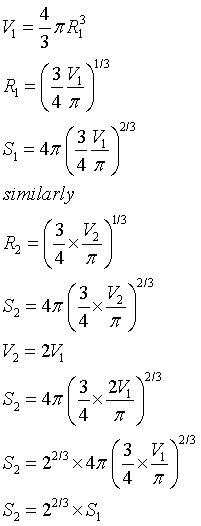
If work done in blowing a bubble of volume V is W then the work done in blowing a soap bubble of volume 2V will be [ PET 1898]
-
0%
a) W
-
0%
b) 2W
-
0%
c)√ W
-
100%
d)(2)2/3 W
Explanation
Q.30.
The force required to drag a circular flat plate of radius 5cm on the surface of water is (S.T. of water is 75 dynes/cm) [ MPPMT 1991]
-
0%
a) 30 dynes
-
0%
b) 60 dynes
-
0%
c) 750 dynes
-
100%
d) 750π dynes