Q.1.
Chromatic aberration will be absent if for two thin lenses in contact
-
48%
a) (ω1 / f1 ) + (ω2 /f2)=0
-
33%
b)(ω1 / f2 ) + (ω2 /f1)=0
-
11%
c)(f1/ω2 ) + (f2.ω1 )=0
-
8%
d)(ω1+ω2) + (f1 + f2)=0
Q.2.
A thick plane mirror shows a number of images of the filament of an electric bulb. Of these the brightest is the
-
42%
a) First
-
43%
b) Second
-
6%
c) Third
-
10%
d) Last
Q.3.
The image formed by a convex mirror of focal length 20cm is half the size of the object. Then the distance of the object from the mirror is
-
39%
a)20 cm
-
39%
b) 10 cm
-
12%
c)30 cm
-
10%
d)60 cm
Q.4.
A light ray incident normally on plane mirror suffers a deviation of
-
44%
a) zero
-
23%
b) π/2
-
27%
c)π
-
5%
d)2π
Q.5.
A man stands in front of mirror with his hand at 03 m from the mirror. In order to see the image of the hand clearly the man must focus his eye at a distance of
-
31%
a) 0.3 m
-
18%
b) 0.45 m
-
37%
c)0.6 m
-
14%
d)0.75 m
Q.6.
A person wears glasses of power -2.0D. The defect of the eye and the far point of the person without the glasses will be [ MPPMT 1999]
-
48%
a) Nearsighted, 50cm cm
-
31%
b) Farsighted, 50cm
-
17%
c)Nearsighted, 250 cm
-
3%
d)Astigmatism, 50
Q.7.
An object is placed at a distance of 10cm from a concave mirror of radius of curvature 0.6m. Which of the following statements is incorrect?
-
14%
a)the image is formed at a distance of 15cm from the mirror
-
30%
b) the image formed is real
-
24%
c)the image is 1.5 times the size of the object
-
32%
d)the image formed is virtual and erect
Q.8.
The ray of different colours fail to converge at a point after going through a converging lens. This defect is called
-
28%
a) Spherical aberration
-
26%
b) distortion
-
12%
c) coma
-
34%
d) chromatic aberration
Q.9.
Chromatic aberration of lens can be corrected by
-
41%
a)Providing different suitable curvature of its two surfaces
-
7%
b) Proper polishing of its two surfaces
-
32%
c)Suitably combining it with another lens
-
20%
d)reducing its aperture
Q.10.
An achromatic combination of lenses produces
-
31%
a) Image in black and white
-
18%
b) coloured images
-
41%
c)Images unaffected by variation of refractive index with wavelength
-
10%
d)highly enlarged images
Q.11.
The size of an object as perceived by an eye depends primarily on
-
13%
a) actual size of the object
-
42%
b) distance of the object from eye
-
13%
c)aperture of the pupil
-
32%
d)size of the image formed on the retina
Q.12.
The magnifying power of compound microscope in terms of the magnification mo due to objective and magnifying power me by the eye-piece is given by [ CET 1994]
-
26%
a)mo / me
-
32%
b) mo × me
-
24%
c)mo + me
-
18%
d)me / mo
Q.13.
A dentist has a small mirror of focal length 16mm. He views the cavity in the tooth of a patient by holding the mirror at a distance of 8mm from the cavity. the magnification is
-
18%
a) 1
-
36%
b) 1.5
-
42%
c)2
-
3%
d)3
Q.14.
Total internal reflection can occur when light passes from
-
39%
a) A denser to rarer medium
-
26%
b) A rare to denser medium
-
19%
c)One medium to another of equal refractive index
-
16%
d)One medium to another of equal absorption coefficient
Q.15.
When a plane mirror is placed horizontally on level ground at a distance of 60 metres from the foot of tower, the tower and its image in the mirror subtend at the eye an angle of 90°. the height of the tower is
-
17%
a) 30 m
-
28%
b) 90 m
-
31%
c) 60 m
-
24%
d) 120 m
Q.16.
Which of the following wave lengths is in infrared region [ EAMCET 1994]
-
18%
a) 5460 Å
-
25%
b) 5893 Å
-
29%
c)7000 Å
-
29%
d)4320 Å
Q.17.
The length of an astronomical telescope for normal vision is [ EAMCET 1995]
-
46%
a) fo × fe
-
31%
b) fo / fe
-
8%
c)fe / fo
-
15%
d)fo + fe
Q.18.
Which one of the wave can not be polarized? [ EAM CET 1994]
-
20%
a) Radio waves
-
40%
b) sound waves
-
28%
c)X-rays
-
12%
d)Ultraviolet rays
Q.19.
A plane mirror reflecting a ray of incident light is rotated through an angle θ about an axis through the point of incidence in the plane of the mirror perpendicular to the plane of incidence then
-
14%
a)the reflected ray does not rotate
-
18%
b) the reflected ray rotates through angle θ
-
54%
c)the reflected ray rotates through an angle 2θ
-
14%
d)the incident ray is rotates
Q.20.
A convex mirror is used to form an image of real object. Then tick the wrong statement
-
21%
a) the image lies between the pole and focus
-
21%
b) the image is diminished in size
-
25%
c)the image is erect
-
33%
d)the image is real
Q.21.
Sunlight filtering through a tree often makes circular patches on the ground because
-
26%
a) the space through which light penetrates is round
-
4%
b) the sun is round
-
26%
c)light is transmitted as wave motion
-
44%
d)Due to diffraction phenomenon
Q.22.
In a simple microscope, if the final image is located at infinity then its magnifying power
-
33%
a) 25/F
-
17%
b) 25/D
-
12%
c) F/25
-
38%
d) ( 1 +25/F)
Q.23.
An astronomical telescope has a length of 44 cm and ten fold magnification. The focal length of the objective lens is.. [ CBSE-PMT 1997]
-
10%
a) 4 cm
-
45%
b) 40 cm
-
20%
c)44 cm
-
25%
d)440 cm
Q.24.
The ratio of angle of minimum deviation from a thin prim with respect to air and when dipped in water will be µg=3/2, µw=3/4 [ AFMC 1999]
-
23%
a) 1/3
-
36%
b) 1/4
-
32%
c)1/2
-
9%
d)1/8
Q.25.
If the critical angle for total internal reflection from a medium to vacuum is 30°. Then velocity of light in the medium is ---{AFMC 1997]
-
38%
a)1.5×10⁸ m/s
-
14%
b) 2×10⁸ m/s
-
19%
c)3×10⁸ m/s
-
29%
d)0.75 ×10⁸ m/s
Q.26.
If the critical angle of medium of prism is C and the angle of prism is A, then there will be no emergent ray when
-
32%
a) A < 2C
-
36%
b) A=2C
-
23%
c)A > 2C
-
9%
d)A ≥ 2C
Q.27.
The diameter of the object lens of telescope is 5.0 m and wavelength of light is 6000 Å . The limit of resolution of this telescope is [AFMC 1997]
-
14%
a) 0.15 sec
-
36%
b) 0.06 sec
-
36%
c)0.03sec
-
14%
d)3.03 sec
Q.28.
Two lenses have powers +D and -2D respectively. The power of combination is ..[AFMC 1998]
-
23%
a) +2D
-
18%
b) -3D
-
50%
c) -D
-
9%
d) +D
Q.29.
A ray of light is incident on the surface of separating two transparent medium at an angle 45° and is refracted in medium at an angle 30°. Velocity of light in the medium will be..[ AFMC 1998]
-
41%
a)3.8×10⁸ m/s
-
18%
b) 3.38×10⁸ m/s
-
23%
c)2.12×10⁸ m/s
-
18%
d)1.5×10⁸ m/s
Explanation
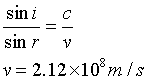
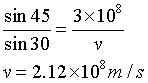
Q.30.
A ray of light is incident on a glass plate at an angle of 60°. What would be the refractive index of glass if reflected and refracted rays are perpendicular to each other? [ AFMC 1998]
-
29%
a) √3
-
29%
b) 3/2
-
29%
c)√3 / 2
-
14%
d)1/2
Explanation


Q.31.
If red light and violet light rays are of focal length fR and fv respectively then which one of the following is true..[ AFMC 1999]
-
26%
a)λR ≤ λv
-
42%
b)µR > µv
-
11%
c)µR=µv
-
21%
d)µR < µv
Q.32.
The objective with large aperture are used in telescope for [ AFMC 2000]
-
0%
a) ease of manufacture
-
21%
b) reducing lens aberration
-
58%
c) greater resolution
-
21%
d) bright image
Q.33.
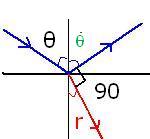
Light from a denser medium I goes to rarer medium II. When angle of incidence is θ, the reflected and refracted rays are perpendicular to each other. The critical angle is [ AFMC 2000]
-
25%
a)sin-1(cos θ)
-
15%
b) sin-1(cot θ)
-
45%
c)sin-1(tan θ)
-
15%
d)sin-1(1)
Explanation
Q.34.
A point object is 24 cm above the surface of water (µ=4/3) in lake. A fish inside the water will observe the image to be at a point [ AFMC 2001]
-
20%
a) 6cm above the surface of water
-
5%
b) 6cm below the surface of water
-
45%
c)18 cm above the surface of water
-
30%
d)32 cm above the surface of water
Explanation

Q.35.
The optical length of an astronomical telescope with magnifying power of 10, for normal vision is 44cm. What is focal length of the objective? [ AFMC 2001]
-
5%
a) 4cm
-
55%
b) 40 cm
-
25%
c)44cm
-
15%
d)440 cm
Q.36.
An optician prescribes spectacles to a patient with a combination of convex lens of focal length 40cm and concave lens 25cm. The power of spectacles is ...[ AFMC 2002]
-
11%
a) 6.0 D
-
32%
b) 1.5 D
-
32%
c) -6.0 D
-
26%
d) -1.5 D
Q.37.
Ray optics is valid, when characteristic dimensions are... [ CBSE-PMT 1989]
-
45%
a) of the same order as the wavelength of light
-
20%
b) much smaller than the wavelength of light
-
10%
c) of the order of one millimeter
-
25%
d) much larger than the wavelength of light
Q.38.
The frequency of light wave in material is 2×10¹⁴Hz and wavelength is 5000Å. The refractive index of material will be... [ CBSE-PMT 2007]
-
11%
a) 1.50
-
32%
b) 3.00
-
26%
c) 1.33
-
32%
d) 1.40
Q.39.
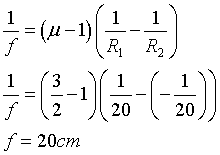
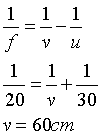
A biconvex lens has a radius of curvature of magnitude 20cm. Which one of the following options best describe the image formed of object of height 2cm placed 30cm from the lens?
-
16%
a) Virtual, upright, height = 1cm
-
42%
b) Virtual, upright, height = 0.5cm
-
21%
c) Real, inverted, height = 4cm
-
21%
d) Real, inverted, height = 1cm
Explanation
Q.40.
A converging beam of ray is incident on a diverging lens. Having passed through the lens the ray intersect at point 15cm from the lens on the opposite side. If the lens is removed the point where the ray meet will move 5cm closer to the lens. The focal length of the lens is .. [ CBSE-PMT 2011]
-
20%
a) -10 cm
-
25%
b) 20 cm
-
35%
c) -30cm
-
20%
d) 5 cm
Q.41.
A convex lens and a concave lens, each having same focal length of 25cm, are put in contact to form a combination of lenses. The power in diopters of the combination is .. [ CBSE-PMT 2006]
-
16%
a)50
-
32%
b) infinite
-
26%
c)zero
-
26%
d)25
Q.42.
Which of the following is not due to total internal reflection? [ CBSE-PMT 2011]
-
6%
a) Working of optical fiber
-
44%
b) Difference between apparent and real depth of pond
-
33%
c)Mirage on hot summer days
-
17%
d)Brilliance of diamond
Q.43.
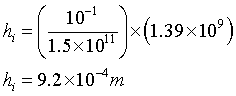
A boy is starting a fire by focusing sunlight on a piece of paper using an equiconvex lens of focal length 10cm. The diameter of sun is 1.39×10⁹m and its mean distance from the earth is 1.5×What is the diameter of the Sun's image on the paper? .. [ CBSE-PMT 2008]
-
16%
a)9.2×10⁻⁴
-
53%
b) 6.5×10⁻⁴
-
11%
c)6.5×10⁻⁵
-
21%
d)12.4×10⁻⁴
Explanation
Q.44.
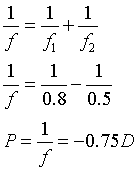
A convex lens of focal length 80cm and a concave lens of focal length 50cm are combined together. What will be their resulting power? [CBSE-PMT 1996]
-
20%
a) +6.5D
-
20%
b) -6.5D
-
30%
c) +7.5D
-
30%
d) -0.75D
Explanation
Q.45.
A ray of light traveling in a transparent medium of refractive index μ, falls on a surface separating the medium from air at an angle of incidence of 45°. For which of the following values of μ the ray can undergo total internal reflection? [ CBSE-PMT 2010]
-
10%
a)1.33
-
30%
b) 1.40
-
40%
c)1.50
-
20%
d)1.25
Q.46.
Monochromatic light is the light in which
-
30%
a)single wavelength is present
-
35%
b) Various wavelengths are present
-
30%
c)Red and violet light is present
-
5%
d)Yellow and red light is present
Q.47.
Two independent mono-chromatic sources of light are
-
38%
a) coherent
-
24%
b) incoherent
-
33%
c)coherent or incoherent depending up on the nature of source
-
5%
d)None of the above
Q.48.
A thin prism of angle 15° made of glass of refractive index μ1=1.5 is combined with another prism of glass of refractive index μ2=1.The combination of the prism produces dispersion without deviation. The angle of the second prism should be [ CBSE-PMT 2011]
-
16%
a) 7°
-
32%
b) 10°
-
37%
c)12°
-
16%
d)5°
Q.49.
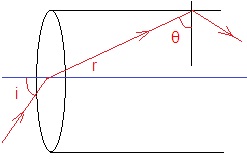
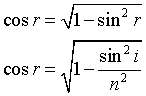
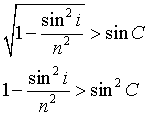
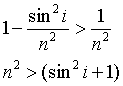
light enters at an angle of incidence in a transparent rod of refractive index n. For what value of the refractive index n. For what value of the refractive index of the material of rod the light once entered into it will not leave it through its lateral face whatsoever be the value of angle of incidence? [ CBSE-PMT 1998]
-
25%
a) n > √2
-
35%
b) n=1
-
30%
c)n=1.1
-
10%
d)n=1.3
Explanation
Q.50.
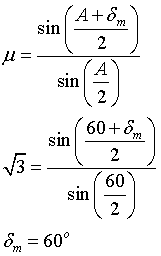
The refractive index of the material of the prism is √3 ; Angle of prism is 60° then the angle of minimum deviation of the prism is.. [ CBSE-PMT 1999]
-
15%
a) 30°
-
35%
b) 45°
-
35%
c) 60°
-
15%
d) 75°
Explanation