Q.1.
Which of the following has the highest nucleophilicity?
-
0%
a) F-
-
0%
b) OH-
-
33%
c) CH3-
-
67%
d) NH2-
Q.2.
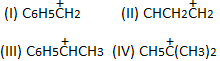
Consider the following carbocations:
-
50%
a) II < I < III < IV
-
25%
b) II < III < I < IV
-
25%
c) III < I < II < IV
-
0%
d) IV < III < I < II
Q.3.
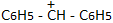
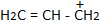
Which one of the following carbocations is most stable?
-
50%
a)
-
25%
b)

-
0%
c)
-
25%
d)

Q.4.
Which of the following contains three pairs of electron?
-
50%
a) Carbocation
-
25%
b) Carbanion
-
0%
c) Free radical
-
25%
d) None of these
Q.5.
The kind of delocalization involving sigma bond orbitals is called
-
25%
a) hybridization
-
25%
b) conjugatioon
-
25%
c) hyperconjugation
-
25%
d) conformation
Q.6.
Hyperconjugation phenomenon is possible in
-
0%
a) H2C = CH2
-
50%
b) CH3CH2 - CH = CH2
-
50%
c) C6H5CH = CH2
-
0%
d) (CH3)3C - CH = CH2
Q.7.
Which of the following has the highest nucleophilicity?
-
0%
a) F-
-
0%
b) OH-
-
100%
c) CH3-
-
0%
d) NH2-
Q.8.
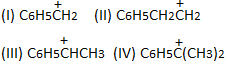
Consider the following carbocations The correct sequqence of the stability of these is
-
67%
a) II < I < III < IV
-
0%
b) II < III < I < IV
-
0%
c) III < I < II < IV
-
33%
d) IV < III < I < II
Q.9.
The arrangeent of (CH3)3 C -, (CH3)2CH - , CH3CH2 - when attached a benzene or an unsaturated group in increasing order of inductive effect is
-
0%
a) (CH3)3 C - < (CH3)2CH - < CH3CH2 -
-
100%
b) CH3CH2 - < (CH3)2CH - < (CH3)3 C -
-
0%
c) (CH3)2CH- < (CH3)3 C - < CH3CH2 -
-
0%
d) (CH3)3 C - < CH3CH2 - < (CH3)2CH-
Q.10.
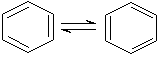
Which of the following statements regarding the resonance energy of benzene is correct?
-
33%
a) The energy required to break the C - H bond in bezene
-
33%
b) The energy required to break the C - C bond in benzene
-
33%
c) The energy is a measure of stability of benzene
-
0%
d) The energy required to convert
Q.11.
Which of the following is the correct order of stability of free radicals? [ PMT (Delhi) 2002]
-
25%
a) benzyl > allyl > 3° > 2°
-
50%
b) allyl > benzyl > 3° > 2°
-
25%
c) allyl > 3° > 2° benzyl
-
0%
d) benzyl > 3° > 2° allyl
Q.12.
Arrange the following nucleophiles in the order of their nucleophilic strength ... [ MGIMS (Wardha) 2003]
-
0%
a) OH- > CH3COO- > CH3O- > C6H5O-
-
50%
b) CH3COO- < C6H5O- < CH3O- < OH-
-
50%
c) C6H5O- < CH3COO- < CH3O- < OH-
-
0%
d) CH3COO- < C6H5O- < OH- < CH3O-
Q.13.
The stability of Me2C = CH2 is more than that of MeCH2CH = CH2 due to
-
0%
a) inductive effect of the Me group
-
0%
b) resonance effect of the Me group
-
67%
c) hyperconjugative effect of the Me group
-
33%
d) resonance as well as inductive effect of the Me group
Q.14.
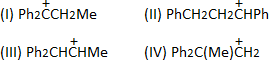
Among the following carbocations: the order of stability is
-
67%
a) IV > II > I > III
-
0%
b) I > II > III > IV
-
33%
c) II > I > IV > III
-
0%
d) I > IV > III > II
Q.15.
Due to the presence of an unpired electron, free radicals are ... [ JCECE 2008]
-
33%
a) chemically reactive
-
0%
b) chemically inactive
-
0%
c) anions
-
67%
d) cations
Q.16.
The increasing order of stability of the following free radicals is
-
33%
a)

-
33%
b)

-
0%
c)

-
33%
d)

Q.17.
Hyperconjugation involves overlap of the following orbitals
-
0%
a) σ - σ
-
33%
b) σ - p
-
33%
c) p - p
-
33%
d) π - π
Q.18.
Which among the following statement are true with respect to electronic displacement in a covalent bond? [ PMT 2008] (1) Inductive effect operates through a π-bond (2) Resonance effect operates through a σ- bond (3) Inductive effect operates through a σ-bond (4) Resonance effect operates through a π-bond. (5) Resonance and inductive effects operates through σ-bond
-
33%
a) 1 and 2
-
0%
b) 2 and 3
-
67%
c) 2 and 3
-
0%
d) 3 and 4
Q.19.
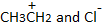
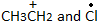
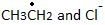
CH3CH2Cl undergoes homolysis fission produces
-
0%
a)

-
33%
b)
-
33%
c)
-
33%
d)
Q.20.
The temporary effect in which there is a complete transfer of a shared pair of pi-electrons to one of the atoms joined by a multiple bond on the demand of an arttacking reagent is called
-
0%
a) inductive effect
-
33%
b) electromeric effect
-
0%
c) hyperconjugation
-
67%
d) positive resonance effect
Q.21.
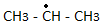
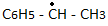
The stablest free radical among the following is
-
33%
a)

-
33%
b)
-
0%
c)

-
33%
d)
Q.22.
Which of the following is not true regarding electromeric effect? [ CET (karnataka) 2021]
-
33%
a) It requires an attacking reagent
-
0%
b) It is a temperary effect
-
0%
c) It operates on multiple bonds
-
67%
d) It results in the apperance of partial charges on the carbon atoms
Q.23.
Free radicals can undergo
-
0%
a) disproportionation to two species
-
0%
b) rearrangement to a more stable free radical
-
0%
c) decomposition to give another free radical
-
100%
d) all of the above are correct
Q.24.
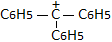
The most stable carbocation is :
-
67%
a)
-
33%
b)
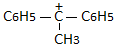
-
0%
c)
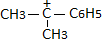
-
0%
d)

Q.25.
Assertion: Methl cyanide is a nucleophile as well as an electrophile Reason: Electrophiles are electron loving and nucleophiles are nucleus loving species.
-
0%
a) Both Assertion and Reason are true and the Reason is correct explanation of Assertion
-
100%
b) Both Assertion and Reason are true but Reason is not the correct explanation of Assertion
-
0%
c) Assertion is true, but Reason is false
-
0%
d) Assertion and Reason are false
Q.26.
Removal of hydride ion from a methane molecule will give a
-
33%
a) methyl radical
-
33%
b) carbocation
-
33%
c) carbanion
-
0%
d) methyl group
Q.27.
The electromeric effect in organic compounds is a
-
33%
a) temporary effect
-
0%
b) permanent effect
-
33%
c) temporary - permanent effect
-
33%
d) none of the above
Q.28.
Heterolysis of carbon-chlorine bond productes
-
0%
a) two free radicals
-
0%
b) two carbocation
-
0%
c) two carbanions
-
100%
d) one cation and one anion
Q.29.
The arrangement of decreasing order of stability of
-
33%
a)

-
33%
b)

-
0%
c)

-
33%
d)

Q.30.
Assertion : Allyl and benzyl carbonium ions are stable than propyl carbonium ions Reason: Electron releasing group stabilized carbonium ion
-
0%
a) Both Assertion and Reason are true and the Reason is correct explanation of Assertion
-
75%
b) Both Assertion and Reason are true but Reason is not the correct explanation of Assertion
-
25%
c) Assertion is true, but Reason is false
-
0%
d) Assertion and Reason are false