Q.1.
Chlorine can not displace [ MP PMT 1996]
-
50%
a)Fluorine from NaF
-
12%
b) Iodine from NaI
-
12%
c)Bromine from NaBr
-
25%
d)None of these
Q.2.
Mark the false statement [ MP PET 1998]
-
14%
a) A salt bridge is used to eliminate liquid junction potential
-
43%
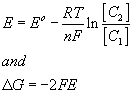
b) The Gibbs free energy change, ΔG is related with electromotive force E as ΔG=-2FE
-
0%
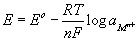
c)Nernst equation for single electrode potential is
-
43%
d)The efficiency of a hydrogen-oxygen fuel cell is 23%
Explanation
Q.3.
E° for the cell, Zn|Zn2+(aq) || Cu2+(aq)\Cuis 1.10 V at 25°C. The equilibrium constant for the cell reactionZn + Cu2+(aq) ⇒ Cu + Zn2+(aq)is of order of ..[CBSE PMT 1997]
-
0%
a) 10-37
-
86%
b) 1037
-
0%
c)10-17
-
14%
d)1017
Explanation

Q.4.
In electrolysis of NaCl when Pt electrode is taken then H2 is liberated at cathode while with Hg cathode, it forms sodium amalgam. This is because [ CBSE PMT 2002]
-
29%
a) Hg is more inert than Pt
-
29%
b) More voltage is required to reduce H+ at Hg than at Pt
-
0%
c) na is dissolved in Hg while it does not dissolve in Pt
-
43%
d) Conc. of H+ ions is larger when Pt electrode is taken
Q.5.
In the reaction: Cu(s) + 2Ag+(aq) → Cu2+(aq) + Ag(s) the reduction half cell reaction is
-
33%
a)Cu + 2e- → Cu2+
-
17%
b) Cu -2e → Cu2+
-
50%
c) Ag+ + e- → Ag
-
0%
d)Ag -e → ag+
Q.6.
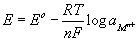
What will be the emf for given cell [AIEEE 2002]
-
0%
a)

-
25%
b)

-
75%
c)

-
0%
d)none of these
Explanation

Q.7.
Which of the following is a strong electrolyte? [ Pb CET 1994]
-
33%
a) Ca(NO3)2
-
17%
b) HCN
-
33%
c)H2SO3
-
17%
d)NH4OH
Q.8.
The standard EMF of Danielle cell is 1.1 V. The maximum electrical work obtained from the Danielle cell is [MP PMT 2002]
-
0%
a) 212.3 kJ
-
20%
b) 175.4 kJ
-
80%
c) 106.15 kJ
-
0%
d) 53.07 kJ
Q.9.
The oxidation potentials of A and B are +2.37 and +1.66V respectively. In chemical reactions ..[Pb CET 1997]
-
25%
a) A will be replaced by B
-
50%
b) A will replace B
-
25%
c)A will not replace by B
-
0%
d)A and b will not replace each other
Q.10.
On the basis of information available from the reaction (4/3)Al + O2 → (2/3)Al2O3, ΔG=-827 kJmol-1of O2 the minimum emf required to carry out an electrolysis of Al2O3 is [ F=96500 C mol-) [ CBSE PMT 2003]
-
25%
a) 2.14 V
-
75%
b) 4.28 V
-
0%
c)6.42 V
-
0%
d)8.56 V
Q.11.
Zn(s) + Cl2 (1atm) → Zn2+ + 2Cl-The E° of the cell is 2.12V. to increase E ..[ DPMT 2003]
-
50%
a) Zn2+ concentration should be increased
-
0%
b) Zn2+
-
50%
c)Cl- concentration should be increased
-
0%
d)partial pressure of Cl2 should be decreased
Explanation

Q.12.
Which one of the following cells can convert chemical energy of H2 and O2 directly into electrical energy? [ MP PMT 1998]
-
20%
a) Mercury cell
-
40%
b) Danielle cell
-
40%
c) Fuel cell
-
0%
d) lead storage cell
Q.13.
Pure water does not conduct electricity because it .. [ manipal PMT 1995]
-
14%
a)has low boiling point
-
43%
b) is almost unionised
-
29%
c)is neutral
-
14%
d)is readily decomposed
Q.14.
The standard reduction potential for two reaction are given belowAgCl(s) + e- → Ag(s) + Cl-(aq), E°=0.22VAg+(aq) + e- → Ag(s) , E°=0.80Vthe solubility product of AgCl under standard condition of temperature (298K) is given by ..[kerala MEE 2003]
-
0%
a) 1.6 ×10-
-
50%
b) 1.5 ×10⁻¹⁰
-
25%
c)3.2 ×10⁻⁸
-
25%
d)3.2 ×10⁻¹⁰
Explanation
Q.15.
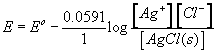
What is the potential of half-cell consisting of zinc electrode in 0.01m ZnSO4 solution at 25°C [ Eoxo=0.763V) [ manipal PMT 2001]
-
0%
a) 0.8221 V
-
25%
b) 8.221 V
-
75%
c) 0.5282V
-
0%
d)9.282V
Explanation

Q.16.
The equivalent conductance at infinite dilution of a weak acid such as HF [ Pb PMT 1998]
-
20%
a) Can be determined by extrapolation of measurements on dilute solutions of HCl, HBr and HI
-
20%
b) Can be determined by measurement on every dilute HF solutions
-
40%
c) Can best be determined from measurements on dilute solutions of NaF, NaCl and HCl
-
20%
d) Is an undefined quantity
Q.17.
Reaction that takes place at graphite anode in dry cell is ..[MP PET 1996]
-
17%
a)Zn2+ + 2e- → Zn(s)
-
33%
b) Zn(s) → Zn2+ +2e-
-
0%
c)Mn2+ +2e- → Mn(s)
-
50%
d)Mn(s) → Mn+ + e- +1.5V
Q.18.
An gives H2 gas with H2SO4 and HCl but not with HNO3 because [ CBSE PMT2002]
-
40%
a) Zn acts as oxidizing agent when reacts with HNO3
-
20%
b) HNO3 is weak acid than H2SO4 and HCl
-
40%
c)In electrochemical series Zn is above hydrogen
-
0%
d)NO3- is reduced in preference to hydronium ion
Q.19.
Calculate the standard free energy change for reaction, 2Ag + 2H+ → H2 + 2Ag+ E° for Ag+ + e- → Ag is 0.80V [ ISM Dhanbad 1994]
-
25%
a) +154.4 kJ
-
50%
b) +308.8 kJ
-
25%
c)-154.4 kJ
-
0%
d)-308.8 kJ
Q.20.
For the cell reaction,Cu2+ [C1(aq)] + Zn(s) → Zn2+ [C2(aq)] + Cu(s)of an electrochemical cell, the change in free energy, ΔG at a given temperature is a function of ..[CBSE PMT 1998]
-
25%
a) ln(C1)
-
25%
b) ln(C2/C1)
-
50%
c) ln(C1 + C2)
-
0%
d) ln(C2)
Explanation