Q.1.
For electrochemical cell M|M+ || X- |X, Eo(M+/M)=0.44 Vand Eo(X/X-)=0.33 VFrom this data, one can deduce that [ IIT 2000]
-
0%
a) M + X → M+ + X- is the spontaneous reaction
-
57%
b) M+ + X- → M + X is the spontaneous reaction
-
29%
c)Ecell=0.77 V
-
14%
d)Ecell=-0.77 V
Q.2.
The molar conductivity is maximum for the solution of concentration
-
0%
a) 0.004 M
-
29%
b) 0.002 M
-
29%
c) 0.005 M
-
43%
d) 0.001 M
Q.3.
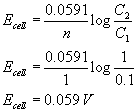
The emf of the cell Ag|Ag+( 0.1M)|| Ag+( 1M) | Ag at 298K is
-
0%
a)0.59 V
-
50%
b) 5.9 V
-
33%
c)0.059 V
-
17%
d)0.0059 V
Explanation
Q.4.
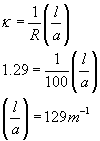
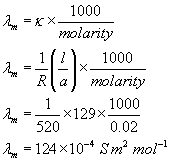
resistance of a conductivity cell filled with solution of an electrolyte of concentration 0.1M is 100 Ω. the conductivity of this solution is 1.29 Sm-Resistance of the same cell when filled with 0.2M of the same solution is 520Ω. The molar conductivity of 0.02M solution of the electrolyte will be [ AIEEE 2006]
-
0%
a) 124 × 10-4S m2 mol-1
-
25%
b) 1240 × 10-4S m2 mol-1
-
25%
c)1.24 × 10⁻⁴S m2 mol-1
-
50%
d)12.4 × 10⁻⁴S m2 mol-1
Explanation
Q.5.
The Eo (M3+ / M2+) values for Cr, Mn, Fe and Co are -0.41, +1.57, +0.77 and +1.97 respectively . For which one of these metals the change in oxidation state from +2 to +3 is easiest? [ AIEEE 2004]
-
100%
a) Cr
-
0%
b) Co
-
0%
c)Fe
-
0%
d)Mn
Q.6.
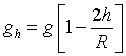
For the redox reaction Zn + Cu2+(0.1M) → Zn2+(1M) + Cu taking place in cell, Eocell is 1.1 V. Ecell for the cell will be [ AIEEE 2003]
-
43%
a) 2.14 V
-
29%
b) 1.8 V
-
14%
c) 1.07 V
-
14%
d) 0.82 V
Explanation
Q.7.
The half cell reaction for the corrosion are 2H+ + ½ O2 → H2O ; Eo=-1.23 V Fe2+ + 2e- → Fe ; Eo=- 0.44 V Find ΔGo ( in kJ) for the over all reaction [ IIT 2005]
-
17%
a)-76
-
17%
b) -322
-
17%
c)-161
-
50%
d)-152
Q.8.
Standard reduction electrode potential of three metals A, B and C are respectively +0.05V, -3.0V and -1.2V. The reducing powers of ..[ AIEEE 2003]
-
20%
a) B > C > A
-
40%
b) A > B > C
-
20%
c)C > B > A
-
20%
d)A > C > B
Q.9.
Calculate the volume of H2 gas at NTP obtained by passing 4 amperes through acidified H2O for 30 minutes
-
14%
a) 0.0836 L
-
29%
b) 0.0432 L
-
14%
c)0.1672 L
-
43%
d)0.836 L
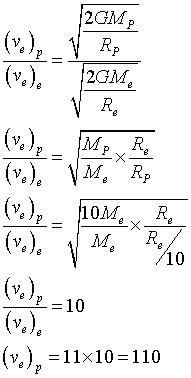
Explanation
Q.10.
Consider the following Eo values Eo ( Fe3+/ Fe2+ )=+0.77 V , Eo ( Sn2+/ Sn )=-0.14V Under standard conditions, the potential for the reaction Sn + 2Fe3+ → 2Fe2+ + Sn2+ is .. [ AIEEE 2004]
-
0%
a) 1.68 V
-
0%
b) 0.63 V
-
60%
c) 0.91 V
-
40%
d) 1.4 V
Q.11.
The standard reduction potential at 298K for the following half reactions are given against each, which willa act as best reducing agent Zn2+ + 2e- → Zn ; -0.762 V Cr3+ + 3e- → Zn ; -0.740 V 2H+ + 2e- → H2 ; -0.00 VFe3+ + e- → Fe2+ ; -0.762 V
-
25%
a)Zn
-
25%
b) Cr
-
0%
c)H2
-
50%
d)Fe2+
Q.12.
Standard electrode potential (Eo) for OCl-/Cl- and Cl- / (1/2) Cl2 are respectively 0.94 V and -1.36 V. The Eo value for OCl-/ Cl2 will be
-
50%
a) -0.42 V
-
0%
b) -2.20 V
-
25%
c)0.52 V
-
25%
d)1.04 V
Q.13.
The oxidation state of chromium in Cr(CO)6 is ..[AIIMS 1993]
-
56%
a)0
-
11%
b) +2
-
11%
c)-2
-
22%
d)+6
Q.14.
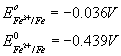
Given The value of standard electrode potential for the changeFe3+ + e- → Fe2+ will be.. [ AIEEE 2009]
-
50%
a) -0.072 V
-
0%
b) 0.85 V
-
0%
c) 0.770 V
-
50%
d) -0.270 V
Q.15.
The unit of molar conductivity is
-
0%
a)Ω cm2 mol-1
-
40%
b) Ω-1 cm2 mol-1
-
60%
c)Ωcm2 mol-1
-
0%
d)Ω-1 cm-2 mol-1
Q.16.
In corrosion of iron
-
20%
a) An electrochemical ( galvanic cell) is formed in which Fe acts as anode and cathode where O2 is reduced
-
0%
b) Electrons flow from anode to cathode through the metal while ions flow through the water droplets
-
40%
c)Dissolved O2 oxidises Fe2+ to Fe3+ before it is deposited as rust ( Fe2 . H2O)
-
40%
d)All of the above takes place
Q.17.
A standard hydrogen electrode has zero electrode potential because [ IIT 1997]
-
0%
a) Hydrogen is easier to oxidise
-
33%
b) This electrode potential is assumed to be zero
-
33%
c)Hydrogen atom has only electron
-
33%
d)hydrogen is the lightest element
Q.18.
The oxidation potential for the half cell reactions are Zn → Zn+ +2e- ; Eo=+0.76 V Fe → Fe+ +2e- ; Eo=+0.41 V The emf of cell reaction Fe+ + Zn → Zn+ + Fe is [IIT 1981]
-
17%
a) -0.35 V
-
33%
b) +0.35 V
-
33%
c) +1.17 V
-
17%
d) 0.117 V
Q.19.
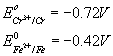
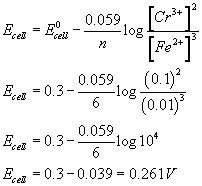
Given The potential of cell Cr|Cr3+(0.1M) || Fr2+(0.01M)| Fe is [ AIEEE 2008]
-
0%
a)-0.26 V
-
100%
b) 0.26 V
-
0%
c)0.339 V
-
0%
d)-0.339 V
Explanation
Q.20.
A gas X at 1 atm pressure is bubbled through a solution containing a mixture of 1M Y- ions and 1M Z- ions at 125°C. If reduction potential of Z > Y; X > Z then
-
50%
a) Y will oxidise Z and not X
-
0%
b) Y will oxidise X and not Z
-
25%
c)Y will oxidise X and Z
-
25%
d)Y will reduce both X and Z
Q.21.
Best way to prevent rusting of iron is by
-
11%
a) Making iron cathode
-
11%
b) Putting it in saline water
-
56%
c)Both of these
-
22%
d)None of these
Q.22.
Saturated solution of KNO3 is used to make salt bridge because [ IIT 2001]
-
0%
a) Velocity of K+ is greater than that of NO3-
-
12%
b) Velocity of NO3- is greater than that of K+
-
38%
c) Velocity of both K+ and NO3-
-
50%
d) KNO3 is highly soluble in water
Q.23.
Which of the following is not a redox reaction? [ AIIMS 1993]
-
17%
a)CaCO3 → CaO +CO2
-
50%
b) O2 + 2H2 → 2H2O
-
17%
c)Na + H2O → NaOH + ½ H2
-
17%
d)MnCl3 → MnCl2 + ½Cl2
Q.24.
Which substance serves as reducing agent in the following reaction?14H+ Cr2O7- + 3Ni → 2Cr3+ + 7H2O + 3Ni2+ [ CBSE PMT 1994]
-
50%
a) H2O
-
33%
b) Ni
-
0%
c)H+
-
17%
d)Cr2O72-
Q.25.
Nitric oxide acts as a reducing agent in the reaction [ DEC 1994]
-
33%
a) 4NH3 + 5O2 → 4NO + 6H2O
-
33%
b) 2NO + 3I2 +4 H2O → 2NO3- + 6I- + 8H+
-
17%
c)2NO + H2SO3 → N2O + H2SO4
-
17%
d)2NO + H2S → N2O + S + H2O
Q.26.
In which of the following reaction, hydrogen is acting as an oxidising agent? [ MPPMT 1987]
-
17%
a) With iodine to give hydrogen iodide
-
33%
b) With lithium to give lithium hydride
-
33%
c) With nitrogen to give ammonia
-
17%
d) With sulphur to give hydrogen sulphide
Q.27.
When SO2 is passed through solution of potassium iodate, the oxidation state of iodine changes from .. [ Roorkee 1990]
-
25%
a)+5 to 0
-
50%
b) +5 to -1
-
0%
c)-5 to 0
-
25%
d)-7 to -1
Q.28.
M is the molecular weight of KMnOthe equivalent weight of KMnO4 when it is converted into K2MnO4 is .. [ AFMC 1994]
-
43%
a) M
-
0%
b) M/3
-
29%
c)M/5
-
29%
d)M/7
Q.29.
In the reaction, 3Br2 + 6CO32- + 3H2O → 5Br- + BrO3- + 6HCO3- [ MP PMT 1995, Pb CET 1996]
-
20%
a) Bromine is oxidised and carbonate is reduced
-
0%
b) Bromine is reduced and water is oxidised
-
0%
c)Bromine is neither reduced nor oxidised
-
80%
d)Bromine is both reduced and oxidised
Q.30.
Which of the following elements has least oxidation number [ Rajasthan PMT 1998]
-
0%
a) Ni(CN)4
-
78%
b) Ni(CO)4
-
0%
c) Fe2O3
-
22%
d) SF4