Q.1.
Among the following, identify the species with an atom in +6 oxidation state [ IIT screening test 2000]
-
0%
a) MnO4-
-
50%
b)Cr(CN)63-
-
17%
c)NiF62-
-
33%
d)CrO2Cl2
Q.2.
A mole of N2H4 loses ten moles of electrons to form a new compound Y. Assuming that all the nitrogen appears in the new compound, what is the oxidation state of nitrogen in Y ( there is no change in oxidation number of hydrogen)
-
20%
a) -1
-
40%
b) -3
-
40%
c) +3
-
0%
d) +5
Q.3.
In which of the following, transition metal has zero oxidation state? [ CBSE PMT 1999]
-
67%
a)[Fe(CO)5]
-
17%
b) NH2 . NH2
-
0%
c)NOClO4
-
17%
d)CrO5
Q.4.
In standardization of Na2S2O3 using K2Cr2O7 by iodometery, equivalent weight of K2Cr2O7 is [ IIT 2000]
-
0%
a) (Molecular weight)/2
-
50%
b) (Molecular weight)/6
-
50%
c)(Molecular weight)/3
-
0%
d)same as molecular weight
Q.5.
HNO3 acts as [ Manipal 2001]
-
0%
a) acid
-
40%
b) oxidizing agent
-
20%
c)reducing agent
-
40%
d)both a and b
Q.6.
n a reaction, 4 moles of electrons are transferred to one mole of HNOthe possible product obtained due to reduction is
-
0%
a) 0.5 mole of N2
-
40%
b) 0.5 mole of N2O
-
60%
c) 1 mole of NO2
-
0%
d) 1 mole of NH3
Q.7.
The equivalent weight of phosphoric acid(H3PO4 ) in the reaction, NaOH + H3PO4 → NaH2PO4 + H2O is [AIIMS 1999]
-
20%
a)59
-
40%
b) 49
-
40%
c)25
-
0%
d)98
Q.8.
The reaction 2H2O(l) → 4H+(aq) + O2(g) +4e- is [kerala MEE]
-
20%
a) An oxidation reaction
-
20%
b) A reduction reaction
-
40%
c)A redox reaction
-
20%
d)Sololysis reaction
Q.9.
The average oxidation number of sulphur in Na2S4O6 is [ Rajasthan PMT 2002]
-
0%
a)1.5
-
100%
b) 2.5
-
0%
c)3
-
0%
d)2
Explanation
Q.10.
Equivalent weight of MnO4- in acidic, basic and neutral media are in the ratio of
-
40%
a) 3:5:15
-
20%
b) 5:3:1
-
20%
c) 5:1:3
-
20%
d) 3:5:5
Q.11.
The standard reduction potential at 298K for following half reactions are given against each Zn2+ +2e- → Zn(s) , -0.762 Cr3+ +3e- → Cr(s) , -0.740 2H+ +2e- → H2 , 0.00 Fe3+(aq) + e- → Fe2+ 0.777 Which is the strongest reducing agent? [ IIT 1981]
-
20%
a)Zn
-
20%
b) Cr
-
0%
c)H2
-
60%
d)Fe2+
Q.12.
The two Pt electrodes fitted in a conductance cell are 1.5cm apart while the cross-sectional area of each electrode is 0.75cmWhat is the cell constant? [ Pb CET 1989]
-
40%
a) 1.25
-
60%
b) 0.5 cm
-
0%
c)2.0 cm-1
-
0%
d)0.2 cm-
Q.13.
What is the standard cell potential for the cellZn|Zn2+(1M)|| Cu2+(1M)|Cu?Eo for Zn2+/Zn=-0.76Eo for Cu2+/Cu=0.34 AIIMS 1980]
-
20%
a)-0.42V
-
40%
b) +0.42V
-
40%
c)+1.10V
-
0%
d)-1.10V
Q.14.
The ionic mobility of the cation and the anion of a salt are 140 and 80 mhos respectively. The equivalent conductivity of the salt at infinite dilution will be [ Harayana CEET 1991]
-
20%
a) 160 mhos
-
0%
b) 280 mhos
-
40%
c) 66 mhos
-
40%
d) 220 mhos
Q.15.
The number of Faradays needed to reduce 4gm equivalents of Cu2+ to Cu metal will be .. [ BHU]
-
0%
a)1
-
25%
b) 2
-
0%
c)1/2
-
75%
d)4
Q.16.
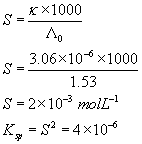
The conductivity of a saturated solution of BaSO4 is 3.06 × 10- ohm- cm- and its equivalent conductance is 1.53 ohm- cm2 equiv-. the Ksp of BaSO4 will be ..[haryana CEET 1996]
-
0%
a) 4 × 10-12
-
25%
b) 2.5 ×10⁻⁹
-
50%
c)2.5 × 10⁻¹³
-
25%
d)4 × 10⁻⁶
Explanation
Q.17.
Conductivity of a solution is directly proportional to ..[KCET 1984]
-
17%
a) dilution
-
17%
b) number of ions
-
0%
c)current density
-
67%
d)volume of the solution
Q.18.
The equivalent conductivity of 0.1M weak acid is 100times less than that at infinite dilution. The degree of dissociation is [ Tamil nadu CET2001]
-
0%
a) 100
-
50%
b) 10
-
50%
c) 0.01
-
0%
d) 0.001
Explanation

Q.19.
the number of electrons involved in the reaction when a faraday of electricity is passed through an electrolyte in solution is [ NCERT 1982]
-
25%
a)12 × 1046
-
25%
b) 96540
-
0%
c)8 ×10¹⁶
-
50%
d)6 × 10²³
Q.20.
What weight of copper will be deposited by passing 2 F of electricity through a cupric salt ( At wt. Cu=63.5] [NCERT 1973]
-
0%
a) 2.0 g
-
25%
b) 3.175 g
-
50%
c)63.5 g
-
25%
d)127.0 g
Q.21.
Which one of the following will increase the voltage of the cellSn(s) + 2Ag+(aq) → Sn2+(aq) + 2Ag(s)? [ Pb CET 1985]
-
0%
a)Increase in the size of the silver ros
-
50%
b) Increase in the concentration of Sn2+ ions
-
50%
c)Increase in the concentration of Ag+ ions
-
0%
d)None of the above
Explanation

Q.22.
Specific conductance of 0.1M sodium chloride solution is 1.06×10⁻² ohm-1 cm-Its molar conductance in ohm-1cm2 mol-1 is [ kerala MEE 2001]
-
25%
a) 1.06 ×10²
-
25%
b) 1.06 ×10³
-
25%
c) 1.06 ×10⁴
-
25%
d) 5.3 ×10²
Explanation

Q.23.
In electrolysis of dil H2SO4 using platinum electrodes.. [ DPMT 1983]
-
20%
a)H2 is evolved at cathode
-
20%
b) SO2 is produced at anode
-
40%
c)O2 is obtained at cathode
-
20%
d)SO2 is produced at cathode
Q.24.
When the same quantity of electricity is passed through the solutions of different electrolytes in series, the amount of products obtained are proportional to their.. [ JIPMER 1994]
-
0%
a) Atomic weights
-
60%
b) Chemical equivalents
-
20%
c)gram molecular volume
-
20%
d)gram atomic ions
Q.25.
2.5 F of electricity is passed through a solution of CuSOthe number of gram gram equivalents of copper deposited on the cathode will be [ DPMT 1982]
-
0%
a) 1
-
0%
b) 2
-
100%
c)2.5
-
0%
d)1.25
Q.26.
Molar conductivity of a solution is 1.26×10² ohm- cm2 mol-. Its molarity is 0.Its specific conductivity will be ..[manipal PMT 2002]
-
0%
a) 1.26 ×10⁻⁵
-
25%
b) 1.26 ×10⁻³
-
25%
c) 1.26 ×10⁻⁴
-
50%
d) 0.0063
Explanation

Q.27.
Faraday's laws of electrolysis are related to [ IIT 1983]
-
20%
a)atomic number of cation
-
0%
b) atomic number of anion
-
60%
c)equivalent weight of the electrolyte
-
20%
d)speed of the cation
Q.28.
The one of that is good conductor of electricity in the following list of solids is [ NCERT 1984]
-
50%
a) Sodium chloride
-
25%
b) graphite
-
25%
c)diamond
-
0%
d)sulphur
Q.29.
Equivalent conductance of NaCl, HCl and CH3COONA at infinite dilution are 126.45, 426.16 and 91 ohm-1cm2 respectively. The equivalent conductance of CH3COOH at infinite dilution would be [ CBSE PMT 1997]
-
0%
a) 101.38 ohm-1cm2
-
25%
b) 253.62ohm-1cm2
-
75%
c)390.71ohm-1cm2
-
0%
d)678.90ohm-1cm2
Q.30.
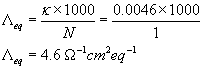
The resistance of 1N solution of acetic acid is 250Ω, when measured in a cell of cell constant 1.15cm-. The equivalent conductance ( in ohm-Cm2 equiv-1) of 1N acetic acid is ..[ CBSE PMT 1994]
-
25%
a) 4.6
-
75%
b) 9.2
-
0%
c) 18.4
-
0%
d) 0.023
Explanation