Q.1.
Consider the reaction Mn+(aq) + ne- → M(s) The standard reduction potential values of the elements M1, M2 and M3 are -0.34V, -3.05V and -1.66V respectively. the order of their reducing power will be [ NCRT 1990]
-
14%
a)M1 > M2 > M3
-
14%
b) M3 > M2 > M1
-
14%
c)M1 > M3 > M2
-
57%
d)M2 > M3 > M1
Q.2.
When Ag+/Ag=0.80 volts and Zn2+/ Zn=-0.76 volt, which of the following is correct? [ MP 1994]
-
43%
a) Ag+ can be reduced by H2
-
0%
b) Ag can oxidise H2 into H+ ion
-
43%
c)Zn2+ can be reduced by H2
-
14%
d)Ag can reduce Zn2+ ion
Q.3.
When a solution of an electrolyte is heated, the conductance of the solution [ KCET 1991]
-
0%
a) increases because number of molecules of the electrolyte increases
-
50%
b) decreases because of the increased heat
-
17%
c)decreases because the dissociation of electrolyte is suppressed
-
33%
d)increases because the electrolyte is dissociated more
Q.4.
How long will it take for a current of 3 amperes to decompose 36g water? [ Eq. Wt of hydrogen is 1 and that of oxygen 8) [BHU 1992]
-
60%
a) 36 Hrs
-
20%
b) 18 Hrs
-
20%
c) 9 Hrs
-
0%
d) 4.5 Hrs
Q.5.
In the electrolysis of NaCl: [ AFMC 1991]
-
60%
a)Cl- is oxidised at anode
-
20%
b) Cl- is reduced at anode
-
20%
c)Cl- is oxidised at cathode
-
0%
d)Cl- is neither reduced nor oxidised
Q.6.
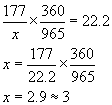
A current of 2.0 A passed for 5 hours through a molten metal salt deposits 22.2 g of metal ( At Wt.=177]. The oxidation state of the metal in the metal salt is [ haryana CEET 1996]
-
20%
a) +1
-
60%
b) +2
-
20%
c)+3
-
0%
d)+4
Explanation
Q.7.
When a rod of metal A is dipped in an aqueous solution of metal B ( concentration of B2+=1M) at 25°C, the electrode potentials are A2+/A=-0.76 volts, B2+/B=+0.34 volts. [ KCET 1992]
-
20%
a)A will gradually dissolve
-
40%
b)B will deposit on A
-
0%
c)No reaction will occur
-
40%
d)Water will decompose into Hydrogen and Oxygen
Q.8.
An unknown metal M displaces nickel from nickel(II) sulphate solution but does not displace manganese from manganese sulphate solution. Which order represents the correct order of reducing power
-
40%
a) Mn > Ni > M
-
40%
b) Ni > Mn > M
-
20%
c) Mn > M > Ni
-
0%
d) M > Ni > Mn
Q.9.
The correct order of chemical reactivity with water according to electrochemical series is ..[MP PMT 1991]
-
20%
a)K > Mg > Zn > Cu
-
20%
b) Mg > Zn > Cu > K
-
60%
c)K > Zn > Mg > Cu
-
0%
d)Cu > Zn > Mg > K
Q.10.
The standard EMF got the cell reactionZn + Cu2+ → Cu + Zn2+ is 1.1 Volt at 25°C The EMF for the cell reaction, when 0.1 M Cu2+ and 0.1M Zn2+ solution are used, at 25°C is [ Manipal PMT 2001]
-
60%
a) 1.10 V
-
40%
b) 0.10 V
-
0%
c)-1.10V
-
0%
d)-0.110 V
Explanation

Q.11.
The cell reaction in Daniel cell is [ KCET 1992]
-
40%
a) Zn + Cu → Zn2+ + Cu2+
-
0%
b) Zn2+ + Cu → Zn + Cu2+
-
20%
c)Zn + Cu2+ → Zn2+ + Cu
-
40%
d)Zn2+ + Cu2+ → Zn + Cu
Q.12.
The voltage of a cell whose half cells are given below is Mg2+ + 2e- → Mg(s), -2.37 V Cu2+ + 2e- → Cu(s) , 0.34 V [EAMCET 1987]
-
20%
a) -2.03 V
-
0%
b) 1.36 V
-
60%
c) 2.71 V
-
20%
d) 2.03 V
Q.13.
What is the amount of Chlorine evolved when 2 amp of current is passed for 30 minutes in an aqueous solution of NaCl? [ AIIMS 1999]
-
17%
a)66 g
-
33%
b) 1.32 g
-
33%
c)33 g
-
17%
d)99 g
Q.14.
The standard reduction potential for Fe2+/Fe and S2+ Sn electrodes are -0.44 and -0.14 volt respectively. For the cell reaction:Fe2+ + Sn → Fe + Sn2+, the standard emf is [ IIT 1990] < img id="hidden8" width="67px" height="15px"class="hidden8"alt="" src="images/c.png"/>
-
40%
a) +0.30 V
-
20%
b) -0.58 V
-
0%
c)+0.58 V
-
40%
d)-0.30 V
Q.15.
In a galvanic ell [ Pb CET 1994]
-
0%
a) Chemical energy is converted into electricity
-
40%
b) Chemical energy is converted into heat
-
20%
c)Electrical energy is converted into heat
-
40%
d)Electrical energy converted into chemical energy
Q.16.
If half cell reaction A +e- → A- has a large negative reduction potential, it follows that ..[ MLNR 1992]
-
0%
a) A is readily reduced
-
20%
b) A is readily oxidized
-
20%
c) A- is readily reduced
-
60%
d) A- is readily oxidized
Q.17.
Which of the following can be considered as a weal electrolyte [ harayana CEET 1991]
-
0%
a)NaCl
-
0%
b) HCl
-
60%
c)CH3COOH
-
40%
d)K2SO2
Q.18.
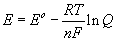
The Nernst equation, Indicates that the equilibrium constant Kc will be equal to Q when
-
0%
a)E=Eo
-
60%
b) E=zero
-
20%
c)Eo=1
-
20%
d)RT/nF=1
Q.19.
Four moles of electrons were transferred from anode to cathode in an experiment on electrolysis of water. the total volume of the two gases ( dry and at STP) produced will be approximately ( in liters) [ AIIMS 1993]
-
0%
a) 22.4
-
60%
b) 44.8
-
20%
c)67.2
-
20%
d)89.4
Q.20.
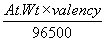
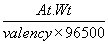
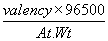
Electrochemical equivalent of an element is [ CPMT 1991]
-
0%
a)
-
40%
b)

-
40%
c)
-
20%
d)
Q.21.
if the number of moles of electrons involved in a reaction is doubled by multiplying all of the species appearing in the overall reaction by 2 then the [ Bihar MDAT 1994]
-
0%
a) potential is halved
-
80%
b) potential is doubled
-
20%
c) potential is unchanged
-
0%
d) potential is squared
Q.22.
When current is passed through an electrolyte containing ions .. [ AFMC 1991]
-
0%
a)all ions move to oppositely charged plates
-
0%
b) ions do not move
-
60%
c)all ions moves to respective charged plates
-
40%
d)all the above facts are false
Q.23.
Which of the following reaction occurs at the cathode during the charging of lead storage battery? [ BHU 1993]
-
20%
a) Pb2+ + 2e- → Pb
-
0%
b) Pb2+ + SO42- → PbSO4
-
80%
c)Pb → Pb2+ +2e-
-
0%
d)PbSO4 + 2H2O → 2PbO2 +4H+ + SO2- +2e-
Q.24.
The conductivity of electricity required to liberate one gram equivalent of an element is called [ KCET 1992]
-
0%
a) increases on dilution slightly
-
0%
b) does not change on dilution
-
60%
c)decreases on dilution
-
40%
d)depends on density of electrolyte itself
Q.25.
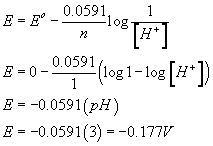
The hydrogen electrode is dipped in a solution of pH=3 at 25°C. The potential of the cell would be ( the value of 2.303RT/F is 0.059 V) [ KCET 1993]
-
20%
a) 0.177 V
-
40%
b) 0.087 V
-
40%
c) -0.177 V
-
0%
d) 0.059 V
Explanation
Q.26.
Which is not correct? the degree of dissociation of an electrolyte depends on [ MP PMT 1991]
-
20%
a)Nature of the electrolytes
-
20%
b) Catalytic action
-
60%
c)Dilution
-
0%
d)Temperature
Q.27.
Standard reduction potentials for Li+/Li; Zn2+/Zn; H+/H2 and Ag+/Ag are -3.05, -0.762, 0.00 and +0.80V respectively. Which of the following has highest reduction capacity? [ MP PMT 1992]
-
0%
a) Ag
-
40%
b) H2
-
40%
c)Zn
-
20%
d)Li
Q.28.
The electroplating with chromium is undertaken because [ MP PMT 1996]
-
0%
a) Electrolysis of chromium is easer
-
0%
b) Chromium can form alloy with other metals
-
75%
c)Chromium gives protective and decorative coating to the base metal
-
25%
d)Of the high reactivity of metallic chromium
Q.29.
A cell constructed by coupling a standard magnesium electrode has emf of 2.7 volts. if the standard reduction potential of copper electrode is +0.34 volts, that of magnesium electrode is [ KCET 1989]
-
0%
a) +3.04 volts
-
50%
b) -3.04 volts
-
25%
c) +2.36 volts
-
25%
d) -2.36 volts
Q.30.
When CuSO4 is electrolyzed by platinum electrodes [ CBSE PMT 1993]
-
0%
a) Copper is liberated at cathode, sulphur at anode
-
50%
b) Copper is liberated at cathode, oxygen at anode
-
0%
c)Sulphur is liberated at cathode, oxygen at anode
-
50%
d)Oxygen is liberated at cathode, copper at anode