Q.1.
Common between vegetative reproduction and apomixis is ... [ CBSE 2011]
-
0%
a) Both occur around the year
-
67%
b) Both produce progeny identical to parent
-
33%
c) Both bypass flowering phase
-
0%
d) Both applicable to dicots
Q.2.
During favourable condition the encysted amoeba divided by multiple fission and produces pseudopodiospores. This phenomenon is known as
-
0%
a) Budding
-
14%
b) Regeneration
-
36%
c) Fragmentation
-
50%
d) Sporulation
Q.3.
In oogamy fertilisation involves ...[ CBSE 2004]
-
67%
a) A large non-motile female gamete and a small motile male gamete
-
8%
b) A large non-motile female gamete and a small non-motile male gamete
-
17%
c) A large motile female gamete and a small non-motile male gamete
-
8%
d) A small non-motile female gamete and large motile male gamete
Q.4.
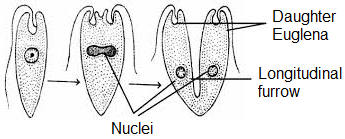
The mode of asexual reproduction in Euglena is ...[ CET Chd 2011]
-
40%
a) Transverse binary fission
-
10%
b) Irregular binary fission
-
10%
c) Multiple fission
-
40%
d) Longitudinal binary fission
Explanation
Q.5.
A population of genetically identical individuals, obtained from asexual reproduction is ...[ CBSE 1993]
-
0%
a) Callus
-
75%
b) Clone
-
17%
c) Deme
-
8%
d) Aggregates
Q.6.
Method of raising new plants in large number from a small plant tissue over a culture medium is ... [ KCET 2010]
-
0%
a) Juvenility
-
0%
b) Callus formation
-
92%
c) Micropropagation/ tissue culture
-
8%
d) Micrografting
Q.7.
Bacteria, fungi and lower plants survive during adverse conditions by ...[ AIIMS 2011]
-
9%
a) Suspending growth
-
64%
b) Formation of thick-walled spores
-
27%
c) Migration
-
0%
d) Diapause
Q.8.
Plants developed in vitro culture from pollen grains are ... [ AIIMS 1996]
-
44%
a) Pollen plants
-
33%
b) Androgenic haploids
-
11%
c) Male plants
-
11%
d) Sterile plants
Q.9.
In which plants, artificial vegetative propagation can be carried out through root cuttings ... [ Guj CET 2006]
-
0%
a) Lemon and Rose
-
27%
b) Rose and Hibiscus
-
36%
c) Tamarind and Chrysanthemum
-
36%
d) Lemon and Tamarind
Q.10.
An example of parthenogenesis is the development of fruit is the one ...[ Pb. P.M.T 1992]
-
0%
a) With viable seeds after fertilization
-
10%
b) With viable seeds after pollination
-
60%
c) With viable seeds without fertilisation
-
30%
d) Without seeds after pollination
Q.11.
Bryophyllum is multiplies vegetatively by ...[ Kerala 2002]
-
0%
a) Roots
-
80%
b) Leaves
-
20%
c) Stem branch
-
0%
d) Rhizome
Q.12.
Why is asexual reproduction sometimes disadvantageous ...[ JKCET 2012]
-
20%
a) It allows animals to produce may offspring quickly
-
70%
b) It produces genetically uniform population
-
10%
c) It allows sedentary animals to produce offspring without mates
-
0%
d) It saves times and energy of gamete formation
Q.13.
Parasexual hybridization means fusion of ... [ MPPMT 1995]
-
11%
a) Male gamete with female gametes
-
11%
b) Somatic protoplasts
-
33%
c) Male gamete with somatic cell
-
44%
d) Male gamete with male gamete with protoplasts
Q.14.
Find out correct order of vegetative propagules of plants like Potato, Ginger, Agave, Bryophyllum and Water Hyacinth ..[ Kerala 2012]
-
0%
a) Offset,bulbil, leaf bud, rhizome and eyes
-
20%
b) Leaf bud, bulbil, offset, rhizome and eyes
-
80%
c) Eyes, rhizome, bulbil, leaf bud and offset
-
0%
d) Offset, bulbil, leaf bud, rhizome and eyes
Q.15.
For ovulation in reflex ovulators ..[ MPPMT 1995]
-
33%
a) Coitus is necessary
-
22%
b) Coitus is not necessary
-
11%
c) Plenty of food is not necessary
-
33%
d) Plenty of food is necessary
Q.16.
Micropropagation is a technique for production of ...[ WB 2010]
-
22%
a) Somaclonal plants
-
0%
b) Haploid plants
-
56%
c) production of clonal plants
-
22%
d) Somatic hybrids
Q.17.
Development of haploid plants from pollen is ... [ EAMCET 2002]
-
67%
a) Androgenesis
-
0%
b) Somatic hybridisation
-
33%
c) Parthenocarpy
-
0%
d) Emasculation
Q.18.
Identify the correct statement ...[ KCET 2009]
-
38%
a) Because of marked climatic variations plants growing near the sea shore do not produce annual rings
-
0%
b) Healing of damaged tissue is because of activity of sclerenchyma cells
-
38%
c) The age of the plant can be determined by its height
-
25%
d) Grafting is difficult in monocot plants as they have scattered vascular bundles
Q.19.
Development of an organism from female gamete/egg without involving fertilization is ...[ AFMC 1993]
-
0%
a) Adventive embryony
-
88%
b) Parthenogenesis
-
0%
c) Polyembryony
-
12%
d) Parthenocarpy
Q.20.
A major use of embryo culture is in ...[ BHU 2000]
-
25%
a) Inductionod somacional variations
-
38%
b) Overcoming hydridisation barriers
-
25%
c) Production of alkaloids
-
12%
d) Clonal propagation
Q.21.
Which is wrongly matched ...[ CBSE Mains 2011]
-
0%
a) Agave - bulbils
-
0%
b) Penicillium - conidia
-
100%
c) Water Hyacinth - runner
-
0%
d) Bryophyllum - leaf buds
Q.22.
Callus is ..[ DPMT 1996]
-
12%
a) Tissue that forms embryo
-
0%
b) An insoluble carbohydrate
-
38%
c) Tissue that grows to form embryoid
-
50%
d) Unorganised activity dividing mass of cells maintained in culture
Q.23.
Consider the following statements with respect to reproduction in the lower living organisms a) Organisms like yeast and Planaria reproduce asexually by means of budding (b) True regeneration is observed in Hydra (c) Protonema of mosses multiply by fragmentation (d) In unicellular organisms like bacteria, algae and Amoeba, reproduction is synonymous with growth,i.e. increase in number of cells ..[ kerala 2012]
-
29%
a) a and b correct
-
14%
b) a and d correct
-
57%
c) c and d correct
-
0%
d) c and a correct
Q.24.
Explant is required to be disinfected before placing in culture. This is done by ..
-
20%
a) X-rays
-
0%
b) Clorox or hypochlorite
-
60%
c) Autoclaving
-
20%
d) Ultra-violet rays
Q.25.
n Angiosperms, which parts of the flowers wither and fall off ?
-
0%
a) Sepals
-
43%
b) Petals
-
43%
c) Stamens
-
14%
d) All the three
Q.26.
hich of the following flowers only once in its life-time ? [NEET 2018] )
-
0%
a) Mango
-
14%
b) Jackfruit
-
86%
c) Bamboo species
-
0%
d) Papaya
Q.27.
hich among the following groups reproduce through special asexual reproductive structures?
-
33%
a) Algae and bryophytes
-
17%
b) Algae and fungi
-
17%
c) Pteridophytes and angiosperms
-
33%
d) Fungi and pteridophytes
Q.28.
hich of the following matches is/are true with respect to their capacity to develop a part of their somatic body into a new independent plant? (i) Underground stem – Ginger/potato. (ii) Sub aerial stem – Banana. (iii) Roots – Dahlia. (iv) Leaves – Bryophyllum. (v) Bulbils – Agave. (vi) Stem cuttings – Sugarcane.
-
17%
a) (i) only
-
17%
b) (iii) only
-
33%
c) (ii) and (iii) only
-
33%
d) All are true
Q.29.
uring embryogenesis, the zygote undergoes:
-
33%
a) Meiosis and differentiation
-
0%
b) Meiosis and de – differentiation
-
50%
c) Mitosis and differentiation
-
17%
d) Mitosis and de – differentiation
Q.30.
n which among the following combinations of possibilities of sexual reproduction, water is not essential for gamete transfer and fertilization:
-
50%
a) Oogamy, non – motile egg and motile male gametes
-
0%
b) Anisogamy, motile egg and non motile male gametes
-
33%
c) Oogamy, non motile egg and non motile male gamete
-
17%
d) Anisogamy, non motile egg and motile male gamete