Q.1.
he most significant value of vegetative propagation is that:
-
71%
a) It is a means of producing a large population or individuals genetically identical to the parent
-
0%
b) It enables production of genetic variation
-
21%
c) It is an ancient practise
-
7%
d) It ensures that the progeny are safe from attack of diseases and pests
Q.2.
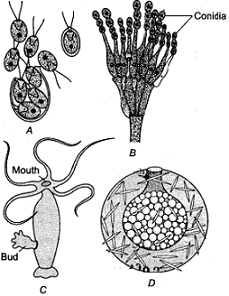
dentify the given figures and choose the correct statements (i) Figure A represents zoospores in Chlamydomonas which is endogenous and figure B represents Conidiospores in Penicillium which is exogenous. (ii) The reproductive structure shown in figure A is motile while that in figure B is non – motile. (iii) Figure D shows internal buds which is common in all fresh water sponges except Spongilla. (iv) In Figure D the internal buds are surrounded by a resistant Chitinous covering. (v) Figure C shows budding in hydra which is also called torulation due to its unequal division. (vi) A and B are fungal species, C a comb jelly and D a sponge.
-
33%
a) (i), (ii), (iii), (v) and (vi) are true while (iv) is false
-
44%
b) (i), (ii) and (iv) are true while (iii), (v) and (vi) are false
-
0%
c) (i), (ii), (iv) and (vi) are true while (iii) and (v) are false
-
22%
d) All statements are true
Q.3.
uds develops in Bryophyllum daigremonthianum:
-
44%
a) From marginal notches when leaf falls on the ground
-
56%
b) From marginal notches while leaf is attached to the plant
-
0%
c) From the marginal notches of leaves of another plant
-
0%
d) From the site of injury
Q.4.
ericarp is the ------ of the fruit
-
27%
a) leaf
-
73%
b) wall
-
0%
c) stem
-
0%
d) root
Q.5.
ll individuals produced are genetically identical
-
64%
a) clone
-
18%
b) off spring
-
18%
c) fission
-
0%
d) monoecious
Q.6.
n this plant, the site of origin of new plants is node.
-
36%
a) Potato tuber
-
0%
b) Onion bulb
-
0%
c) Rhizome ginger
-
64%
d) All the above
Q.7.
Find the monoecious plant
-
30%
a) Coconut
-
10%
b) Cucurbits
-
30%
c) Both a and b
-
30%
d) Papaya
Q.8.
evelopment of zygote depends on
-
25%
a) Life cycle of the organism
-
8%
b) Environment it is exposed to
-
67%
c) Both a and b
-
0%
d) None of the above
Q.9.
porulation occurs in...........
-
44%
a) Plasmodium
-
11%
b) Hydra
-
11%
c) Starfish
-
33%
d) Spongilla
Q.10.
hich animals reproduce by exogenous budding ?
-
67%
a) Hydra
-
11%
b) Spongilla
-
11%
c) Plasmodium
-
11%
d) Amoeba
Q.11.
y which asexual reproductive method do Dictyota, Fucus and Yeast reproduces ?
-
71%
a) Budding
-
14%
b) Sporulation
-
14%
c) Fragmentation
-
0%
d) Fission
Q.12.
n Which plant stem is used for vegetative propagation of the plant ?
-
22%
a) Lemon, grapes
-
11%
b) Hibiscus, mogra
-
56%
c) Sugarcane, rose
-
11%
d) Mango, apple
Q.13.
n plants, the phase from germination to grow till its maturity is known as ?
-
43%
a) Linear growth phase
-
43%
b) Germination phase
-
0%
c) Flowering phase
-
14%
d) None of the above
Q.14.
hich structure is produced by germination of pollen grain ?
-
57%
a) Pollen tube
-
14%
b) Style
-
29%
c) Tube
-
0%
d) Vessels
Q.15.
hich type of vegetative reproduction occurs in Grape and Hibiscus ?
-
71%
a) Cutting
-
29%
b) Layering
-
0%
c) By seed
-
0%
d) Grafting
Q.16.
n which reproductive system plants, Animals & Fungi are differentiated morphologically, histologically, and physiologically?
-
0%
a) Asexual
-
50%
b) Sexual
-
17%
c) Vegetative
-
33%
d) Artificial reproduction
Q.17.
ssertion: Corm is a condensed rhizome. Reason: Ginger is a rhizome.
-
0%
a) Assertion is true and Reason is false
-
20%
b) Assertion is false and Reason is true
-
20%
c) Assertion and Reason both are true and Reason is correct explanation of Assertion
-
60%
d) Assertion and Reason both are true but Reason is not correct explanation of Assertion
Q.18.
he plants which bears only two types of hetero spores during Sporophytic stage is known as.........
-
0%
a) Spores
-
50%
b) Somatic spores
-
25%
c) Homosporous
-
25%
d) Heterosporous
Q.19.
atch the appropriate pairs.
| Column - I | Column - II |
| (P) Binary fission | (i) Paramoecium |
| (Q) Multiple fission | (ii) Hydra |
| (R) Sporulation | (iii) Amoeba |
| (S) Budding | (iv) Plasmodium |
-
60%
a) P-iii, Q-i, R-iv ,S-ii
-
0%
b) P-i, Q-ii, R-iii, S-iv
-
20%
c) P-iv, Q-iii, R-ii, S-i
-
20%
d) P-ii, Q-iii, R-iv, S-i
Q.20.
n a given figure which type of asexual reproduction take place ?
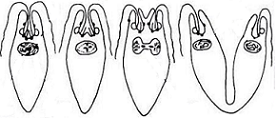
-
0%
a) Fission
-
60%
b) Binary fission
-
20%
c) Transverse binary fission
-
20%
d) Longitudinal binary fission
Q.21.
dentify A, B and C in the following figure.
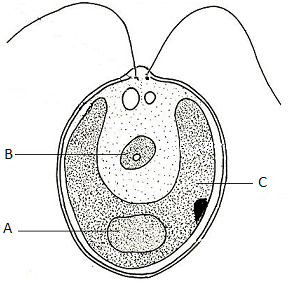
-
50%
a) A-nucleus, B-chloroplast, C-Pyrenoids
-
0%
b) A-chloroplast, B-pyrenoid, C- nucleus
-
25%
c) A-pyrenoid ,B-nucleus,C-chloroplast
-
25%
d) A-chloroplast,B-nucleus,C-mitochondria
Explanation
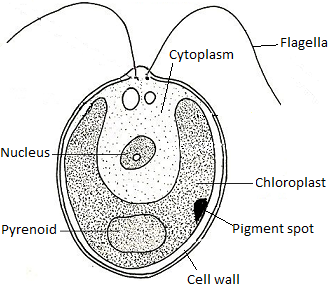
Q.22.
hich of the following is a dioecious plant?
-
40%
a) Vallisneria
-
0%
b) Maize
-
20%
c) Castor
-
40%
d) Cucumber
Q.23.
evelopment of an embryo before the adult stage is not found in the following group of organisms:
-
20%
a) Bryophytes and Pteridophytes
-
60%
b) Algae and Fungus
-
20%
c) Mammals and Flowering plants
-
0%
d) Birds and Reptiles
Q.24.
n plants, the period between birth and reproductive maturity is called:
-
0%
a) Life span
-
33%
b) Vegetative phase
-
50%
c) Reproductive phase
-
17%
d) Senescent phase
Q.25.
tudy the following statements and select the correct option: (i) Bamboo species flowers only once in their life time, generally after 50 – 100 years and produce large number of fruits and die. (ii) In animals, juvenile phase is followed by morphological and physiological changes prior to active reproductive behaviour. (iii) The reproductive phase is same duration in all organisms. (iv) Juvenile phase is the period of growth between birth of an individual till it reaches reproductive maturity.
-
33%
a) (i) and (ii) are correct while (iii) and (iv) are wrong
-
0%
b) (i), (iii) and (iv) are correct while (ii) is wrong
-
33%
c) (i), (ii) and (iv) are correct while (iii) is wrong
-
33%
d) All are correct
Q.26.
he vital link that ensures continuity of species between organisms of one generation and the next is:
-
50%
a) Male gamete
-
25%
b) Zygote
-
0%
c) Fertilization
-
25%
d) All of above
Q.27.
onsider the following statements and chose the correct option. (a) The genetic constitution of a plant is unaffected in vegetative propagation. (b) Rhizome in ginger serves as an organ of vegetative reproduction. (c) totipotency of cells enables us to micropropagate plants.
-
33%
a) Statement (b) is alone is true
-
0%
b) Statements (a) and (b) are true
-
33%
c) Statements (b) and (c) are true
-
33%
d) All the statements are true
Q.28.
hat is meiocyte?
-
50%
a) The cell undergoes meiosis
-
25%
b) The cell undergoes mitosis
-
25%
c) Both a and b
-
0%
d) None of the above
Q.29.
ulb acts as a propagule in
-
50%
a) Onion
-
0%
b) Garlic
-
0%
c) Agave
-
50%
d) Both and b
Q.30.
------is for increase the number of cells.
-
0%
a) Cell enlargement
-
60%
b) Cell division
-
40%
c) Cell differentiation
-
0%
d) Zygote