Q.1.
on 145 The largest and second largest cell in female gametophyte is:
-
48%
a) Central cell and egg
-
29%
b) Egg and central cell
-
14%
c) Antipodals and synergids
-
8%
d) Synergids and antipodals
Q.2.
In water hyacinth and water lily, pollination takes place by : [NEET 2020]
-
26%
a) Wind and water
-
19%
b) Insects and water
-
38%
c) Insects or wind
-
17%
d) Water currents only
Q.3.
on 253 Pollination in grasses takes place through:
-
18%
a) Entemophily
-
54%
b) Anemophily
-
15%
c) Ornithophily
-
13%
d) Cleistogamy
Q.4.
on 254 Identify the wrong statement from the following;
-
12%
a) Most of the monocot seeds are endospermous: Orchids are non – endospermous
-
21%
b) Non – endospermic seeds are common in dicots: Some dicots are endospermic
-
46%
c) Seeds fail to germinate due to absence of external environmental conditions are dormant seeds. Dormancy and quiescence are because of endogenous factors
-
21%
d) Most of the angiospermic have true fruit which is the fertilized ovary
Q.5.
on 255 In majority of angiosperms:
-
23%
a) egg has a Filiform apparatus
-
9%
b) there are numerous antipodal cells
-
48%
c) reduction division occurs in the megaspore mother cells
-
20%
d) a small central cell is present in the embryo sac
Q.6.
on 260 In flowering plants, fertilization occur in
-
35%
a) Ovary
-
47%
b) Embryo sac
-
8%
c) Nucellus
-
10%
d) Ovule
Q.7.
on 318 The process by which seedless fruits are produced are known as
-
59%
a) Parthenocarpy
-
12%
b) Apogamy
-
26%
c) Parthenogenesis
-
3%
d) Apospory
Q.8.
on 256 Fertilization in which male gametes are carried through pollen tube is known as:
-
20%
a) Porogamy
-
44%
b) Syngamy
-
26%
c) Siphonogamy
-
10%
d) Chalazogamy
Q.9.
on 257 Formation of embryo directly from nucellus and integuments is:
-
30%
a) Adventive Polyembryony
-
13%
b) Apospory
-
24%
c) Apogamy
-
33%
d) Apomixis
Q.10.
on 319 The source of food for developing embryo is
-
25%
a) Nucellus
-
10%
b) Ovule
-
59%
c) Endosperm
-
6%
d) Anther
Q.11.
on 320 Which structure pushes the developing embryo toward endosperm to get nutrition ?
-
21%
a) Hypophysis
-
14%
b) Terminal octant
-
26%
c) Proembryo
-
39%
d) Suspensor
Q.12.
on 258 Assertion: Polyspory condition is found in Cuscuta. Reason: Four pollen grains joined together in a bundle to form Polyspory.
-
45%
a) Both Assertion and Reason are true and Reason is the correct explanation of Assertion
-
28%
b) Both Assertion and Reason are true but Reason is NOT the correct explanation of Assertion
-
18%
c) Assertion is true but Reason is false
-
10%
d) Both Assertion and Reason are false
Q.13.
on 259 The unit of female reproductive body in flower is
-
38%
a) Carpel
-
33%
b) Megasporangium
-
13%
c) Ovule
-
16%
d) Ovary
Q.14.
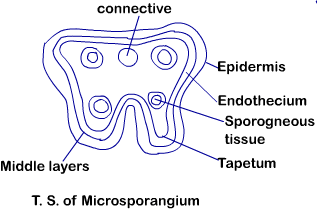
on 146 The anther wall layer which develop fibrous thickenings and helps in the dehiscence of the anther and dispersal of pollen grains due to its hygroscopic nature:
-
21%
a) Epidermis
-
46%
b) Endothecium
-
15%
c) Middle layers
-
18%
d) Tapetum
Q.15.
on 190 Which of the following is not correct about Sporopollenin?
-
22%
a) Pollen grains are well preserved due to it
-
15%
b) No enzyme that degrades Sporopollenin is so far known
-
17%
c) Exine of pollen grain is composed of sporopollenin
-
46%
d) It is a proteinaceous substance that provides protection to pollen grains from high temperature, acid and alkaline medium
Q.16.
on 191 The given figure shows the false fruit of apple. What does a – d represent?
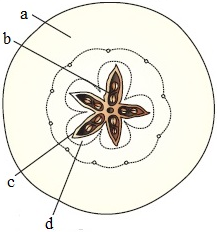
-
19%
a) a – endosperm, b – thalamus, c – seed, d – mesocarp
-
22%
b) a – thalamus, b – seed, c – endocarp, d – Achene
-
53%
c) a – thalamus, b – seed, c – endocarp, d – mesocarp
-
6%
d) None of these
Q.17.
on 192 If the antipodal cell contains 8 chromosomes, then the number of chromosomes in Aleurone layer will be:
-
19%
a) 8
-
46%
b) 16
-
32%
c) 24
-
3%
d) 12
Q.18.
on 193 Find the mis – matching series:
-
13%
a) Monocarpellary pistil → Pistil → Carpel → Gynoecium
-
22%
b) Pentacarpellary syncarpous pistil → Five carpels → One pistil → Only one style and stigma for five carpels
-
33%
c) Multicarpellary apocarpous pistil → Number of carpels = Number of pistils → Each carpel has stigma and style
-
32%
d) Multicarpellary syncarpous pistil → Number of carpels = One pistil → Each carpel has stigma and style
Q.19.
Which one of the following statements regarding post-fertilization development in flowering plants is incorrect? [ NEET 2019]
-
11%
a) Ovary develops into fruit
-
11%
b) Zygote develops into embryo
-
21%
c) Central cell develops into endosperm
-
57%
d) Ovules develop into embryo sac
Q.20.
In some plants, the female gamete develops into embryo without fertilization. This phenomenon is known as ... [NEET 2019]
-
8%
a) Autogamy
-
40%
b) Parthenocarpy
-
7%
c) Syngamy
-
45%
d) Parthenogenesis
Q.21.
Double fertilization is .... .. [NEET 2018]
-
14%
a) Fusion of two male gametes with one egg
-
18%
b) Fusion of one male gamete with two polar nuclei
-
16%
c) Fusion of two male gametes of a pollen tube with two different eggs
-
52%
d) Syngamy and triple fusion
Q.22.
Number of prothallial cells present in male gametophyte of flowering plant is ... .. [ DPMT 2002 ]
-
19%
a) Three
-
45%
b) Two
-
17%
c) One
-
19%
d) Zero
Q.23.
Gloriosa superba exhibits ... ... [ EAMCET 2002]
-
18%
a) Heterostyly
-
29%
b) Self sterility
-
31%
c) Herkogamy
-
23%
d) Cleistogamy
Q.24.
Bees are important to agriculture as they ... ... [ CPMT 1996 ]
-
7%
a) Produce wax
-
65%
b) Perform pollination
-
11%
c) Prevent pollination
-
18%
d) Produce honey
Q.25.
In mature embryo sac, the central cell is ... ... [ AMU 2009 ]
-
17%
a) Single nucleate
-
56%
b) Binucleate
-
8%
c) Four nucleate
-
19%
d) Eight nucleate
Explanation
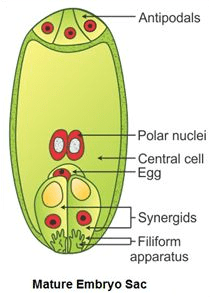
Q.26.
Sporopollenin occurs in ... ... [ DPMT 1997 ]
-
10%
a) Female gametophyte
-
20%
b) Male gametophyte
-
16%
c) Vegetative cells of pollen grain
-
53%
d) Exine of pollen wall
Explanation
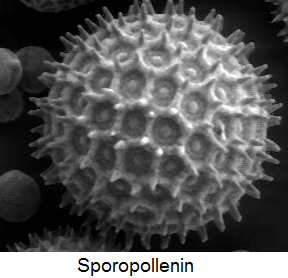
Q.27.
Triploid tissue is ... ... [ BHU 1999 ]
-
67%
a) Endosperm in Maize/ Wheat/Lily
-
11%
b) Leaf in Onion/Bryophyllum/Pinus
-
10%
c) Root in Onion/Radish/Carrot
-
12%
d) Fern prothallus
Q.28.
Remnants of nucellus present in seed are called ... ... [ HPPMT 2012 ]
-
24%
a) Pericarp
-
14%
b) Periderm
-
21%
c) Endosperm
-
41%
d) Perisperm
Explanation
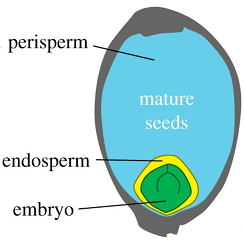
Q.29.
Male gametes are formed by ... .. [ CBSE 2007 ]
-
10%
a) Pollen cell
-
44%
b) Generative cell
-
13%
c) Pollen tube cell
-
33%
d) Pollen mother cell
Q.30.
Which one is diploid ... ... [ BHU 1996 ]
-
16%
a) Synergids
-
50%
b) Secondary nucleus
-
14%
c) Antipodals
-
20%
d) Egg
Q.31.
Intraspecific incompatibility is overcome by ... ... [ BHU 2002 ]
-
48%
a) Mixed pollination
-
36%
b) Self pollination
-
10%
c) Wetting of anthers
-
6%
d) Wetting of stigmas
Q.32.
Cleistogamous flowers are .. .. [ manipal 1995 ]
-
9%
a) Male flowers which never open
-
13%
b) Female flowers which never open
-
52%
c) Bisexual flowers which never open
-
26%
d) Open bisexual flowers which perform self pollination in bud condition
Q.33.
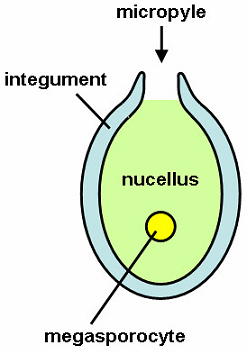
Ovule integuments gets transformed into ... ... [ CMC 2003 ]
-
13%
a) Seed
-
61%
b) Seed coat
-
14%
c) Fruit wall
-
12%
d) Cotyledons
Explanation
Q.34.
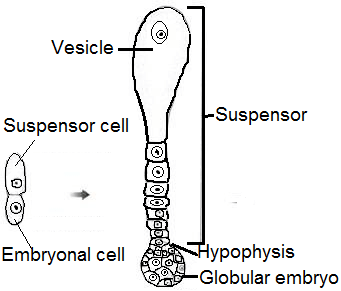
Part of suspensor that helps in food absorption is ... ... [ MHT CET 2011]
-
29%
a) Hypophysis
-
24%
b) Haustorium
-
30%
c) Basal cell
-
18%
d) Intermediate cell
Explanation
Q.35.
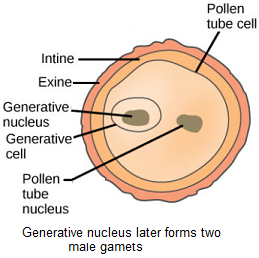
Number of gametes produced by a male gametophyte of flowering plant is ... ... [ MHTCET 2010 ]
-
29%
a) Four
-
18%
b) One
-
11%
c) Three
-
43%
d) Two
Explanation
Q.36.
on 194 Geocarpic flowers are:
-
20%
a) Castor and Viola
-
23%
b) Oxalis and castor
-
44%
c) Viola and Oxalis
-
13%
d) Oxalis and pineapple
Q.37.
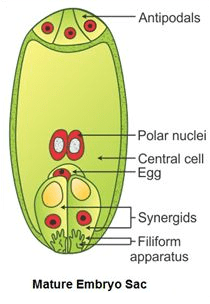
Polygonum type of embryo sac is ... .. [ MPPMT 2000 ]
-
53%
a) 8-nucleate
-
19%
b) 16-nucleate
-
21%
c) 24-nucleate
-
6%
d) 32-nucleate
Explanation
Q.38.
Endosperm of angiosperms is produced after fertilization of male gamete with ... ... [ BHU 1991 ]
-
9%
a) Antipodals
-
15%
b) Synergids
-
72%
c) Secondary nucleus
-
4%
d) Oosohere
Q.39.
Sporopollenin is formed by polymerization of ... .. [BHU 2012]
-
18%
a) Fat and phenols
-
25%
b) Fats and esters
-
35%
c) Carotenoids and fat
-
22%
d) Carotenoid and esters
Q.40.
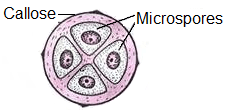
Which one is surrounded by callose wall .. .. [ CBSE 2007 ]
-
16%
a) male gamete
-
38%
b) Pollen grain
-
11%
c) Egg
-
35%
d) Microspore mother cell
Explanation
Q.41.
Endosperm cell of an angiosperm has 24 chromosomes. The number of chromosomes in the gametes would be ... ... [ BHU 1998 ]
-
51%
a) 8
-
17%
b) 16
-
16%
c) 24
-
16%
d) 48
Q.42.
Syngamy produces ... ... [ MHT CET 2011]
-
41%
a) Embryo
-
17%
b) Endosperm
-
7%
c) Perisperm
-
35%
d) Both A and B
Q.43.
Male gametophyte of angiosperms/ monocots is ... .... [ CBSE 1990 ]
-
46%
a) Microsporangium
-
14%
b) Nucellus
-
29%
c) Microspore
-
11%
d) Stamen
Q.44.
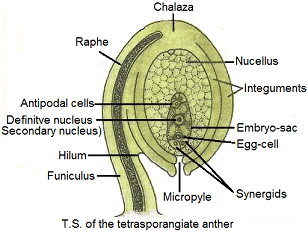
Which of the following statements are true a- Endothecium lies below epidermis b- Fusion of egg with male gamete is called apogamy c- Synergids are haploid d- Point at which funicle touches the ovule is raphe .... [ Kerala 2005 ]
-
18%
a) a and d only
-
15%
b) a and b only
-
18%
c) b and d only
-
49%
d) a and c only
Explanation
Q.45.
A plant pollinated by bats is ....... [BHU 1997 ]
-
20%
a) Ophrys
-
26%
b) Salvia
-
22%
c) Kigelia
-
33%
d) All the above
Q.46.
Coconut water and edible part of coconut represent ... .. [ CBSE 2012 ]
-
66%
a) Endosperm
-
11%
b) Embryo
-
14%
c) Endocarp
-
9%
d) Mesocarp
Q.47.
Embryo of Sunflower has ... ... [ CBSE 1998]
-
27%
a) One cotyledon
-
43%
b) Two cotyledons
-
10%
c) Three cotyledons
-
20%
d) Many cotyledons
Q.48.
Which one form the endosperm .... .. [ BHU 1990 ]
-
6%
a) Antipodals
-
17%
b) Synergids
-
73%
c) Secondary nucleus
-
5%
d) OOsphere
Q.49.
What does filiform apparatus do at the entrance into ovule? It ... ... [ CBSE 2008 ]
-
4%
a) Brings about opening of pollen tube
-
54%
b) Guides pollen tube from synergids to egg
-
30%
c) Helps in entry of pollen tube into synergids
-
11%
d) Prevents entry of more than one pollen tube into embryo sac
Q.50.
Cleistogamous flowers are ... ... [ KCET 2006 ]
-
13%
a) Wind pollinated
-
19%
b) Insect pollinated
-
7%
c) Bird pollinated
-
61%
d) Self pollinated