Q.1.
The postulate that all atoms of an element are exactly alike was proved wrong with the discovery of
-
10%
a)radioactivity
-
20%
b) allotropy
-
63%
c)isotopes
-
6%
d)isobars
Q.2.
The introduction of neutron into the nucleus of an atom would lead to change in
-
7%
a) The number of electrons also
-
4%
b) The chemical nature of atom
-
22%
c)Its atomic number
-
67%
d)Its atomic weight
Q.3.
Which of the following is discrete in Bohr's theory
-
11%
a) Potential energy
-
31%
b) Kinetic energy
-
8%
c)Velocity
-
50%
d)Angular momentum
Q.4.
Which of the following statement is not correct
-
23%
a) Angular momentum of 3s electron is equal to that of 2s electron
-
27%
b) Energy levels of H-atom are not equally spaced
-
40%
c) Energy of electron is zero only when it is stationary
-
10%
d) Humphrey series lies in the far infrared region
Q.5.
When applied, the uncertainty principle has significance in case of
-
3%
a)moving train
-
3%
b) spinning cricket ball
-
61%
c)moving α -particle
-
32%
d)all the above
Q.6.
Which of the following represents de Broglie relation?
-
35%
a)

-
47%
b)

-
6%
c)

-
12%
d)

Q.7.
The wave function |ψ2| in Schrodinger wave equation represents
-
52%
a) probability of the electron
-
19%
b) amplitude of the wave
-
23%
c)frequency of the wave
-
6%
d)speed of the wave
Q.8.
Which of the following statement is not correct?
-
12%
a) Angular momentum of 3s electron and 2s electron is equal
-
12%
b) Energy level of H-atom are not equally spaced
-
68%
c) Energy of electron is zero only when it is stationary
-
8%
d) Balmer series lies in visible region
Q.9.
The metal which gives photoelectric effect most easily is
-
26%
a)Lithium
-
7%
b) Sodium
-
7%
c)Calcium
-
59%
d)Cesium
Q.10.
The probability of finding electron in the orbital is
-
43%
a) 100%
-
29%
b) 90-95%
-
18%
c)70-80%
-
11%
d)50-60%
Q.11.
The total number of energy orbital's in fifth energy level is
-
17%
a) 5
-
31%
b) 10
-
10%
c)15
-
41%
d)25
Q.12.
The designation of a sub shell with n=4 and l=3 is
-
12%
a) 4s
-
19%
b) 4p
-
31%
c) 4d
-
38%
d) 4f
Q.13.
Quantum number not obtained from the solution of Schrodinger wave equation is
-
8%
a)Principal quantum number
-
8%
b) Azimuthal quantum number
-
8%
c)Magnetic quantum number
-
75%
d)Spin quantum number
Q.14.
The uncertainty found from the uncertainty principle ( Δx.Δp=h/4π) is
-
30%
a) the minimum value
-
11%
b) the maximum value
-
15%
c)the exact value
-
44%
d)only approximate value
Q.15.
Which of the following statement about spectral series is incorrect?
-
21%
a) The lines in the Balmer series corresponds to electron transition from energy levels higher than n=2 energy level
-
12%
b) Paschen series appears in the infrared region
-
46%
c)The lines of Lyman series appears in visible region
-
21%
d)Transitions from higher energy level to 4th energy level produce Pfund series which falls in the infrared region
Q.16.
The dual nature of radiation was proposed by
-
25%
a) Max Plank
-
54%
b) d-Broglie
-
17%
c) Einstein
-
4%
d) Schrodinger
Q.17.
The total number sub shells in N shell is
-
9%
a)3
-
65%
b) 4
-
13%
c)5
-
13%
d)7
Q.18.
To give a designation to an orbital, we need
-
43%
a) Principal and azimuthal quantum number
-
14%
b) Principal quantum number and magnetic quantum number
-
10%
c)Azimuthal and magnetic quantum number
-
33%
d)Principal, azimuthal and magnetic quantum numbers
Q.19.
The splitting of the spectral lines under the influence of magnetic field is called
-
50%
a) Zeeman effect
-
14%
b) Compton effect
-
27%
c)Photoelectric effect
-
9%
d)Diffraction
Q.20.
the correct Schrodinger's wave equation for an electron with E as total energy and V as potential energy is -
-
29%
a)
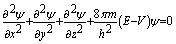
-
24%
b)
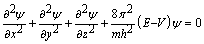
-
24%
c)
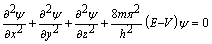
-
24%
d)
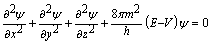
Q.21.
If the threshold frequency of a metal for photoelectric effect is ν0, then which of the following will not happen?
-
0%
a)If frequency of the incident radiation is νo, the kinetic energy of the electrons ejected is zero
-
35%
b) If the frequency of incident radiation is ν, the kinetic energy energy of the electrons ejected will be hν - hνo
-
25%
c)If frequency is kept same at ν but intensity is increased, the number of electrons ejected will increase
-
40%
d)If frequency of incident radiation is further increased, the number of photo-electrons ejected will increase
Q.22.
Which of the following transitions of electrons in hydrogen atom will emit maximum energy?
-
32%
a) n5 → n4
-
5%
b) n4 → n3
-
32%
c)n3 → n2
-
32%
d)all will emit same energy
Q.23.
Magnetic quantum number specifies
-
0%
a) size of orbitals
-
26%
b) Shape of orbitals
-
63%
c)Orientation of orbitals in space
-
11%
d)Nuclear stability
Q.24.
f uncertainty &deltax in position is along X-axis, then uncertainty Δp in momentum is along
-
19%
a) X-axis
-
44%
b) Y-axis
-
19%
c) X-axis
-
19%
d) any axis
Q.25.
The number of orbitals in any shell (n) is equal to
-
44%
a)2n2
-
33%
b) n2
-
17%
c)2n
-
6%
d)n
Q.26.
The maximum number of electrons present in any main energy level is given by
-
5%
a) (2l + 1)
-
53%
b) 2n2
-
37%
c)(2n + 1)
-
5%
d)n2
Q.27.
With the increasing principal quantum number, the energy difference between adjacent energy levels in H-atom
-
18%
a) decreases
-
29%
b) increases
-
18%
c)remain constant
-
35%
d)decreases for lower value of Z and increases for higher value of Z
Q.28.
The wave-mechanical model of atom is based upon
-
33%
a) de Broglie concept of dual character of matter
-
6%
b) Heisenberg's uncertainty principle
-
28%
c) Schrodinger wave equation
-
33%
d) All the three above
Q.29.
Heisenberg's uncertainty principle rules out the exact simultaneous measurement of
-
22%
a)probability and velocity
-
11%
b) energy and velocity
-
6%
c)charge density and radius
-
61%
d)position and momentum
Q.30.
in the photo-electric effect, the number of photo-electrons emitted per unit time depends upon the
-
17%
a) Energy of incident radiations
-
17%
b) Frequency of incident radiations
-
17%
c)Intensity of incident radiations
-
50%
d)Both frequency and intensity of incident radiation
Q.31.
The radius of nth Bohr's orbit can be obtained from the relation
-
33%
a) 0.53n2 nm
-
11%
b) 0.53n nm
-
44%
c)(0.053/n2) nm
-
11%
d)0.053n2 nm
Q.32.
he quantum number which specifies the location as well as energy is
-
56%
a) principal quantum number
-
0%
b) azimuthal quantum number
-
25%
c) spin quantum number
-
19%
d) magnetic quantum number
Q.33.
If a light of wavelength λ hits the moving electron, the uncertainty in measurement of its position will be
-
31%
a)greater than λ
-
31%
b) less than λ
-
31%
c)equal to λ
-
6%
d)It can have any value
Q.34.
he number of electrons subshells in the nth quantum level are
-
0%
a) n
-
73%
b) 2n2
-
20%
c)2n
-
7%
d)n-1
Q.35.
According to photo electric effect, the kinetic energy of the ejected electrons is directly proportional to
-
11%
a) Wavelength of light
-
21%
b) Intensity of light
-
32%
c)frequency of light
-
37%
d)Velocity of incident light
Q.36.
The angular momentum of an electron in an atomic orbital depends upon
-
14%
a) Principal quantum number
-
64%
b) azimuthal quantum number
-
21%
c)magnetic quantum number
-
0%
d)spin quantum number
Q.37.
The energy of an electron in the third orbit of an atom is -E. the energy of an electron in the first orbit will be
-
33%
a) -3E
-
40%
b) -E/3
-
13%
c) -E/9
-
13%
d) -9E
Q.38.
2p - orbital have
-
7%
a)n=1, l=2
-
21%
b) n=2, l=2
-
71%
c)n=2, l=1
-
0%
d)n=2, l=0
Q.39.
THe correct order of increasing energies of the orbitals is
-
20%
a) 3s, 3p, 3d, 4s, 4p
-
33%
b) 3s, 3p, 4s, 4p, 3d
-
40%
c) 3s, 3p, 4s, 3d, 4p
-
7%
d)3s, 3p, 3d, 4p, 4s
Q.40.
The quantum numbers for the electron present in the valence shell of an element are given below:n=2,l=0, m=0, s=+ 1/the atom is
-
40%
a) Lithium
-
13%
b) Beryllium
-
40%
c)Hydrogen
-
7%
d)Boron
Q.41.
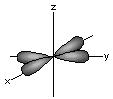
ion Q84) The figure given below is representation of the shape of
-
27%
a) 3dxy orbital
-
13%
b) 3dz2
-
20%
c) 2pzorbital
-
40%
d) 3dx2-y2 orbital
Q.42.
Consider the electron configuration 1s2 2s2 2px2
-
5%
a)It violates Aufbau principle
-
58%
b) It violets Hund's rule
-
11%
c)It violates Pauli's exclusion principle
-
26%
d)It is correct
Q.43.
The nodes present in 3p-orbital are
-
14%
a) one spherical, one planar
-
36%
b) two spherical
-
21%
c)two planar
-
29%
d)one planar
Q.44.
Maximum number of electrons in s, p, d sub-shells are
-
7%
a) 2 in each
-
13%
b) 2, 4, 6
-
67%
c)2,6 ,10
-
13%
d)2, 6, 12
Q.45.
The value of azimuthal quantum number for electrons present in 4p-orbitals is
-
60%
a) 1
-
7%
b) 2
-
20%
c) 3
-
13%
d) 4
Q.46.
The 3d-orbitals having electron density in all three axes is
-
7%
a)3dxy
-
64%
b) 3dz2
-
14%
c)3dyz
-
14%
d)3dzx
Q.47.
Which of the following has zero electron density in xy plane
-
43%
a)dz2
-
36%
b) dz2- y2
-
7%
c)pz
-
14%
d)dxy
Q.48.
An electro having an azimuthal quantum number l=3 is
-
0%
a) s -electrons
-
15%
b) p- electrons
-
15%
c)d-electrons
-
69%
d)f-electrons
Q.49.
How many electrons in a given atom can have the following set of quantum numbersn=3, l=2, m=+2, s=-1/2
-
20%
a) 1
-
53%
b) 18
-
13%
c) 14
-
13%
d) not possible
Q.50.
The energy of orbitals of hydrogen atom are in the order
-
47%
a)3s < 3p < 4s < 3d < 4p
-
20%
b) 3s < 3p < 3d < 4s < 4p
-
27%
c)3s=3p=3d < 4s=4p
-
7%
d)3s=3p=3d < 4s < 4p