Q.1.
The nitrogen atom has 7 protons and 7 electrons, the nitride ion (N3-) will have
-
50%
a) 7 protons and 10 electrons
-
0%
b) 4 protons and 7 electrons
-
50%
c) 4 protons and 10 electrons
-
0%
d) 10 protons and 7 electrons
Q.2.
Which of the following has maximum number of unpaired electrons
-
20%
a)Cu2+
-
60%
b) Cr3+
-
0%
c)Ni2+
-
20%
d)Fe3+
Q.3.
Assertion : In a multielectron atom, the electrons in different sub-shells have different energies. Reason : Energy of an orbital depends upon n + l value.
-
40%
a) Both Assertion and Reasoning are true and Reasoning is correct explanation of Assertion
-
40%
b) Both are correct but Reason is not explanation of Assertion
-
0%
c) Assertion is correct but Reason is wrong
-
20%
d) Both Assertion and Reason are incorrect.
Q.4.
Isoelectronic species are
-
33%
a) CO, CN–, NO+, C22–
-
17%
b) CO–, CN, NO, C2–
-
33%
c) CO+, CN+, NO–, C2
-
17%
d) CO, CN, NO, C2
Q.5.
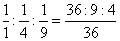
The ratio of the energy required to remove an electron from the first three Bohr’s orbits of hydrogen is
-
29%
a) 3 : 2 : 1
-
29%
b) 9 : 4 : 1
-
14%
c) 36 : 9 : 4
-
29%
d) 1 : 4 : 9
Explanation
Q.6.
Be2+ is isoelectronic with which of the following ions ? [AIPMT-2014]
-
0%
a) H+
-
80%
b) Li+
-
0%
c) Na+
-
20%
d) Mg2+
Q.7.
Assertion : The charge to mass ratio of the particles in anode rays depends on nature of gas taken in the discharge tube. Reason : The particles of anode rays carry positive charge.
-
75%
a) Both Assertion and Reasoning are true and Reasoning is correct explanation of Assertion
-
0%
b) Both are correct but Reason is not explanation of Assertion
-
0%
c) Assertion is correct but Reason is wrong
-
25%
d) Both Assertion and Reason are incorrect.
Q.8.
If the uncertainty in the position of electron is zero, the uncertainty in its momentum would be
-
20%
a) Zero
-
40%
b) Greater than h/4π
-
0%
c) Less than h/4π
-
40%
d) Infinite
Q.9.
Which of the following is not permissible arrangement of electrons in an atom? [AIPMT (Prelims)-2009]
-
0%
a) n = 5, l = 3, m = 0, s =1/2
-
100%
b) n = 3, l = 2, m = –3, s = -1/2
-
0%
c) n = 3, l = 2, m = –2, s = -1/2
-
0%
d) n = 4, l = 0, m = 0, s = +1/2
Q.10.
Which one of the elements with the following outer orbital configurations may exhibit the largest number of oxidation states? [AIPMT (Prelims)-2009]
-
33%
a) 3d5, 4s1
-
67%
b) 3d5, 4s2
-
0%
c) 3d2, 4s2
-
0%
d) 3d3, 4s2
Q.11.
Which one of the following ions has electronic configuration [Ar]3d6? (At. nos. Mn = 25, Fe = 26, Co = 27, Ni = 28)
-
0%
a) Co3+
-
50%
b) Ni3+
-
25%
c) Mn3+
-
25%
d) Fe3+
Q.12.
If n = 6, the correct sequence of filling of electrons will be [AIPMT (Prelims)-2011]
-
75%
a) ns → np →(n - 1)d →(n - 2)f
-
0%
b) ns →(n - 2)f →(n -1)d→ np
-
0%
c) ns →(n - 1)d →(n - 2)f → np
-
25%
d) ns → (n - 2)f → np → (n - 1)d
Q.13.
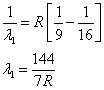
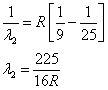
What will be the ratio of the wavelength of the first line to that of the second line of Paschen series of H atom?
-
33%
a) 256 : 175
-
33%
b) 175 : 256
-
33%
c) 15 : 16
-
0%
d) 24 : 27
Explanation

Q.14.
Which of the following statement concerning the four quantum number is incorrect?
-
25%
a) n gives the size of an orbital
-
25%
b) l gives the shape of an orbital
-
0%
c) m gives the energy of the electron in orbital
-
50%
d) s gives the direction of spin of electron in the orbital
Q.15.
The energy of second Bohr orbit of the hydrogen atom is –328 kJ mol–1; hence the energy of fourth Bohr orbit would be [AIPMT (Prelims)-2005]
-
14%
a) –41 kJ mol–1
-
57%
b) –1312 kJ mol–1
-
0%
c) –164 kJ mol–1
-
29%
d) –82 kJ mol–1
Q.16.
he geometry of sp3d2 hybrid orbitals is
-
25%
a) linear
-
25%
b) pentagonal bipyramidal
-
25%
c)trigonal bipyramidal
-
25%
d)octahedral
Q.17.
The d-orbitals involved in dsp2 hybridization is
-
0%
a) dxy
-
0%
b) dz2
-
50%
c) dx2 - y2
-
50%
d) dzx
Q.18.
Assertion : Electronic energy for hydrogen atom of different orbitals follow the sequence : 1s < 2s = 2p < 3s = 3p = 3d. Reason : Electronic energy for hydrogen atom depends only on n and is independent of ‘l’ & ‘m’ values.
-
33%
a) Both Assertion and Reasoning are true and Reasoning is correct explanation of Assertion
-
0%
b) Both are correct but Reason is not explanation of Assertion
-
67%
c) Assertion is correct but Reason is wrong
-
0%
d) Both Assertion and Reason are incorrect.
Q.19.
A transition element X has a configuration (Ar)3d4 in its +3 oxidation state. Its atomic number is
-
25%
a) 22
-
25%
b) 19
-
25%
c) 25
-
25%
d) 26
Q.20.
What will be the longest wavelength line in Balmer series of spectrum of H-atom?
-
0%
a) 546 nm
-
33%
b) 656 nm
-
0%
c) 566 nm
-
67%
d) 556 nm
Q.21.
Zeeman effect refers to the
-
75%
a) Splitting of the spectral lines in a magnetic field
-
0%
b) Splitting up of the spectral lines in an electrostatic field
-
0%
c) Emission of electrons from metals when light falls on it
-
25%
d) Random scattering of α-particles by gold foil
Q.22.
Assertion : The number of angular nodes in 3zd2 is zero. Reason : Number of angular nodes of atomic orbitals is equal to value of l.
-
40%
a) Both Assertion and Reasoning are true and Reasoning is correct explanation of Assertion
-
20%
b) Both are correct but Reason is not explanation of Assertion
-
20%
c) Assertion is correct but Reason is wrong
-
20%
d) Both Assertion and Reason are incorrect.
Q.23.
Which of the following set of quantum number is possible?
-
0%
a) n = 4, l = 2, m = –2, s = –2
-
0%
b) n = 4, l = 4, m = 0, s =1/2
-
67%
c) n = 4, l = 3, m = –3, s =1/2
-
33%
d) n = 4, l = 0, m = 0, s = 0
Q.24.
The position of both, an electron and a helium atom is known within 1.0 nm. Further the momentum of the electron is known within 5.0 × 10⁻²⁶ kg ms–The minimum uncertainty in the measurement of the momentum of the helium atom is
-
0%
a) 8.0 × 10⁻²⁶ kg ms–1
-
50%
b) 80 kg ms–1
-
25%
c) 50 kg ms–1
-
25%
d) 5.0 × 10⁻²⁶ kg ms–1
Q.25.
If kinetic energy of a proton is increased nine times, the wavelength of the de-Broglie wave associated with it would become
-
0%
a) 3 times (2) (3)
-
33%
b) 9 times
-
33%
c) (1/3) times
-
33%
d) (1/6) times
Explanation

Q.26.
Two electrons in K shell will not have
-
25%
a) Same principal quantum number
-
12%
b) Same azimuthal quantum number
-
50%
c) Same magnetic quantum number
-
12%
d) Same spin quantum number
Q.27.
The momentum of a particle which has a de-Broglie wavelength of 0.1 nm is
-
33%
a) 3.2 × 10⁻²⁴ kg ms–1
-
0%
b) 4.3 × 10⁻²² kg ms–1
-
33%
c) 5.3 × 10⁻²² kg ms–1
-
33%
d) 6.62 × 10⁻²⁴ kg ms–1
Q.28.
An electron jumps from lower orbit to higher orbit, when
-
25%
a) Energy is released
-
0%
b) Energy is absorbed
-
25%
c) No change in energy
-
50%
d) It radiates energy
Q.29.
For a ‘p’ electron, the orbital angular momentum is
-
25%
a) √6 ħ
-
50%
b) √2 ħ
-
0%
c) ħ
-
25%
d) 2 ħ
Explanation

Q.30.
The total number of subshells in fourth energy level of an atom is
-
0%
a) 4
-
0%
b) 8
-
50%
c) 16
-
50%
d) 32
Q.31.
Total number of spectral lines in UV region, during transition from 5th excited state to 1st excited state
-
0%
a) 10
-
50%
b) 3
-
50%
c) 4
-
0%
d) zero
Q.32.
Which of the following electronic in a transition hydrogen atom will require the largest amount of energy?
-
0%
a) n = 1 to n = 2
-
50%
b) n = 2 to n = 3
-
0%
c) n = 1 to n = ∞
-
50%
d) n = 3 to n = 5
Q.33.
Which combinations of quantum numbers n, l, m and s for the electron in an atom does not provide a permissible solutions of the wave equation?
-
0%
a) 3, 2, 2, 1/2
-
17%
b) 3, 3, 1, -1/2
-
17%
c) 3, 2, 1, 1/2
-
67%
d) 3, 1, 1,-1/2
Q.34.
The measurement of the electron position is associated with an uncertainty in momentum, which is equal to 1 × 10–18 g cm s–The uncertainty in electron velocity is, (Mass of an electron is 9 × 10–28g) [AIPMT (Prelims)-2008]
-
0%
a) 1 × 1011 cm s–1
-
100%
b) 1 × 109 cm s–1
-
0%
c) 1 × 106 cm s–1
-
0%
d) 1 × 105 cm s–1
Q.35.
The number of radial nodes in 4s and 3p orbitals are respectively
-
0%
a) 2, 0
-
0%
b) 3, 1
-
67%
c) 2, 2
-
33%
d) 3, 2
Q.36.
Which shell would be the first to have ‘g’ sub-shell?
-
0%
a) L
-
0%
b) M
-
0%
c) N
-
100%
d) O
Q.37.
Maximum number of electrons in a subshell with l = 3 and n = 4 is [AIPMT (Prelims)-2012]
-
20%
a) 10
-
40%
b) 12
-
20%
c) 14
-
20%
d) 16
Q.38.
Assertion : The orbitals having equal energy are known as degenerate orbitals. Reason : The three 2p orbitals are degenerate in the presence of external magnetic field.
-
50%
a) Both Assertion and Reasoning are true and Reasoning is correct explanation of Assertion
-
0%
b) Both are correct but Reason is not explanation of Assertion
-
25%
c) Assertion is correct but Reason is wrong
-
25%
d) Both Assertion and Reason are incorrect.
Q.39.
Among the following which one is not paramagnetic? [Atomic numbers; Be = 4, Ne = 10, As = 33, Cl = 17]
-
50%
a) Ne2+
-
0%
b) Be+
-
50%
c) Cl–
-
0%
d) As+
Q.40.
The de Broglie wavelength of a particle with mass 1 g and velocity 100 m/s is
-
25%
a) 6.63 × 10⁻³⁵ m
-
0%
b) 6.63 × 10⁻³⁴ m
-
75%
c) 6.63 × 10⁻³³ m
-
0%
d) 6.65 × 10⁻³⁵ m
Q.41.
Number of spectral lines falling in Balmer series when electrons are de-excited from nth shell will be given as
-
50%
a) (n – 2) in UV
-
0%
b) (n – 2) in visible region
-
0%
c) (n – 3) in near IR
-
50%
d) (n – 3) in far IR
Q.42.
Electronic energy is negative because
-
0%
a) Electron has negative charge
-
25%
b) Energy is zero near the nucleus and decreases as the distance from nucleus increases
-
75%
c) Energy is zero at infinite distance from the nucleus and decreases as the electron comes towards nucleus
-
0%
d) These are interelectronic repulsions
Q.43.
The electronic configuration of gadolinium (Atomic No. 64) is
-
0%
a) [Xe]4f3 5d5 6s2
-
0%
b) [Xe]4f 6 5d2 6d2
-
0%
c) [Xe]4f8 5d9 6s2
-
100%
d) [Xe] 4f 7 5d1 6s2
Q.44.
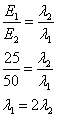
The energies E1and E2 of two radiations are 25 eV and 50 eV respectively. The relation between their wavelengths i.e. λ1 and λ2 will be
-
0%
a) λ1 = λ2/2
-
50%
b) λ1 = λ2
-
0%
c) λ1 = 2λ2
-
50%
d) λ1 = 4λ2
Explanation
Q.45.
The correct order of energy difference between adjacent energy levels in H atom
-
0%
a) E2– E1 > E3– E2 > E4– E3
-
50%
b) E2– E1 > E4 – E3 > E3 – E2
-
0%
c) E4 – E3 > E3 – E2 > E2– E1
-
50%
d) E3 – E2 > E4– E3 > E2 – E1
Explanation

Q.46.
In the presence of magnetic field, the possible number of orientations for an orbital of azimuthal quantum number 3, is
-
33%
a) Three
-
33%
b) One
-
0%
c) Five
-
33%
d) Seven
Q.47.
Maximum number of electrons in a subshell of an atom is determined by the following [AIPMT (Prelims)-2009]
-
0%
a) 2l+1
-
0%
b) 4l- 2
-
25%
c) 2n2
-
75%
d) 4l + 2
Q.48.
The orbital angular momentum of electron in 4s orbital is
-
33%
a) h/4π
-
33%
b) zero
-
0%
c) h/2π
-
33%
d) 2.5h/2π
Q.49.
Given : The mass of electron is 9.11×10⁻³¹ kg. Planck’s constant is 6.626×10⁻³⁴ Js, the uncertainty involved in the measurement of velocity within a distance of 0.1 Å is [AIPMT (Prelims)-2006]
-
0%
a) 5.79 × 10⁶ ms–1
-
50%
b) 5.79 × 10⁷ ms–1
-
25%
c) 5.79 × 10⁸ ms–1
-
25%
d) 5.79 × 10⁵ ms–1
Q.50.
Which of the following electronic configuration is not possible?
-
20%
a) 2p3
-
40%
b) 2d5
-
40%
c) 4s1
-
0%
d) 5f8