Q.1.
on Q199) Consider the following sets of quantum numbers Which of the following sets of quantum number is not possible? [AIPMT (Prelims)-2007]
| Sr | n | l | m | s |
| (a) | 3 | 0 | 0 | +1/2 |
| (b) | 2 | 2 | 1 | +1/2 |
| (c) | 4 3 –2 | 3 | -2 | -1/2 |
| (d) | 1 0 –1 | 0 | -1 | -1/2 |
| (e) | 3 | 2 | 3 | +1/2 |
-
33%
a) a and c
-
17%
b) b, c and d
-
17%
c) a, b, c and d
-
33%
d) b, d and e
Q.2.
Assertion : K.E. of two subatomic particles, having same de-Broglie’s wavelength is same. Reason : de-Broglie’s wavelength is directly related to mass of subatomic particles.
-
67%
a) Both Assertion and Reasoning are true and Reasoning is correct explanation of Assertion
-
17%
b) Both are correct but Reason is not explanation of Assertion
-
0%
c) Assertion is correct but Reason is wrong
-
17%
d) Both Assertion and Reason are incorrect.
Q.3.
If uncertainty in position and momentum are equal, then uncertainty in velocity is [AIPMT (Prelims)-2008]
-
0%
a)

-
100%
b)

-
0%
c)

-
0%
d)

Q.4.
The ratio of specific charge of an electron to that of a proton is
-
9%
a) 1 : 1
-
64%
b) 1837 : 1
-
18%
c) 1 : 1837
-
9%
d) 2 : 1
Q.5.
In an atom, which has 2K, 8L, 18M and 2N electrons in the ground state. The total number of electrons having magnetic quantum number, m = 0 is
-
0%
a) 6
-
60%
b) 10
-
0%
c) 7
-
40%
d) 14
Q.6.
Assuming the velocity to be same, the wavelength of the waves associated with which of the following particles would be maximum?
-
33%
a) An electron
-
0%
b) A proton
-
67%
c) An α-particle
-
0%
d) A deutro
Q.7.
Assertion : Energy of electron is taken negative. Reason : Energy of electron at infinity is zero.
-
88%
a) Both Assertion and Reasoning are true and Reasoning is correct explanation of Assertion
-
0%
b) Both are correct but Reason is not explanation of Assertion
-
12%
c) Assertion is correct but Reason is wrong
-
0%
d) Both Assertion and Reason are incorrect.
Q.8.
For the transition from n = 2 → n = 1, which of the following will produce shortest wavelength?
-
40%
a) H atom
-
0%
b) D atom
-
20%
c) He+ ion
-
40%
d) Li2+ ion
Q.9.
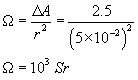
In a Bohr’s model of an atom, when an electron jumps from n = 1 to n = 3, how much energy will be emitted or absorbed?
-
20%
a) 2.389 × 10⁻¹² ergs
-
0%
b) 0.239 × 10⁻¹⁰ ergs
-
40%
c) 2.15 × 10⁻¹¹ ergs
-
40%
d) 0.1936 × 10⁻¹⁰ ergs
Explanation
Q.10.
The wavelength associated with a ball of 200 g and moving with a speed of 5 m/hour is of the order of
-
0%
a) 10–10 m
-
20%
b) 10–20 m
-
40%
c) 10–30 m
-
40%
d) 10–40 m
Q.11.
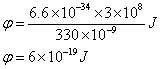
If threshold wavelength (λo) for ejection of electron from metal is 330 nm, then work function for the photoelectric emission is
-
17%
a) 6 × 10⁻¹⁰ J
-
0%
b) 1.2 × 10⁻¹⁸ J
-
33%
c) 3 × 10–19 J
-
50%
d) 6 × 10–19 J
Explanation
Q.12.
Which of the following orbital is with the four lobes present on the axis?
-
17%
a) dz2
-
50%
b) dxy
-
0%
c) dyz
-
33%
d) dx2-y2
Q.13.
A 0.66 kg ball is moving with a speed of 100 m/s. The associated wavelength will be (h = 6.6 × 10⁻³⁴ Js) [AIPMT (Mains)-2010]
-
0%
a) 6.6 × 10⁻³² m
-
20%
b) 6.6 × 10⁻³⁴ m
-
40%
c) 1.0 × 10⁻³⁵ m
-
40%
d) 1.0 × 10⁻³² m
Q.14.
Assertion : Isotopes of an element have almost similar chemical properties. Reason : Isotopes have same electronic configuration.
-
57%
a) Both Assertion and Reasoning are true and Reasoning is correct explanation of Assertion
-
29%
b) Both are correct but Reason is not explanation of Assertion
-
14%
c) Assertion is correct but Reason is wrong
-
0%
d) Both Assertion and Reason are incorrect.
Q.15.
En = –313.6/n2 kcal/mole. If the value of E = –34.84 kcal/mole, to which value does ‘n’ correspond?
-
14%
a) 4
-
14%
b) 3
-
43%
c) 2
-
29%
d) 1
Q.16.
on Q214) Consider the following sets of quantum number Which of the following sets of quantum number is not possible?
| Sr | n | l | m | s |
| (i) | 3 | 0 | 0 | +1/2 |
| (ii) | 2 | 2 | 1 | +1/2 |
| (iii) | 4 | 3 | -2 | –1/2 |
| (iv) | 1 | 0 | -1 | -1/2 |
| (v) | 3 | 2 | 3 | +1/2 |
-
0%
a) (i), (ii), (iii) and (iv)
-
33%
b) (ii), (iv) and(v)
-
33%
c) (i) and (iii)
-
33%
d) (ii), (iii) and (iv)
Q.17.
How many 3d electrons can have spin quantum number (-1/2)
-
17%
a) 5
-
33%
b) 7
-
33%
c) 8
-
17%
d) 10
Q.18.
If each orbital can hold a maximum of 3 electrons. The number of elements in 2nd period of periodic table
-
12%
a) 27
-
25%
b) 9
-
12%
c) 18
-
50%
d) 12
Q.19.
The Bohr orbit radius for the hydrogen atom (n = 1) is approximately 0.530 Å. The radius for the first excited state (n = 2) orbit is (in Å)
-
0%
a) 4.77
-
29%
b) 1.06
-
29%
c) 0.13
-
43%
d) 2.12
Explanation

Q.20.
Who modified Bohr’s theory by introducing elliptical orbits for electron path?
-
33%
a) Rutherford
-
0%
b) Thomson
-
17%
c) Hund
-
50%
d) Sommerfield
Q.21.
The ion that is isoelectronic with CO is
-
50%
a) CN–
-
17%
b) N2+
-
17%
c) O2–
-
17%
d) N2–
Q.22.
The value of Planck's constant is 6.63 × 10⁻³⁴ Js. The speed of light is 3 × 10¹⁷ nm s–Which value is closest to the wavelength in nanometer of a quantum of light with frequency of 6 × 10¹⁵ s–1? [NEET-2013]
-
17%
a) 25
-
67%
b) 50
-
17%
c) 75
-
0%
d) 10
Q.23.
Which of the following has maximum number of unpaired d-electrons?
-
0%
a) N3+
-
60%
b) Fe2+
-
0%
c) Zn+
-
40%
d) Cu+
Q.24.
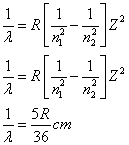
The first emission line in the atomic spectrum of hydrogen in the Balmer series appears at
-
20%
a) (5R/36) cm-1
-
40%
b) (3R/4) cm-1
-
20%
c) (7R/144) cm-1
-
20%
d) (9R/400) cm-1
Explanation
Q.25.
Which of the following is not among shortcomings of Bohr’s model?
-
0%
a) Bohr theory could not account for the fine lines in the atomic spectrum
-
40%
b) Bohr theory was unable to account for the splitting of the spectral lines in the presence of magnetic field
-
20%
c) Bohr theory failed for He atom
-
40%
d) It did not give information about energy level
Q.26.
According to Bohr’s theory angular momentum of an electron in 6th orbit is
-
0%
a) 2.5h/π
-
40%
b) 6h/π
-
40%
c) 3h/π
-
20%
d) 2.5h/2π
Q.27.
Assertion : In third energy level there is no f-subshell. Reason : For n = 3, the possible values of l are 0, 1, 2 and for f-subshell l = 3.
-
67%
a) Both Assertion and Reasoning are true and Reasoning is correct explanation of Assertion
-
17%
b) Both are correct but Reason is not explanation of Assertion
-
0%
c) Assertion is correct but Reason is wrong
-
17%
d) Both Assertion and Reason are incorrect.
Q.28.
For which one of the following set of quantum numbers an electron will have the highest energy?
-
0%
a) 3, 2, 1, 1/2
-
75%
b) 4, 2, 1, 1/2
-
25%
c) 4, 1, 0, -1/2
-
0%
d) 5, 0, 0, 1/2
Q.29.
Uncertainty in position of an electron (mass = 9.1 × 10⁻²⁸g) moving with a velocity of 3 × 104 cm/s accurate upto 0.001% will be (Use h/(4π) in uncertainty expression where h = 6.626 × 10⁻²⁷ erg-s)
-
20%
a) 5.76 cm
-
0%
b) 7.68 cm
-
40%
c) 1.93 cm
-
40%
d) 3.84 cm
Q.30.
In the ground state, an element has 13 electrons in its M-shell. The element is
-
40%
a) Manganese
-
20%
b) Cobalt
-
40%
c) Nickel
-
0%
d) Iron
Q.31.
Assertion : Orbital angular momentum of (1s, 2s, 3s etc.) all s electrons is same. Reason : Orbital angular momentum depends on orientation of orbitals.
-
100%
a) Both Assertion and Reasoning are true and Reasoning is correct explanation of Assertion
-
0%
b) Both are correct but Reason is not explanation of Assertion
-
0%
c) Assertion is correct but Reason is wrong
-
0%
d) Both Assertion and Reason are incorrect.
Q.32.
For principal quantum number n = 5, the total number of orbitals having l = 3 is
-
0%
a) 7
-
33%
b) 14
-
33%
c) 9
-
33%
d) 18
Q.33.
The following quantum numbers are possible for how many orbitals : n = 3, l = 2, m = +2?
-
0%
a) 1
-
50%
b) 2
-
50%
c) 3
-
0%
d) 4
Q.34.
A p-n photodiode is made of a material with a band gap of 2.0 eV. The minimum frequency of the radiation that can be absorbed by the material is nearly [AIPMT (Prelims)-2008]
-
75%
a) 20 × 1014 Hz
-
0%
b) 10 × 1014 Hz
-
25%
c) 5 × 10¹⁴ Hz
-
0%
d) 1 × 10¹⁴ Hz
Q.35.
Which transition of Li2+ is associated with same energy change as n = 6 to n = 4 transition in He+?
-
0%
a) n = 3 to n = 1
-
33%
b) n = 8 to n = 6
-
67%
c) n = 9 to n = 6
-
0%
d) n = 2 to n = 1
Explanation


Q.36.
According to the Bohr Theory, which of the following transitions in the hydrogen atom will give rise to the least energetic photon? [AIPMT (Mains)-2011]
-
0%
a) n = 6 to n = 5
-
75%
b) n = 5 to n = 3
-
25%
c) n = 6 to n = 1
-
0%
d) n = 5 to n = 4
Q.37.
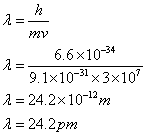
The de-Broglie wavelength of an electron travelling with 10% of velocity of light is equal to (mass of electron =9.1× 10⁻³¹ kg)
-
25%
a) 242.4 pm
-
0%
b) 24.2 pm
-
50%
c) 2.42 pm
-
25%
d) 2.424 pm
Explanation
Q.38.
The correct set of four quantum numbers for the valence electron of rubidium atom (Z = 37) is [AIPMT (Prelims)-2012]
-
50%
a) 5, 0, 0, 1/2
-
0%
b) 5, 1, 0, 1/2
-
25%
c) 5, 1, 1, 1/2
-
25%
d) 6, 0, 0, 1/2
Q.39.
In a hydrogen atom, if the energy of electron in the ground state is –x eV., then that in the 2nd excited state of He+ is
-
33%
a) –x eV
-
0%
b) -4x/9 eV
-
33%
c) +2x eV
-
33%
d) -9x/4 eV
Explanation

Q.40.
The orientation of an atomic orbital is governed by [AIPMT (Prelims)-2006]
-
0%
a) Azimuthal quantum number
-
40%
b) Spin quantum number
-
40%
c) Magnetic quantum number
-
20%
d) Principal quantum number
Q.41.
The orbital angular momentum of a p-electron is given as [AIPMT (Mains)-2012]
-
40%
a)

-
0%
b)

-
40%
c)

-
20%
d)

Q.42.
In hydrogen atom, energy of first excited state is –3.4 eV. Then find out KE of same orbit of hydrogen atom
-
33%
a) +3.4 eV
-
0%
b) +6.8 eV
-
67%
c) –13.6 eV
-
0%
d) +13.6 eV
Q.43.
What is the maximum numbers of electrons that can be associated with the following set of quantum numbers? n = 3, l = 1 and m = –1 [NEET-2013]
-
25%
a) 6
-
0%
b) 4
-
50%
c) 2
-
25%
d) 10
Q.44.
With which of the following configuration an atom has the lowest ionization enthalpy ? [AIPMT (Prelims)-2007]
-
20%
a) 1s2 2s2 2p6
-
20%
b) 1s2 2s2 2p5
-
40%
c) 1s2 2s2 2p3
-
20%
d) 1s2 2s2 2p5 3s1
Q.45.
In Bohr series of lines of hydrogen spectrum, the third line from the red end corresponds to which one of the following inter-orbit jumps of the electron for Bohr orbits in an atom of hydrogen?
-
50%
a) 3 → 1
-
0%
b) 5 → 2
-
25%
c) 2 → 5
-
25%
d) 3 → 2
Q.46.
The angular momentum of electron in 'd' orbital is equal to ... [ AIMPMT 2015]
-
0%
a) 0ħ
-
0%
b) √6 ħ
-
80%
c) √2 ħ
-
20%
d) 2√3 ħ
Q.47.
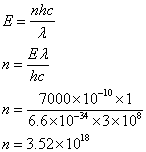
The number of photons of light of wavelength 7000Å equivalent to 1 J are
-
17%
a) 3.52 × 10⁻¹⁸
-
33%
b) 3.52 × 10¹⁸
-
17%
c) 50,000
-
33%
d) 10,0000
Explanation
Q.48.
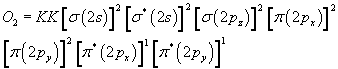
Which of the following contains maximum number of electrons in the antibonding molecular orbitals
-
0%
a) O2
-
67%
b) O22-
-
0%
c)O2-
-
33%
d)O2+
Explanation
Q.49.
Number of spectral lines in Balmer series when an electron return from 7th orbit to 1st orbit of hydrogen atom
-
0%
a) 5
-
67%
b) 6
-
0%
c) 21
-
33%
d) 15
Q.50.
Which of the following transition will emit maximum energy in hydrogen atom?
-
0%
a) 4f → 2s
-
0%
b) 4d → 2p
-
33%
c) 4p → 2s
-
67%
d) All have same energy