Q.1.
The set of quantum numbers not applicable to an electron
-
67%
a) 1, 1, 1, 1/2
-
0%
b) 1, 0, 0, 1/2
-
0%
c) 1, 0, 0 , -1/2
-
33%
d) 2, 0, 0, 1/2
Q.2.
The frequency of a wave is 6 × 10¹⁵ s–Its wave number would be
-
0%
a) 105 cm–1
-
100%
b) 2 × 10⁷ m–1
-
0%
c) 2 × 107 cm–1
-
0%
d) 2 × 105 cm–1
Q.3.
Atomic number and mass number of an element M are 25 and 52 respectively. The number of electrons, protons and neutrons in M2+ ion are respectively
-
0%
a) 25, 25 and 27
-
25%
b) 25, 27 and 25
-
75%
c) 27, 25 and 27
-
0%
d) 23, 25 and 27
Q.4.
The maximum number of electrons in an atom which can have n = 4 is
-
0%
a) 4
-
0%
b) 8
-
50%
c) 16
-
50%
d) 32
Q.5.
Maximum number of electrons in a subshell with l = 3 and n = 4 is
-
0%
a) 10
-
0%
b) 12
-
100%
c) 14
-
0%
d) 16
Q.6.
Assertion : Zn(II) salts are diamagnetic. Reason : Zn2+ ion has one unpaired electron.
-
0%
a) Both Assertion and Reasoning are true and Reasoning is correct explanation of Assertion
-
100%
b) Both are correct but Reason is not explanation of Assertion
-
0%
c) Assertion is correct but Reason is wrong
-
0%
d) Both Assertion and Reason are incorrect.
Q.7.
Which of the following has maximum number of unpaired electrons?
-
0%
a) Mg2+
-
100%
b) Ti3+
-
0%
c) Fe2+
-
0%
d) Mn2+
Q.8.
A certain metal when irradiated with light (ν = 3.2 × 10¹⁶ Hz) emits photo electrons with twice kinetic energy as did photo electrons when the same metal is irradiated by light (ν = 2.0 × 10¹⁶ Hz). Calculate ν0 ofelectron?
-
100%
a) 1.2 × 10¹⁴ Hz
-
0%
b) 8 × 10¹⁵ Hz
-
0%
c) 1.2 × 10¹⁶ Hz
-
0%
d) 4 × 10¹² Hz
Q.9.
Uncertainty in the momentum of an electron is 1.0×10⁻⁵ kg m-the uncertainty in its position will be ( h=6.62 ×10⁻³⁴ kg m2 s-1) ... [ AFMC 1998]
-
50%
a) 1.05 ×10⁻²⁸ m
-
0%
b) 1.05 ×10⁻²⁶ m
-
50%
c) 5.27 ×10⁻³⁰ m
-
0%
d)5.25 ×10⁻²⁸ m
Explanation

Q.10.
The principal and azimuthal quantum number of electrons in 4f orbitals are
-
0%
a) 4, 2
-
50%
b) 4, 4
-
0%
c) 4, 3
-
50%
d) 3, 4
Q.11.
ratio of kinetic energy and potential energy of an electron in a Bohr orbit like hydrogen - like species is
-
0%
a) 1/2
-
33%
b) -1/2
-
67%
c)1
-
0%
d)-1
Q.12.
If the energy difference between the ground state and excited state of an atom is 4.4 × 10⁻¹⁹ J. The wavelength of photon required to produce this transition is
-
0%
a) 4.5 × 10⁻⁷ m
-
50%
b) 4.5 × 10⁻⁷ nm
-
0%
c) 4.5 × 10⁻⁷ Å
-
50%
d) 4.5 × 10⁻⁷ cm
Explanation

Q.13.
Two particles A and B are in motion. If the wavelength associated with particle A is 5 × 10⁻⁸ m ; calculate the wavelength associated with particle B if its momentum is half of A.
-
0%
a) 5 × 10⁻⁸ m
-
100%
b) 10–5 cm
-
0%
c) 10–7 cm
-
0%
d) 5 × 10⁻⁸ cm
Explanation

Q.14.
Assertion : Angular momentum of an electron in an atom is quantized. Reason : In an atom only those orbits are permitted in which angular momentum of the electron is a natural number multiple of h/2π
-
25%
a) Both Assertion and Reasoning are true and Reasoning is correct explanation of Assertion
-
0%
b) Both are correct but Reason is not explanation of Assertion
-
25%
c) Assertion is correct but Reason is wrong
-
50%
d) Both Assertion and Reason are incorrect.
Q.15.
hat is the maximum number of orbitals that can be identified with the following quantum numbers? n = 3, l = l, m l= 0 [AIPMT-2014]
-
0%
a) 1
-
0%
b) 2
-
50%
c) 3
-
50%
d) 4
Q.16.
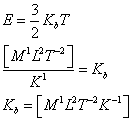
If r1is the radius of the first orbit of hydrogen atom, then the radii of second, third and fourth orbits in term of r1 are
-
0%
a) r12, r13, r14
-
0%
b) 4r1, 9r1, 16r1
-
0%
c) 8r1, 27r1, 64r1
-
100%
d) 2r1, 6r1, 8r1
Explanation
Q.17.
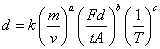
The wavelength of radiation emitted, when in He+ electron falls from infinity to stationary state would be (R = 1.097 × 10⁷ m–1)
-
0%
a) 2.2 × 10⁻⁸ m
-
0%
b) 2.2 × 10⁻⁹ m
-
0%
c) 120 m
-
100%
d) 22 × 107 m
Explanation
Q.18.
The time taken by the electron in one complete revolution in the nth Bohr’s orbit of the hydrogen atom is
-
50%
a) Inversely proportional to n2
-
0%
b) Directly proportional to n3
-
0%
c) Directly proportional to h/2π
-
50%
d) nversely proportional to n/h
Explanation

Q.19.
The bond order for a species with the configurationσ1s2, σ*1s2, σ2s2, σ*2s2, σ2px1 will be ... [ Haryana CEET 1991]
-
50%
a) 1
-
0%
b) ½
-
0%
c) zero
-
50%
d) 1
Q.20.
A p-orbital can accommodate upto
-
33%
a) Four electrons
-
33%
b) Six electrons
-
0%
c) Two electrons
-
33%
d) Eight electrons
Q.21.
The four quantum numbers of valence electron of potassium are
-
33%
a) 4, 0, 1, 1/2
-
0%
b) 4, 1, 0, 1/2
-
0%
c) 4, 0, 0, 1/2
-
67%
d) 4, 1, 1, 1/2
Q.22.
Quantum numbers for some electrons are given below A : n = 4, l = 1 B : n = 4, l = 0 C : n = 3, l = 2 D : n = 3, l = 1 The correct increasing order of energy of electrons
-
33%
a) A < B < C < D
-
0%
b) D < C < B < A
-
0%
c) D < B < C < A
-
67%
d) C < B < A < D
Q.23.
Which of the following electronic level would allow the hydrogen to absorb a photon but not emit a photon?
-
33%
a) 3s
-
33%
b) 2p
-
33%
c) 2s
-
0%
d) 1s
Q.24.
The energy absorbed by each molecule (A2) of a substance is 4.4 × 10⁻¹⁹J and bond energy per molecule is 4.0 × 10⁻¹⁹ J. The kinetic energy of the molecule per atom will be [AIPMT (Prelims)-2009]
-
0%
a) 2.2 × 10⁻¹⁹ J
-
50%
b) 2.0 × 10⁻¹⁹ J
-
50%
c) 4.0 × 10⁻²⁰J
-
0%
d) 2.0 × 10⁻²⁰J
Q.25.
The uncertainty in momentum of an electron is 1 × 10⁻⁵ kg-m/s. The uncertainty in its position will be (h = 6.62 × 10⁻³⁴ kg-m2/s)
-
0%
a) 5.27 × 10⁻³⁰ m
-
0%
b) 1.05 × 10⁻²⁶ m
-
0%
c) 1.05 × 10⁻²⁸ m
-
100%
d) 5.25 × 10⁻²⁸ m
Q.26.
For which of the following options m = 0 for all orbitals?
-
0%
a) 2s, 2px, 3dxy
-
0%
b) 3s ,2pz ,3dz2
-
100%
c) 3s ,2pz ,3dx2 -y2
-
0%
d) 3s, 3px, 3dxy
Q.27.
The number of lobes in most of the d-orbitals are
-
50%
a) 6
-
0%
b) 8
-
50%
c) 10
-
0%
d) 4
Q.28.
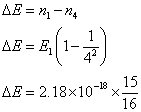
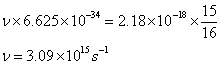
The frequency of radiation emitted when the electron falls from n = 4 to n = 1 in a hydrogen atom will be (Given ionization energy of H = 2.18 × 10⁻¹⁸ J atom–1 and h = 6.625 × 10⁻³⁴ Js)
-
0%
a) 1.54 × 10¹⁵ s–1
-
0%
b) 1.03 × 10¹⁵ s–1
-
0%
c) 3.08 × 10¹⁵ s–1
-
100%
d) 2.00 × 10¹⁵ s–1
Explanation

Q.29.
The total number of atomic orbitals in fourth energy level of an atom is [AIPMT -2011]
-
33%
a) 4
-
0%
b) 8
-
67%
c) 16
-
0%
d) 32
Q.30.
Calculate the energy in joule corresponding to light of wavelength 45 nm: (Planck's constant h = 6.63 × 10⁻³⁴ Js; speed of light c = 3 × 10⁸ ms–1) [AIPMT-2014]
-
0%
a) 6.67 × 10¹⁵
-
0%
b) 6.67 × 10¹¹
-
100%
c) 4.42 × 10⁻¹⁵
-
0%
d) 4.42 × 10⁻¹⁸
Q.31.
Number of neutron in heavy hydrogen atom is [ MP PMT]
-
0%
a)0
-
67%
b) 1
-
33%
c)2
-
0%
d)3
Q.32.
Which of the following statement is incorrect [ BHU 1985]
-
0%
a) The charge on an electron electron and on protons are equal and opposite
-
67%
b) Neutron has no charge
-
33%
c)Electrons and protons have the same weight
-
0%
d)The mass of a proton and neutron are nearly identical
Q.33.
The maximum number of electrons in f -subshell is .... [ IIT Ranchi 1988]
-
0%
a) 2
-
33%
b) 8
-
33%
c)14
-
33%
d)32
Q.34.
A photon in X region is more energetic than in the visible region; X is [ BHU 1981]
-
33%
a) IR
-
50%
b) UV
-
17%
c) Microwave
-
0%
d) Radiowave
Q.35.
Which of the following are possible values of n , l and m for an atom having maximum value of m=+2? [ Pb. PMT 1985]
-
0%
a)n=4, l=3, m=+2
-
50%
b) n=3, l=2, m=-2
-
50%
c)n=3, l=3, m=+2
-
0%
d)n=4, l=3, m=-2
Q.36.
The increasing value of e/m ( charge /mass) is .... [ IIT 1984]
-
25%
a) e, p, n, α
-
0%
b) n. p, e, α
-
25%
c)
-
50%
d)n, α, p, e
Q.37.
The radius of atom nucleus is of the order of...... [ IIT 1985]
-
0%
a) 10-12 m
-
0%
b) 10-8 m
-
50%
c) 10-15 m
-
50%
d) 10-10 m
Q.38.
In the given atom no two electrons can have the same value for all the four quantum numbers. This is called [ CPMT 92]
-
33%
a) Hund's rule
-
0%
b) Aufbau principle
-
33%
c) Uncertainty principle
-
33%
d) Pauli's exclusion principle
Q.39.
Cathode rays are [ JIPMER 1987]
-
33%
a)Electromagnetic waves
-
0%
b) Radiation
-
33%
ac)stream of α particles
-
33%
d)stream of electrons
Q.40.
Which statement is correct about proton [ MP PMT 1985]
-
32%
a) Proton is nucleus of Deuterium
-
32%
b) proton is α particle
-
16%
c)Proton is ionised hydrogen atom
-
21%
d)proton is ionised hydrogen
Q.41.
When the azimuthal quantum number is l=1, the shape of the orbital will be ..[ EAMCET 1982]
-
33%
a)Spherical
-
33%
b) dumbell
-
33%
c)double dumbell
-
0%
d)more complicated
Q.42.
There is no difference between 2p and a 3p orbital regarding [ BHU 1981]
-
0%
a) shape
-
20%
b) size
-
80%
c) energy
-
0%
d) value of n
Q.43.
Bohr's model can explain ..... [ IIT 1985]
-
33%
a)Spectrum of Hydrogen atom only
-
33%
b) Spectrum of atom or ion containing one electron only
-
0%
c)the spectrum of hydrogen molecule
-
33%
d)The solar spectrum
Q.44.
The electron level which allows the hydrogen to absorb photon but not to emit is ... [ IIT1984]
-
25%
a) 1s
-
25%
b) 2s
-
50%
c)2p
-
0%
d)3d
Q.45.
Neutral atom ( atomic number > 1) consists of [ CPMT 1982]
-
25%
a) Only protons
-
0%
b) Neutrons + Protons
-
0%
c)Neutrons + electrons
-
75%
d)Neutrons + electrons + protons
Q.46.
The quantum number which is designed by letters s, p, d and f instead of number is [ BHU 1980]
-
25%
a) n
-
50%
b) l
-
25%
c) ml
-
0%
d) ms
Q.47.
The number of unpaired electrons in carbon atom is .. [ MLNR 1987]
-
0%
a)1
-
80%
b) 2
-
0%
c)3
-
20%
d)4
Q.48.
Rutherford's alpha particle scattering experiment eventually led to the conclusion that ... [ IIT 1986]
-
0%
a) mass and energy are related
-
67%
b) electron occupy space around the nucleus
-
33%
c)Neutron are buried deep in the nucleus
-
0%
d)the point of impact with matter can be precisely determined
Q.49.
The maximum number of electrons in a subshell for which l=3 i9s .... [ EAMCET 1982]
-
50%
a) 14
-
25%
b) 10
-
0%
c)8
-
25%
d)4
Q.50.
" The exact path of electron in 2p-orbital cant be determined" this statement is based on [DPMT 1981]
-
50%
a) Hund's rule
-
0%
b) Bohr's rule
-
25%
c) Uncertainty principle
-
25%
d) Aufbau principle