Q.1.
the spectrum of He+ is expected to be similar to that of .... [ AIITMS 1990]
-
57%
a) Hydrogen
-
43%
b) Li+
-
0%
c) Na
-
0%
d) He
Q.2.
Magnetic quantum number for the valence electron in sodium atom is equal to.... [ CPMT 1988]
-
17%
a)3
-
33%
b) 2
-
33%
c)1
-
17%
d)0
Q.3.
Number of unpaired electrons in N2+ is ..[ CBSE PMT 1989]
-
0%
a) 2
-
0%
b) 0
-
60%
c)1
-
40%
d)3
Q.4.
p orbital can accommodate .... [ MLNR 1990]
-
0%
a) 4 electrons
-
21%
b) 6 electrons
-
21%
c)2 electrons with parallel spin
-
57%
d)2 electrons with opposite spin
Q.5.
The atomic weight of an atom is due to... [ AFMC 1990]
-
20%
a) Electrons and protons
-
0%
b) Electrons and neutrons
-
40%
c) Neutron and protons
-
40%
d) Electron, neutron and protons
Q.6.
For a dumbell shaped orbital, the value of l is ... [ CPMT 1987]
-
0%
a)0
-
60%
b) l
-
40%
c)+1 or -1
-
0%
d)3
Q.7.
Which of the following is the smallest in size [ IIT 1989]
-
0%
a) N3-
-
0%
b) O2-
-
50%
c)F-
-
50%
d)Na+
Q.8.
the total number of electrons that can be accommodated in all the orbitals having principal quantum number 2 and Azimuthal quantum number 1 ... [ CPMT 1989]
-
14%
a) 2
-
14%
b) 4
-
57%
c)6
-
14%
d)8
Q.9.
The energy of an electron in the nth Bohr orbit of hydrogen atom is ...{CBSE PMT 1992]
-
0%
a) 13.6/n4 eV
-
67%
b) 13.6/n3 eV
-
33%
c)13.6/n2 eV
-
0%
d)13.6/n eV
Q.10.
According to Bohr's theory, the angular momentum for an electron in 5th orbit is ...[BHU 1992]
-
40%
a) 2.5h /π
-
0%
b) 5h/π
-
40%
c)25h/π
-
20%
d)5π/2π
Q.11.
Which of the statements is incorrect for an electron that has the quantum number n=4 and m=2? [ MLNR 1993] when m=2, then l can not be0 or 1 Answer: (d)
-
0%
a) The electron may have the quantum number s=+1/2
-
33%
b) The electron may have the quantum number l=2
-
0%
c) The electron may have the quantum number m=-2
-
67%
d) The electron may have the quantum numbers l=0, 1, 2
Q.12.
Pick out the isoelectronic structures from the following I) CH3+II) H3O+III) NH3IV) CH3- [ IIT 1993
-
0%
a) I and II
-
50%
b) III and IV
-
17%
c)I and III
-
33%
d)II, III and IV
Q.13.
Which of the following pair has same electronic structure? [ CPMT 1992]
-
20%
a) Ca, Ar
-
40%
b) Mg, Na+
-
20%
c)Ag, Sn
-
20%
d)Ar, Cl-
Q.14.
The quantum numbers for the designation of 3d are ... [ Pb CET 1991]
-
33%
a) n=3, m=-3
-
0%
b) n=3, l=3
-
33%
c) n=4, l=1
-
33%
d) n=3, l=2
Q.15.
The atomic number of an element having the valence shell electronic configuration 4s2 4p6 is ... [ PMPMT 1991]
-
0%
a)35
-
50%
b) 36
-
0%
c)37
-
50%
d)38
Q.16.
The maximum number of electrons in all those orbitals for which principal quantum number is 3 and azimuthal quantum number 2 is
-
0%
a) 2
-
25%
b) 8
-
50%
c)10
-
25%
d)18
Q.17.
Which of the following represents the correct set of quantum numbers of a 4d electron? [ MLNR1992]
-
75%
a) 4, 3, 2, +1/2
-
0%
b) 4, 2, -2, 0
-
25%
c)4, 3, -2, +1/2
-
0%
d)4, 2, 1, -1/2
Q.18.
What is different in isotopes of an element?
-
0%
a) Atomic number
-
40%
b) Mass number
-
20%
c) Number of protons
-
40%
d) Number of electrons
Q.19.
In any sub-shell, the maximum number of electrons having same value of spin quantum number is
-
20%
a)
-
0%
b) l + 2
-
60%
c) 2l + 1
-
20%
d) 4l + 2
Q.20.
The orbital diagram in which both Pauli's exclusion principle and Hund's rule are violated is ... [ BIT 1992]
-
60%
a)

-
0%
b)
-
0%
c)
-
40%
d)
Q.21.
Which of the following is violation of Pauli's exclusion principle? [ IIT 1993]
-
88%
a)
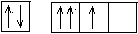
-
0%
b)
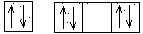
-
0%
c)
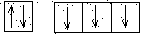
-
12%
d)
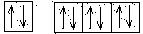
Q.22.
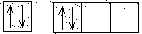
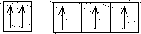
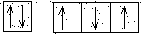
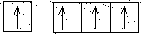
Which of the following sets of quantum numbers represents an impossible arrangement? [ Pb CET 1991]
-
0%
a) n=3, l=2, m=-2, s=1/2
-
0%
b) n=4, l=0, m=0, s=1/2
-
67%
c) n=3, l=2, m=-3, s=1/2
-
33%
d) n=5, l=3, m=0, s=1/2
Q.23.
How many electrons can have value n=2, l=1, and s=+1/2 in the configuration 1s2 2s2 2p3 [ MLNR 1992]
-
33%
a)1
-
33%
b) 3
-
33%
c)5
-
0%
d)7
Q.24.
The de Broglie equation suggest that an electron has .... [ BHU 1992]
-
0%
a) Particle nature
-
20%
b) Wave nature
-
60%
c)Particle - wave nature
-
20%
d)Radiation behavior
Q.25.
the number of unpaired electrons in the p-subshell oxygen atom is .... [ Hariyana CEET 1991]
-
25%
a) 3
-
50%
b) 2
-
25%
c)1
-
0%
d)4
Q.26.
The value of azimuthal quantum number l=2 represents... [BHU 1993]
-
0%
a) s -orbital
-
33%
b) p -orbital
-
67%
c) d -orbital
-
0%
d) f -orbital
Q.27.
Which combinations of quantum numbers n, l, m and s for the electron in an atom does not provide a permissible solution of the wave equation? [ IIT 1992]
-
0%
a)3,2,-2, 1/2
-
100%
b) 3, 3, 1, -1/2
-
0%
c)3, 2, 1, 1/2
-
0%
d)3, 1, 1, -1/2
Q.28.
The probability of finding an electron residing in a px orbit is zero [ AIIMS 1991]
-
33%
a) in yz plane
-
33%
b) in the xy plane
-
33%
c)in the y-direction
-
0%
d)in the z-direction
Q.29.
For an electron if the uncertainty is velocity is Δv the uncertainty in its position (Δx) is given bt ... [ AIIMS 1994]
-
50%
a)
-
0%
b)
-
50%
c)
-
0%
d)
Q.30.
Energy of third orbit of Bohr's atom is ...[PMT 1991]
-
0%
a) -13.6 eV

-
25%
b) -3.4 eV

-
50%
c) -1.5 eV

-
25%
d) None of these

Explanation

Q.31.
The electronic configuration of the element which is just above the element with atomic number 43 in the same periodic group is ... [ MLNR 1992]
-
50%
a)1s2 2s2 2p6 3s2 3p6 3d5 4s2
-
0%
b) 1s2 2s2 2p6 3d2 3p6 3d10
-
50%
c)1s2 2s2 2p6 3d2 3p6 3d64s1
-
0%
d)1s2 2s2 2p6 3d2 3p6 3d10 1s1 4p6
Q.32.
The electron in an atom{Bihar CEE 1992]
-
25%
a) moves randomly around the nucleus
-
0%
b) has fixed space around the nucleus
-
0%
c)is stationary in various energy levels
-
75%
d)moves around its nucleus in definite energy level
Q.33.
If electron, hydrogen, helium and neon nuclei are all moving with the velocity of light, then the wavelengths associated with these articles are in order
-
50%
a) electron > hydrogen > helium >neon
-
50%
b) electron > helium &hydrogen > neon
-
0%
c)electron < hydrogen
- 0%
d)neon < hydrogen < helium ≤electronQ.34.The value of Plank's constant is .... [ Harayana CET 1991]-
67%
a) 6.6 ×10⁻³² g m2 sec
-
0%
b) 6.6 ×10⁻³⁴ kg m2 sec-1
-
0%
c) 6.6 ×10⁻³³ kg m2 sec-1
-
33%
d) 6.6 ×10⁻³⁴ g m2 sec-1
Q.35.Which of the following relates to photos both as wave motion and as a stream of particles{IIT 1992]-
0%
a)Interference
-
33%
b) E=mc2
-
33%
c)Diffraction
-
33%
d)E=hν
Q.36.The number of d electrons in Fe2+ ( at.no of Fe=26) is not equal to that of the .....[ MLNR 1993]-
25%
a) p-electrons in Ne( at. no 10)
-
25%
b) s- electrons in Mg (at. no.=12)
-
25%
c)d electrons in Fe
-
25%
d)p electrons in Cl-
Q.37.The electronic configuration of Cu ( atomic number 29) is-
50%
a) 1s2 2s2, 2p6, 3s2, 3p6, 4s2, 3d9
-
0%
b) 1s2 2s2, 2p6, 3s2, 3p6, 3d10 4s2,
-
0%
c) 1s2 2s2, 2p6, 3s2, 3p6, 4s2,4p6,5s2, 5p1
-
50%
d)1s2 2s2, 2p6, 3s2, 3p6, 4s2 4p6 3d3
Q.38.Which of the following is never true for cathode rays? [ CBSE PMT 1994]-
33%
a) They posses kinetic energy
-
0%
b) They are electromagnetic waves
-
67%
c) They produce heat
-
0%
d) They produce mechanical pressure
Q.39.The number of electrons in 3d shell for element with atomic number 26 is [ Hariyana CEET]-
0%
a)4
-
100%
b) 6
-
0%
c)8
-
0%
d)10
Q.40.Which of the following pairs are isobars? [ KECT 1992]-
33%
a) 92U235 , 94Pu239
-
33%
b) 36Kr83 , 36Kr84
-
0%
c)10Ne19 , 9F19
-
33%
d)58Ce139 , 58Ce140
Q.41.When the azimuthal quantum number has a value of l=1, the shape of the orbital is [ MP PRT 1993]-
0%
a) Unsymmetrical
-
33%
b) Spherically symmetrical
-
67%
c)Dumb-bell
-
0%
d)Complicated
Q.42.Total possible values for magnetic quantum number for the values of l=3 is ..... [ Haryana CET 1991]-
0%
a) 3
-
0%
b) 1
-
0%
c) 5
-
100%
d) 7
Q.43.The order of filling of electrons in the orbital's of an atom will be [ CBSE PMT 1991]-
0%
a)3d, 4s, 4p, 4d, 5s
-
50%
b) 4s, 3d, 4p, 5s, 4d
-
50%
c)5s, 4p, 3d, 4d, 5s
-
0%
d)3d, 4p, 4s, 4d, 5s
Q.44.Which of the following series of lines is found in UV region of the atomic spectrum of hydrogen/ [ EAMCET 1991]-
0%
a) Balmar series
-
50%
b) Paschen series
-
0%
c)Brackett series
-
50%
d)Lyman series
Q.45.6C 14 and 7 N 14 may be classified as .. [ Pb CET sample paper 1993]-
0%
a) Isotopes
-
0%
b) Isotones
-
33%
c)Isobars
-
67%
d)Isoelectronic
Q.46.The electron was shown experimentally to have wave properties by ... [ CBSE PMT 1994]-
60%
a) de Broglie
-
20%
b) Davisson and Germer
-
0%
c) N. Bohr
-
20%
d) Schrodinger
Q.47.If the radius of first Bohr's orbit be ao, then the radius of the third orbit would be [ MP PMT 1998]-
0%
a)3 ×ao
-
0%
b) 6 ×ao
-
50%
c)9 ×ao
-
50%
d)(1/9) ×ao
Q.48.Number of protons, neutrons and electrons in the element 89X231 is ...{AFMC 1997]-
0%
a) 89, 89, 242
-
67%
b) 89, 142, 89
-
33%
c)89, 71, 89
-
0%
d)89, 231, 89
Q.49.The radius of the atom is of the order of ... [ MP PMT 1995]-
50%
a) 10-10 cm
-
25%
b) 10-13 cm
-
0%
c)10-15 cm
-
25%
d)10-8 cm
Q.50.Bohr's model of atom conflict with ... [ DPMT 1994]-
0%
a) Pauli's exclusion principle
-
33%
b) Heisenberg's uncertainty principle
-
67%
c) max plank's quantum theory
-
0%
d) all above three
- 0%