Q.1.
Two cities are 150 km apart. Electric power is sent from one city to another city through copper wires. The fall of potential per kilometer is 8 volt and the average resistance per kilometer is 0.5 Ω. The power loss in the wires is
-
50%
a) 19.2 watt
-
50%
b) 19.2 kilowatt
-
0%
c) 19.2 joule
-
0%
d) 19.2 kWh
Q.2.
A combination of two resistance of 2Ω and 2/3 Ω connected in parallel is joined across a battery of emf of 3 volt and of negligible internal resistance. The energy given out per sec will be
-
50%
a) (1/2) × 3 2 joules
-
50%
b) (1/2)2 × 3 2 joules
-
0%
c) 2 × 3 joules
-
0%
d) 32 × 2 joules
Q.3.
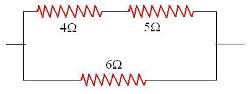
In the circuit shown , the heat produced in the 5Ω resistor due to current flowing it, is 10 calories per second. Then the heat generated in the 4 Ω resistor is
-
50%
a)1 calories per second
-
0%
b) 8 calories per sec
-
0%
c)3 calories per second
-
50%
d)4 calories per sec
Q.4.
The resistance of coil of a small motor of 10 watt, 20V is 12Ω. The rate of heat produced in the motor is
-
0%
a) 3 W
-
0%
b) 7 W
-
50%
c)10 W
-
50%
d)33.3 W
Q.5.
Electric room radiator which operates at 225 volts has resistance of 50 Ω. Power of the radiator is approximately:
-
0%
a) 100 watt
-
0%
b) 450 Watt
-
50%
c)750 watt
-
50%
d)1000 watt
Q.6.
How much electric energy is consumed in using a 100 W lamp for 6 hours every day for 30 days?
-
50%
a) 0.5 kJ
-
0%
b) 0.5 kWh
-
0%
c) 18 kJ
-
50%
d) 18 kWh
Q.7.
A lamp is marked 60W, 220V. If it operates at 200V, the rate of consumption of energy will
-
50%
a)increase
-
50%
b) decrease
-
0%
c)remain unchanged
-
0%
d)cant say it may increase or decrease
Q.8.
A generator generates voltage at terminal voltage of 500 volt. This power is being transmitted to a distance to a 5 km by electric wires. The resistance of each wire is 0.01 ohm/metre. The potential difference across a load of 900Ω connected the terminals of these wires is
-
100%
a) 500 volts
-
0%
b) 300 volt
-
0%
c)450 volts
-
0%
d) cannot be calculated
Q.9.
What are the essential requirements for the heater filament?
-
50%
a) High resistivity, low melting point
-
0%
b) Low resistivity, low melting point
-
50%
c)High resistivity, high melting point
-
0%
d)Low resistivity, high melting point
Q.10.
50 electric bulbs are connected in series across a 220V supply and the illumination produced is I2bulbs are fused . If the remaining 48 are again connected in series the illumination produced is IWhich of the following is true?
-
0%
a) I1=I2
-
50%
b) I1 < I2
-
50%
c) I1 > I2
-
0%
d) It will depend on the resistance of each bulb
Q.11.
If 2.2 kilowatt power is transmitted through a 10Ω line at 22000 volt, the power loss in the form of heat will be [ MPPMT 1998]
-
0%
a)0.1 watt
-
0%
b) 1 watt
-
100%
c)10 watt
-
0%
d)100 watt
Q.12.
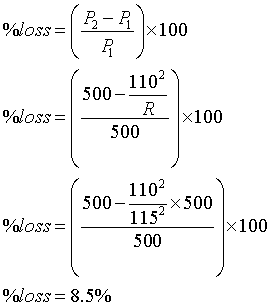
A heater of 500 watt is made to operate at 115 volt line. If the line voltage reduced to 110 volt, then the percentage reduction in heat produced by it is ( Assume resistance of heater remains constant) [ ISM Dhanbad 1994]
-
0%
a) 8.5 %
-
100%
b) 85%
-
0%
c)60%
-
0%
d)there is no change in heat produced
Explanation
Q.13.
An electric heater operating at 220V boils 5 litres of water in 5 minutes. If it is used on 110V, it will boil the same amount of water in
-
0%
a) 10 min
-
0%
b) 20 min
-
100%
c)2.5 min
-
0%
d)the water will not boil
Q.14.
Overloading of an electric circuit implies
-
0%
a) drawing of large current
-
0%
b) connecting higher resistance device
-
100%
c) connecting a number of electric devices in series with the power supply
-
0%
d) none of the above
Q.15.
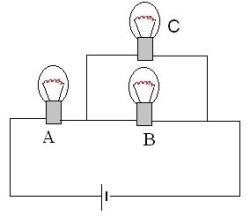
Three bulbs A, B and C are connected as shown in the figure. B and C are identical. IF the bulb C is fused
-
50%
a)both A and B will glow more brightly
-
50%
b) both A and B will glow less brightly than before
-
0%
c)A will glow less brightly and B more brightly
-
0%
d)none of the bulbs will glow
Q.16.
Two 1000 W heaters when connected in parallel across 220 V supply produce heat Qp in times t. If they are connected in series across the same power supply, the heat produced in the same time is Qs ; then Qp/Qs is
-
50%
a) 4
-
0%
b) 2
-
50%
c)0.5
-
0%
d)0.25
Q.17.
A 100 W lamp is connected in series with a 60 W lamp across a 220 V supply. Which of the following statement is wrong
-
0%
a) Potential drop across each lamp is same
-
0%
b) current through each lamp is same
-
0%
c)More heat is produced in 60W lamp
-
100%
d)Resistance of 60W lamp is more than that of 100Q lamp
Q.18.
Let H1 be the heat generated per second in the filament of 100W, 250 V lamp and H2 be that of 200W, 250V lamp. Which of the following is correct
-
0%
a) H1=2H2
-
0%
b) H1=4H2
-
50%
c) 2H1=H2
-
50%
d) 4H1=H2
Q.19.
An electric fan and a heater are marked as 100 watt , 220 volts and 1000 watt, 220 volts respectively. The resistance of heater is
-
0%
a) zero
-
50%
b) greater than that of the fan
-
50%
c)less than that of the fan
-
0%
d)equal to that of the fan
Q.20.
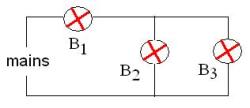
Three bulbs B1, B2 and B3 are connected as shown in figure. How will the incandescence of bulb B1 be affected if one of bulbs B2 or B3 is disconnected from the circuit
-
50%
a) no change in incandescence
-
0%
b) bulb B1 will become brighter
-
0%
c) bulb B1 will become less bright
-
50%
d)bulb B1 may become brighter or dimmer depending upon the cancel power of bulb which is disconnected
Q.21.
Two bulbs of equal wattage, one having carbon filament and the other having a tungsten filament, are connected in series to the mains
-
0%
a) both bulbs glow equally
-
0%
b) carbon filament bulb glows more
-
0%
c)tungsten filament bulb glows more
-
100%
d)carbon filament bulb glows less
Q.22.
A storage battery of 30 volts is being charged by a source of 120 volts. To limit the current at 15 amp, a resistance is connected in series with the charger. The rate of heat developed in the resistance and the time required to heat 1 kg water of 15°C to 100°C are
-
50%
a) 1350W, 4 minutes 24 seconds
-
0%
b) 1350 W, 6 minutes
-
50%
c) 1000 W, 4 minutes 24 seconds
-
0%
d) 1800 W, 4 minutes
Q.23.
Of the two bulbs in a house, one glows brighter than other. Which of the two has a larger resistance
-
0%
a)the bright bulb
-
0%
b) the dim bulb
-
50%
c)both have the same resistance
-
50%
d)the brightness does not depend upon the resistance
Q.24.
You have following electric appliances, which one have highest resistancea) 1 kW 250 V electric heaterb) 1kW 250 V electric kettlec) 1kW 250 V electric bulb
-
50%
a) heater
-
0%
b) kettle
-
0%
c)bulb
-
50%
d)all have equal resistance's
Q.25.
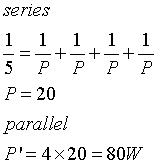
Four equal resistors when connected in series dissipate 5 watt power. If they are connected in parallel, the power dissipated will be
-
0%
a) 20 W
-
0%
b) 40 W
-
50%
c)60 W
-
50%
d)80 W
Explanation
Q.26.
Two identical heater coils are connected in parallel across the mains. If one of the coils breaks, the other coil
-
0%
a) will also not be heated
-
0%
b) will develop the same amount of temperature as before
-
0%
c) develop a higher temperature
-
100%
d) develop a lower temperature
Q.27.
The power dissipated in a conductor of resistivity ρ is proportional to
-
0%
a)ρ
-
50%
b) ρ2
-
0%
c)√ρ
-
50%
d)none of the above
Q.28.
A standard 40 watt tube light is in parallel with a room heater both connected to stable main A/C. Supply line. What will happen when the tube light is switched off
-
0%
a) the heater output will be larger
-
50%
b) it will remain smaller
-
0%
c)it will remain the same
-
50%
d)none of the above
Q.29.
A resistance coil is made by joining two resistance's of 2.5 ohm each. A steady potential difference of 1.0 volt is applied across the coil for 5 minutes. The heat produced in the wire is
-
0%
a) 14.3 cal
-
0%
b) 14.3 Joule
-
100%
c)0.2 Joule
-
0%
d)0.2 cal
Q.30.
Two heater wires of equal length are first connected in series and then connected in parallel ratio of heat produced in the two cases is [ MNR 1987]
-
0%
a) 2:1
-
0%
b) 1:2
-
50%
c) 4:1
-
50%
d) 1:4