Q.1.
All reactions with chemical dissociation are ... [ MP PMT 1990]
-
14%
a) reversible
-
28%
b) reversible and endothermic
-
14%
c) exothermic
-
44%
d) reversible or irreversible and endothermic or exothermic
Q.2.
When water is added to quick lime, the reaction is .....[ MP PMT 1995]
-
8%
a) explosive
-
31%
b) endothermic
-
58%
c) exothermic
-
4%
d) photochemical
Q.3.
Identify the intensive quantity from the following ... [ IIT 1993]
-
26%
a) Enthalpy and temperature
-
21%
b) Volume and temperature
-
16%
c) Enthalpy and Volume
-
36%
d) Temperature and refractive index
Q.4.
In reversible isothermal process, the change in internal energy is ... [ MP PMT 1993]
-
56%
a) zero
-
25%
b) positive
-
18%
c) negative
-
2%
d) none of the above
Q.5.
What is the free energy change , ΔG, when 1.0 mole of water at 100°C and 1atm pressure is converted into steam at 100°C and 1atm pressure? [ MP PMT 1998]
-
26%
a) 540 cal
-
26%
b) -9800 cal
-
20%
c) +9800 cal
-
28%
d) 0 cal
Q.6.
For a spontaneous chemical process, the free energy change is ... [ BHU 1981]
-
21%
a) Positive
-
38%
b) Negative
-
28%
c) Either positive or negative
-
12%
d) Zero
Q.7.
Measuring Zeta potential is useful in determining which property of colloidal solution? [ NEET 2020]
-
40%
a) Stability of the colloidal particles
-
24%
b) Size of the colloidal particles
-
24%
c) Viscosity
-
11%
d) Solubility
Q.8.
For the reaction, 2Cl(g) → Cl2(g), the correct option is : ... [NEET 2020]
-
22%
a) ΔrH <0 and ΔrS > 0
-
42%
b) ΔrH < 0 and ΔrS < 0
-
23%
c) ΔrH > 0 and ΔrS > 0
-
13%
d) ΔrH > 0 and ΔrS < 0
Q.9.
Under isothermal condition, a gas at 300 K expands from 0.1 L to 0.25 L against a constant external pressure of 2 bar. The work done by the gas is ... [NEET 2019] (Given that 1 L bar = 100 J)
-
38%
a) –30 J
-
25%
b) 5 kJ
-
25%
c) 25 J
-
12%
d) 30 J
Q.10.
For an ideal solution, the correct option is : ... [NEET 2019]
-
18%
a) Δmix S = 0 at constant T and P
-
20%
b) Δmix V ≠ 0 at constant T and P
-
45%
c) Δmix H = 0 at constant T and P
-
17%
d) Δmix G = 0 at constant T and P
Q.11.
n which case change in entropy is negative? [NEET 2019]
-
11%
a) Evaporation of water
-
30%
b) Expansion of a gas at constant temperature
-
18%
c) Sublimation of solid to gas
-
41%
d) 2H(g) → H2(g)
Q.12.
Hydrolysis of sucrose is given by the following reaction. Sucrose + H2 O ⇋ Glucose + Fructose If the equilibrium constant (KC) is 2 × 10¹³ at 300 K, the value of ΔrGθ at the same temperature will be : .... [NEET 2020]
-
21%
a) 8.314 J mol-11K-1 × 300 K × ln(3 × 10¹³)
-
26%
b) –8.314 J mol-11K-1 ×300K × ln(4 × 10¹³)
-
32%
c) –8.314 J mol-11K-1 × 300 K × ln(2 × 10¹³)
-
21%
d) 8.314 J mol-11K-1 × 300 K × ln(2 × 10¹³)
Q.13.
The bond dissociation energies of X2, Y2 and XY are in the ratio of 1 : 0·5 :ΔH for the formation of XY is – 200 kJ mol-The bond dissociation energy of X2 will be
-
22%
a) 800 kJ mol-1
-
28%
b) 100 kJ mol-1
-
31%
c) 200 kJ mol-1
-
19%
d) 400 kJ mol-1
Explanation
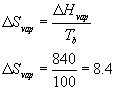
Q.14.
The standard molar heat of formation of ethane, CO2 and water(l) are respectively -21.1 , -94.1 and -68.3 kcal. The standard molar heat of combustion of ethane will be ... [ IIT 1986]
-
33%
a) -372 kcal
-
33%
b) 162 kcal
-
21%
c) -240 kcal
-
12%
d) 183. kcal
Q.15.
Heat of neutralisation of strong acid by a strong base is a constant value because .. [ KCET 1984]
-
19%
a) salt formed does not hydrolyse
-
31%
b) only H+ and OH- ion react in every case
-
25%
c) the strong base and strong acid react completely
-
25%
d) the strong base and strong acid react in aqueous solution
Q.16.
The decreasing order of calorific values is .. [ NCERT 1983]
-
5%
a) C2H2 < C4H10 < C3H8 < C2H4
-
66%
b) C2H2 < C2H4 < C3H8 < C4H10
-
12%
c) C2H4 < C3H8< C4H10 < C2H2
-
17%
d) C3H8 < C2H4 < C4H10< C2H2
Q.17.
Enthalpy of neutralisation of HCl with NaOH is x. The heat evolved when 500ml of 2N HCl are mixed with 250ml of 4N NaOH will be... [ AFMC 2002]
-
20%
a) 500 x
-
23%
b) 100x
-
40%
c) x
-
17%
d) 10x
Q.18.
The heat of combustion of rhombic and monoclinic sulphur are respectively 70960 and 71030 calories. What will be the heat of conversion or rhombic sulphur to monoclinic? [ MP PMT 1988]
-
9%
a) 70960 calories
-
22%
b) 71030 calories
-
38%
c) -70 calories
-
31%
d) +70 calories
Q.19.
One mole of an ideal gas is allowed to expand reversibly and adiabatically from a temperature of 27°C. If the work done during the process is 3kJ, the final temperature will be equal to ... [ KCET 2000] (Cv=20J/K)
-
26%
a) 450 K
-
26%
b) 100 K
-
31%
c) 26.85 K
-
17%
d) 295 K
Q.20.
For which reaction from the following, ΔS will be maximum? [ AIIMS 1983]
-
11%
a) Ca(s) + ½O2(g) → CaO(s)
-
50%
b) CaCO3(s) → CaO(s) + CO2(g)
-
17%
c) C + O2(g) → CO2(g)
-
22%
d) N2(g) + O2 → 2NO(g)
Q.21.
The process of evaporation of a liquid is accompanied by ... [ NCERT 1983]
-
17%
a) decrease in entropy
-
19%
b) decrease in entropy
-
28%
c) no change in free energy
-
36%
d) increase in entropy
Q.22.
Under the same conditions how many ml of 1M KOH and 0.5M H2SO4 solutions, respectively, when mixed to form a total volume of 100 ml. produce the highest rise in temperature? [ IIT 1993]
-
23%
a) 67, 33
-
33%
b) 33, 67
-
30%
c) 40, 60
-
13%
d) 50, 50
Q.23.
ΔHcombustion of a compound is .. [ Pb.PMT 1985]
-
19%
a) positive
-
38%
b) negative
-
30%
c) zero
-
14%
d) positive or negative
Q.24.
The difference between heat of reaction at constant pressure and constant volume for the reaction 2C6H6 + 15 O2 → 12CO2(g) + 6H2O(l) at 25°C in kJ is ..[IIT 1991]
-
20%
a) -7.43
-
33%
b) +3.72
-
33%
c) -3.72
-
13%
d) 7.43
Q.25.
The free energy change for a reversible reaction at equilibrium is [ Pb. CET 1991]
-
40%
a) zero
-
30%
b) small positive
-
13%
c) small negative
-
17%
d) large positive
Q.26.
Calculate the free energy change for the following reaction at 300K2CuO(s) → Cu2O(s) + ½O2(g)Given ΔH=145.6 kJ/molΔS=116 JK-1mol-1
-
36%
a) 110.8 kJ/mol
-
12%
b) 21.5 kJ/mol
-
20%
c) 55.4 kJ/mol
-
32%
d) 145.6 kJ/mol
Explanation

Q.27.
Which has maximum calorific value? [ AFMC 1988]
-
46%
a) Fat
-
8%
b) Protein
-
22%
c) carbohydrate
-
24%
d) Amino acid
Q.28.
Heat of neutralisation for the reactionNaOH + HCl → NaCl + H2O is 57.1 kJ/mol. What will be the heat released when 0.25 mole of NaOH reacts with 0.25 mole of HCl? ... [ CPMT 1990]
-
22%
a) 22.5 kJ/mol
-
26%
b) 57.1 kJ/mol
-
33%
c) 14.3 kJ/mol
-
19%
d) 28.6 kJ/mol
Q.29.
Which of the following statement is correct about heat of combustion? .. [ Bihar CEE 1992]
-
10%
a) It may be exothermic in some cases and endothermic in other cases
-
33%
b) It is applicable to gaseous substances only
-
47%
c) it is always an exothermic reaction
-
10%
d) Its value does not change with temperature
Q.30.
Heat of transfer is the heat evolved or absorbed when a substance is converted from ... [ KCET 1984]
-
9%
a) solid to liquid
-
13%
b) solid to vapour
-
13%
c) liquid to vapour
-
65%
d) one allotropic form to another allotropic form