Q.1.
The enthalpy change at 298K in successive breaking of O - H bond of HOH areH2O(g) → H(g) + OH(g) ; ΔH=498 kJ/molOH(g) → H(g) + O(g) ; °H=428 kJ/molThe bond enthalpy of O-H bond is ... [ CBSE PMT 1994]
-
67%
a) 498 kJ/mol
-
0%
b) 463 kJ/mol
-
33%
c) 428 kJ/mol
-
0%
d) 70 kJ/mol
Q.2.
Mark the correct statement ...[ MP PET 1998]
-
40%
a) For a chemical reaction to be feasible, ΔG should be 0
-
20%
b) Entropy is a measure of order in a system
-
0%
c) For a chemical reaction to be feasible, ΔG should be positive
-
40%
d) The total energy of an isolated system is constant
Q.3.
The enthalpy of neutralization of acetic acid and sodium hydroxide is -55.4 kJ. What is the enthalpy of ionization of acetic acid ... [ KCET 1997]
-
50%
a) - 1.9 kJ
-
25%
b) + 1.9 kJ
-
25%
c) + 5.54 kJ
-
0%
d) -5.54 kJ
Q.4.
The enthalpy of formation of N2O and NO are 82 and 90kJ/mol respectively. The enthalpy of reaction2N2O(g) + O2(g) → 4NO(g) is equal to ... [ CBSE PMT 1991]
-
25%
a) 8 kJ
-
25%
b) 88 kJ
-
0%
c) - 16 kJ
-
50%
d) 196 kJ
Q.5.
The enthalpy change of a reaction does not depend on ... [ AIIMS 1997]
-
0%
a) the state of reactants and products
-
50%
b) nature of reactants and product
-
25%
c) different intermediate reaction
-
25%
d) initial and final enthalpy change of reaction
Q.6.
Heat capacity is ... [ MP PMT 1996]
-
17%
a) dQ/dT
-
50%
b) dQ×dT
-
17%
c) ∑Q/dT
-
17%
d) none of these
Q.7.
For reaction to occurred spontaneously .. [ CBSE PMT 1995]
-
25%
a) ΔS must be negative
-
75%
b) (ΔH - TΔS) must be negative
-
0%
c) (ΔH + TΔS) must be positive
-
0%
d) ΔH must be negative
Q.8.
The calorific value fat is ... [ BHU 1995]
-
0%
a) less than that of carbohydrates and protein
-
0%
b) less than that of protein but more than carbohydrate
-
50%
c) less than carbohydrate but more than that of protein
-
50%
d) more than carbohydrate and protein
Q.9.
The heat of formation of the compound in the following reaction is ... [ MP PMT 1995]H2(g) + Cl2(g) → 2HCl(g) + 44 kcal
-
0%
a) - 44 kcal/mol
-
100%
b) -22 kcal/mol
-
0%
c) -11 kcal/mol
-
0%
d) -88 kcal/mol
Q.10.
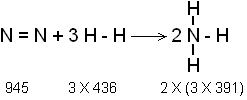
Given the bond energies of N ΞN , H - H and N-H bonds are 945, 436, 391 kJ/mol respectively, the enthalpy of the reaction N2(g) + 3H2(g) → 2NH3(g) is ... [ EAMCET 1992]
-
25%
a) -93 kJ
-
75%
b) 102 kJ
-
0%
c) 90 kJ
-
0%
d) 105 kJ
Explanation
Q.11.
The densities of graphite and diamond at 298K are 2.25 and 3.31 g /cc respectively. If the standard free energy difference (ΔG°) is equal to 1895 J/mol, the pressure at which graphite will be transformed into diamond at 298K is ..
-
25%
a) ;108Pa
-
50%
b) 109Pa
-
0%
c) 1010Pa
-
25%
d) 107Pa
Q.12.
If 900 j/g of heat is exchanged at boiling point of water, then what is increase in entropy ... [ BHU 1998]
-
25%
a) 43.4 J/mole
-
25%
b) 87.2 J/mole
-
0%
c) 900 J/mole
-
50%
d) Zero
Q.13.
Under which of the following condition, work is a state function?
-
33%
a) Adiabatic process
-
0%
b) Isothermal process
-
0%
c) Constant pressure
-
67%
d) None of these
Q.14.
If the enthalpy of vaporization of water is 186.5 J/mol, the entropy of its vaporization will be .... [ CPMT 1988]
-
0%
a) 0.5 JK-1mol-1
-
33%
b) 1.0 JK-1mol-1
-
33%
c) 1.5 JK-1mol-1
-
33%
d) 2.0 JK-1mol-1
Q.15.
For precipitation reaction of Ag+ ions with NaCl which of the following statements is correct?
-
0%
a) ΔH for the reaction is zero
-
33%
b) ΔG for reaction is zero
-
0%
c) ΔG for the reaction is negative
-
67%
d) ΔG=ΔH
Q.16.
The average molar heat capacity of ice and water are 37.6 and 75.2 J mol-1K-1 respectively and its enthalpy of fusion is 6.02kJ/mol. The amount of heat required to raise the temperature of 10g of water from -10°C to +10°C is equal to...
-
25%
a) 2376 J
-
50%
b) 4752 J
-
25%
c) 1128 J
-
0%
d) 3970 J
Q.17.
The enthalpy of combustion at 25°C of H2, Cyclohexene (C6H10) and cyclohexane (C6H12) are -241, -3800 and -3920 kJ/mol respectively. The heat off hydrogenation of cyclohexane is .. [ IIT 1989]
-
0%
a) -121 kJ/mol
-
67%
b) +121 kJ/mol
-
33%
c) -242 kJ/mol
-
0%
d) +242 kJ/mol
Q.18.
Calculate the temperature at which ΔG=-5.2 kJ/mol, ΔH=145.6 kJ/mol and ΔS=216 JK-1mol-1 for a chemical reaction
-
67%
a) 698°C
-
0%
b) 425°C
-
33%
c) 650K
-
0%
d) 650°C
Q.19.
1 mole of ice is converted to liquid at 273K; H2O(s) and H2O(l) have entropies 38.20 and 60.03 J mole-1 deg-Enthalpy change in the conversion will be... [ DPMT 1987]
-
0%
a) 59.59 J/mol
-
33%
b) 595.95 J/mol
-
67%
c) 5959.5 J/mol
-
0%
d) 5959.5 J/mol
Q.20.
For which one of the following equations is ΔHreaction equal to ΔH of product? [ CBSE med. 2003]
-
33%
a) N2(g) + O3(g) → N2O3(g)
-
33%
b) CH4(g) + 2Cl2(g) → CH2Cl2(l) + 2HCl(g)
-
0%
c) Xe(g) + 2F2(g) → XeF4(g)
-
33%
d) 2CO(g) + O2(g) → 2CO2(g)
Q.21.
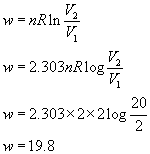
2 mole of an ideal gas at 27°C temperature is expanded reversibly from 2 lit to 20 lit. Find entropy change (R=2cal/mol K) .. [ CBSE PMT 2002]
-
33%
a) 92.1
-
0%
b) 0
-
67%
c) 4
-
0%
d) 9.2
Explanation
Q.22.
The difference between ΔH and ΔE for the combustion of methane at 27°C will be ( in joule/mol) [ kerala MEE 2001]
-
0%
a) 8.314 × 27 × (-3)
-
33%
b) 8.314 × 300 × (-3)
-
67%
c) 8.314 × 300 × (-2)
-
0%
d) 8.314 × 300 × (1)
Q.23.
One mole of an anhydrous salt AB dissolves in water with the evolution of 21.0 J/mol of heat. If the heat of hydration of AB is -29.4 J/mol then the heat of dissociation of the hydrated salt AB is
-
0%
a) 50.4 J/mol
-
67%
b) 8.4 J/mol
-
0%
c) -54.4 J/mol
-
33%
d) -8.4 J/mol
Q.24.
When Zn dust is added to sufficiently large volume of aqueous solution of copper sulphate 3.175g of copper metal and 20J of heat is evolved. The ΔH for the reactionZn(s) + CuSO4(aq) → ZnSO4(aq) + Cu(s)(atomic weight of Zn=63.5, Cu=63.5 )
-
0%
a) 20 J
-
50%
b) 200 J
-
50%
c) 400 J
-
0%
d) 65.3 J
Q.25.
The enthalpy of combusion of cyclohexane, cyclohexene and H2 are respectively -3920, 3800 and -241 kL mol-The heat of hydrogenation of cyclohexene is ...
-
0%
a) -121.0 kJ/mol
-
50%
b) 121.0 kJ/mol
-
50%
c)-242.0 kJ/mol
-
0%
d) 242.0 kJ/mol
Q.26.
Which one of the following has ΔS greater than zero? [ AIIMS 2003]
-
50%
a) CaO(s) + CO2 ⇌ CaCO3
-
0%
b) NaCl(aq) ⇌ NaCl(s)
-
0%
c) NaNO3(s) ⇌ Na+(aq) + Cl-(aq)
-
50%
d) N2(g) + 3H2 ⇌ 2NH3(g)
Q.27.
In which one of the following sets, all the properties belong to same category (all extensive or all intensive)?
-
50%
a) mass, volume, pressure
-
0%
b) temperature, pressure, volume
-
0%
c) heat capacity, density, entropy
-
50%
d) enthalpy, internal energy, volume
Q.28.
During isothermal expansion of an ideal gas, its internal energy
-
0%
a) decreases
-
0%
b) increases
-
50%
c) may increases or decrease
-
50%
d) remains unchanged
Q.29.
In a change from state A to state B
-
0%
a) q depends only on the initial and final state
-
0%
b) w depends only on the initial and final state
-
50%
c) ΔE depends only on the initial and final state
-
50%
d) ΔE depends upon the path adopted by A and change into B
Q.30.
Which of the following statement is not correct
-
50%
a) First law of thermodynamics is also called law of thermal equilibrium
-
0%
b) Heat of combustion cannot be found at room temperature
-
0%
c) On the thermodynamic scale of temperature, one of the reference points is the triple point of water
-
50%
d) One degree kelvin is equal to 1/273.16 of the triple point of water