Q.1.
A cylinder of mass 10kg is sliding on a plane with an initial velocity of 10m/s. If coefficient of friction between surface and cylinder is 0.5, then before stopping it will describe . [Pb. PMT 2001]
-
50%
a) 12.5 m
-
38%
b) 7.5 m
-
0%
c)5 m
-
12%
d)10 m
Q.2.
It is easier to draw up a wooden block along an inclined plane than to haul it vertically, principally because . [CPMT 1977; JIPM]
-
0%
a) The friction is reduced
-
90%
b) Only a part of the weight has to be overcome
-
10%
c)The mass becomes smaller
-
0%
d)‘g’ becomes smaller
Q.3.
A block of mass M is hanging over a smooth and light pulley through a light string. The other end of the string is pulled by a constant force F. The kinetic energy of the block increases by 20J in 1s. Then
-
17%
a) the tension in the string is Mg
-
0%
b) the tension in the string is F
-
50%
c) the work done by the tension on the block is 20 J in 1s
-
33%
d) the work done by the force of gravity is -20J in 1s
Q.4.
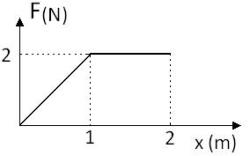
The force acting on a particle of mass 1kg, starting from rest from the origin, is shown in the figure. The velocity of the particle at x=2 m is
-
50%
a)2√2 m/s
-
50%
b) √6 m/s
-
0%
c)2 m/s
-
0%
d)√3 m/s
Q.5.
A body of mass 5 kg is placed at the origin, and can move only on the x-axis. A force of 10 N is acting on it in a direction making an angle of with the x-axis and displaces it along the x-axis by 4 metres. The work done by the force is . [MP PET 2003]
-
25%
a)2.5 J
-
75%
b) 40 J
-
0%
c)7.25 J
-
0%
d)20 J
Q.6.
A ball of mass m moves with speed v and strikes a wall having infinite mass and it returns with same speed then the work done by the ball on the wall is . [BCECE 2004]
-
75%
a) Zero
-
25%
b) m/v.J
-
0%
c) mvJ
-
0%
d) v/m J
Q.7.
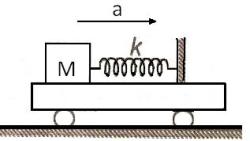
A block of mass M is attached with a spring of spring constant k. The whole arrangement is placed on a vehicle as shown in the figure, if the vehicle starts moving towards right with an acceleration a ( there is no friction any where) the
-
50%
a)maximum elongation in the spring is (Ma/k)
-
25%
b) maximum elongation in the spring is (2Ma/k)
-
25%
c) maximum compression in the spring is (2Ma/k)
-
0%
d) maximum compression in the spring is (Ma/k)
Q.8.
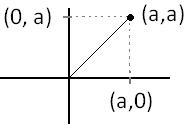
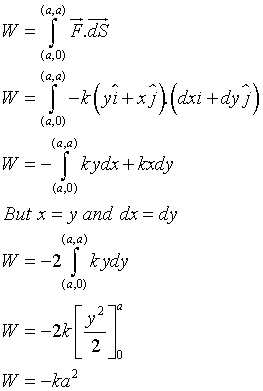
A force F=-k (yi + xj) where k is a positive constant, acts on a particle moving in x-y plane starting from origin, the particle is taken along the positive x-axis to the point (a, 0) and then parallel to the y -axis to the point (a,a). THe total work done by the force F on the particle is [ JEE 98]
-
33%
a) -2ka2
-
67%
b) 2ka2
-
0%
c)-ka2
-
0%
d)ka2
Explanation
Q.9.
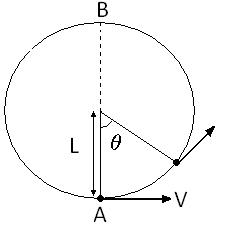
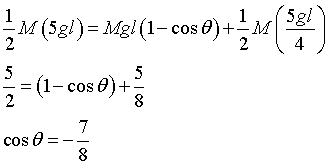
A bob of mass M is suspended by a massless string of length L. The horizontal velocity V at position A is just sufficient to make it reach the position B. The angle θ at which the speed of the bob is half of that at A, satisfies .. [ JEE 2008]
-
50%
a)θ=π/4
-
0%
b) π/4 < θ < π/2
-
50%
c)π/2 < θ < 3π/4
-
0%
d)3π/4 < θ < π
Explanation
Q.10.
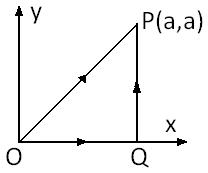
A particle is moved from (0, 0) to ( a, a) under a force F=( 3i + 4j) from two paths. Path 1 is Op and path 2 is OQP. Let W1 and W2 be the work done by this force in these two paths. Then
-
25%
a) W1=W2
-
25%
b) W1=2W2
-
50%
c) W2=2W1
-
0%
d) W2=4W1
Q.11.
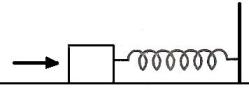
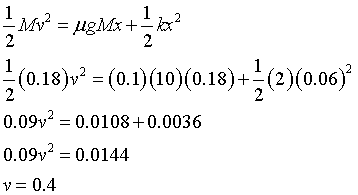
A block of mass 0.18 kg is attached to a spring of force constant 2N/m. the coefficient of friction between the block and the floor is 0.Initially the block is at rest and the spring is un-starched. An impulse is given to the block as shown in the figure. The block slides a distance of 0.06m and comes to rest for the first time. the initial velocity of the block is m/s is V=N/Then N is [ JEE 2011]
-
25%
a)1.8
-
50%
b) 4
-
25%
c)2
-
0%
d)3.6
Explanation
Q.12.
An ideal spring with spring constant k is hung from the celling and a block of mass M is attached to its lower end. The mass is released with the spring initially stretched. Then the maximum extension in the spring is [ JEE 2002]
-
0%
a) 4Mg/K
-
67%
b) 2Mg/k
-
0%
c)Mg/k
-
33%
d)Mg/2k
Q.13.
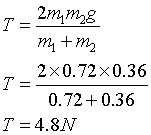
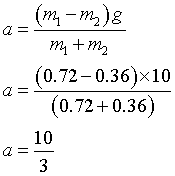
A light inextensible string that goes over a smooth fixed pulley as shown in the figure connected two blocks of masses 0.36kg and 0.72kg. Taking g=10 m/s2, the work done ( in joules) by the string on the block of mass 0.36kg during the first second after the system is released from rest
-
0%
a)8 J
-
0%
b)4 J
-
100%
c)16 J
-
0%
d)20 J
Explanation
Q.14.
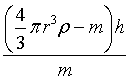
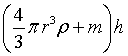
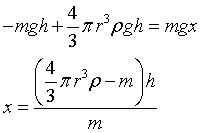
A rubber ball of mass m and radius r is submerged into water of density ρ to a depth h and released. To what height the ball will jump above the surface of water? Disregard the resistance of water and air?
-
100%
a)
-
0%
b)
-
0%
c)

-
0%
d)

Explanation
Q.15.
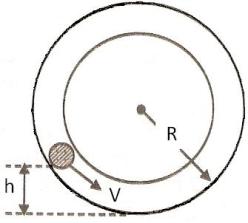
With what minimum speed v must a small ball should be pushed inside a smooth vertical tube from height h so that it may reach the top of the tube? Radius of the tube is R
-
50%
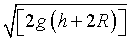
a)
-
50%
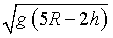
b)

-
0%
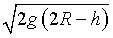
c)
-
0%
d)
Q.16.
An object is thrown straight up. Which of the following is true about the sign of work done by the gravitational force while the object moves up and then down?
-
100%
a)Work is positive on the way up, work is positive on the way down
-
0%
b)Work is negative on the way up, work is negative on the way down
-
0%
c)Work is negative on the way up, work is positive on the way down
-
0%
d)Work is positive on the way up, work is negative on the way down
Q.17.
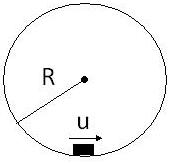
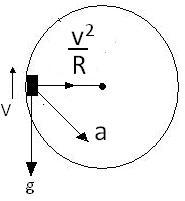
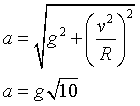
A particle is given an initial speed u inside a smooth spherical shell of radius R=1 m that it is just able to complete the circle. Acceleration of the particle when its velocity become vertical is
-
0%
a) g√10
-
50%
b) g
-
50%
c)g√2
-
0%
d)g√6
Explanation
Q.18.
Which of the following is not a unit for power?
-
0%
a) joule – second
-
0%
b) watt
-
50%
c) newton-meter per second
-
50%
d) horsepower
Q.19.
If the momentum of a body is increased n times, its kinetic energy increases
-
50%
a)n times
-
0%
b) √n times
-
0%
c)2n times
-
50%
d)n2 times
Q.20.
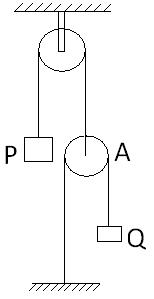
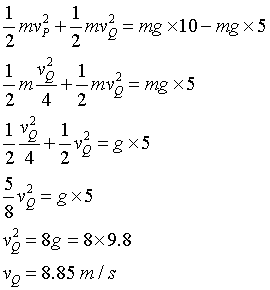
If the system in the figure is released from rest in the configuration shown, find the velocity of the block Q after it has fallen through a distance 10 metres, given mass of P=mass of Q=10 kg
-
0%
a) 8 m/sec
-
50%
b) 8.85 m/sec
-
50%
c)9.5 m/sec
-
0%
d)10 m/sec
Explanation
Q.21.
The work done against gravity in taking 10 kg mass at 1m height in 1sec will be . [RPMT 2000]
-
0%
a)49 J
-
0%
b)196 J
-
0%
c)98 J
-
100%
d)None of these
Q.22.
A body of mass 10kg at rest is acted upon simultaneously by two forces 4 N and 3N at right angles to each other. The kinetic energy of the body at the end of 10 sec is . [Kerala (Engg.)]
-
0%
a) 100 J
-
50%
b) 50 J
-
0%
c) 300 J
-
50%
d) 125 J
Q.23.
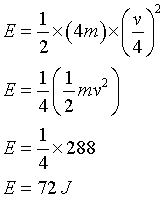
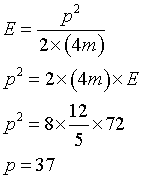
A bomb of 12 kg divides in two parts whose ratio of masses is 1:If kinetic energy of smaller part is 288 J, then momentum of bigger part in kgm/sec will be
-
0%
a) 37
-
50%
b)72
-
25%
c)108
-
25%
d)Data is incomplete
Explanation
Q.24.
The potential energy of a conservative system is given by U(X)=(x2 - 5x) J.Then the equilibrium position is at....... (where x in m)
-
25%
a)x=1.5 m
-
25%
b)x=2m
-
25%
c)x=2.5 m
-
25%
d)x=5 m
Q.25.
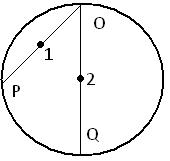
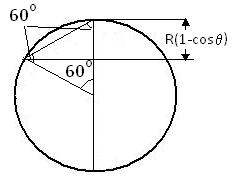
Two particles 1 and 2 are allowed to descend on two friction less chord OP and OQ. the ratio of the speeds of the particles 1 and 2 respectively, when they reach on the circumference is
-
75%
a) 1/4
-
25%
b) 1/2
-
0%
c)1
-
0%
d)1/2√2
Explanation
Q.26.
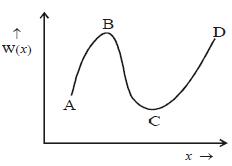
The potential energy of a particle varies with distance x as shown in the graph. The force acting on the particle is zero at
-
50%
a) C
-
0%
b) B
-
25%
c) B and C
-
25%
d) A and D
Q.27.
A man starts walking from a point on the surface of earth (assumed smooth) and reaches diagonally opposite point. What is the work done by him . [DCE 2004]
-
25%
a)Zero
-
0%
b)Negative
-
25%
c)Positive
-
50%
d)Nothing can be said
Q.28.
Two bodies of masses m and 2m have same momentum. Their respective kinetic energies E1 and E2 are in the ratio . [MP PET 1997; KC]
-
25%
a)1 : 2
-
25%
b)1 : √2
-
25%
c)2 : 1
-
25%
d)1 : 4
Q.29.
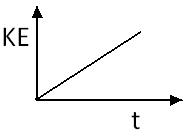
The kinetic energy of a body moving a straight line varies with time as shown in fiure. The force acting on the body is
-
25%
a) zero
-
0%
b) constant
-
50%
c)directly proportional to velocity
-
25%
d)inversly proportional to velocity
Q.30.
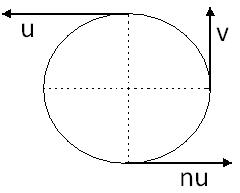
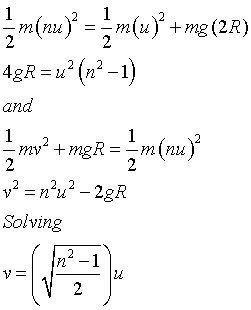
A heavy particle of mass m makes complete revolution in a smooth circular tube in a vertical plane. Its greatest speed is n times the least speed. If the least speed is u, what is the speed at the instant, when it is moving vertically?
-
25%
a)

-
50%
b)

-
0%
c)

-
25%
d)

Explanation